

Drawings and documents
National Archives restored drawings: drawing
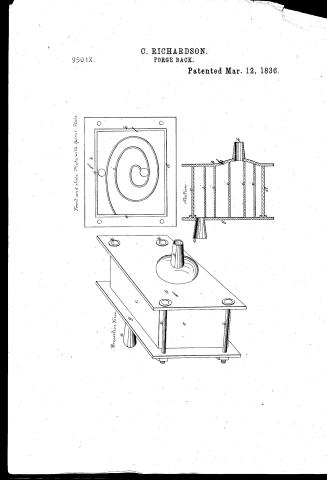
Charles Richardson's Patent Drawing for a Forge Back

National Archives, Restored Patent Drawings (Record Group 241) · Full-size scan at the National Archives · Catalog record
Show the text on the drawing Hide (89 words)
Words on the drawing as machine-read by the National Archives; not checked. Useful mainly for searching.
12 / 75. METALLURGY, / 1. / Fumaces. Forge: / Tuyeres. / fatented Mai 12.1836. X / Vol.27. M.26i / Charles Richardion / Arcort and dideplates with spiralplate. / Torzeback. / 9.501.X / ct / DIVISIOIN. / 9501 X / Inspection view / Reference / a. bellow nose / Top. / (c / a bollom / is om pince / g backplate. / hetin / h.h.h'h bath / i. spiralplate. / K clearn hip / OR / And marn th direction of the Commission / Intent office has 29th iran / of bulth is conforming with act of 3. march 189y / Counsionary of baterh
USPTO scan
The patent as scanned by the USPTO
-
 Page 1
-
 Page 2
-
 Page 3


U.S. Patent and Trademark Office · Google Patents
Show the transcription Hide (822 words)
Machine transcription (LightOnOCR) of the pages as scanned by the USPTO, most of them the handwritten copies made when the records were restored after the 1836 fire. Not checked; it can misread handwriting, so compare it with the scan.
Page 1.
9501X
C. RICHARDSON.
FORGE BACK.
Patented Mar. 12, 1836.

Page 2.
9501X
Mar. 12, 1836
26/
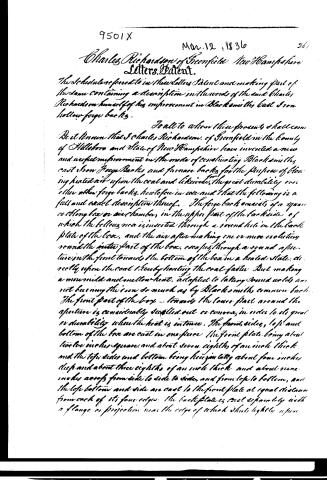
Charles Richardson of Greenfield, New Hampshire
Letters Patent.
The Schedule referred to in these Letters Patent and making part of
the same containing a description in the words of the said Charles
Richardson himself of his improvement in Blacksmiths cast Iron
hollow forge backs.
To all to whom these presents shall come:
Be it known that I, Charles Richardson, of Greenfield in the County
of Hillsboro and State of New Hampshire have invented a new
and useful improvement in the mode of constructing Blacksmiths
cast Iron Forge Backs and furnace backs for the purpose of blow-
ing heated air upon the coal and likewise, the great durability over
other forge backs, heretofore in use and that the following is a
full and exact description thereof. The forge back consists of a square
or oblong box or air chamber, in the upper part of the backside of
which the bellows iron is inserted through a round hole in the back
plate of the box, and the air after making one or more revolutions
round the outer part of the box, escapes through a round aperture
in the front towards the bottom of the box in a heated state, directly
upon the coal thereby heating the coal faster. But making
a more mild and mellow heat, adapted to taking sound welds and
not burning the iron so much as by Blacksmiths common back.
The front part of the box ... towards the lower part around the
aperture is considerably bevelled out or convex, in order to its great
durability when the heat is intense. The front, sides, top and
bottom of the box are cast in one piece the front plate being about
twelve inches square and about seven eighths of an inch thick
and the top, sides and bottom being horizontally about four inches
deep and about three eighths of an inch thick and about nine
inches across from side to side to side, and from top to bottom, and
the top, bottom and side are cast to the front plate at equal distance
from each of its four edges. The back plate is cast separately with
a flange or projection near the edge of which shuts lightly upon
Page 3.
62. 9501X Mar 12, 1836
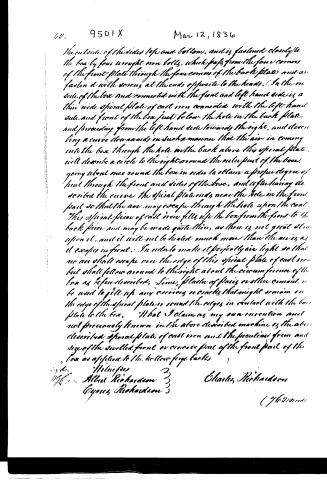
The outside of the sides top and bottom, and is fastened closely to the box by four wrought iron bolts, which pass from the four corners of the front plate through the four corners of the back plate and are fastened with screws at the ends opposite to the heads. On the inside of the box and connected with the front and left hand side is a thin wide spiral plate of cast iron connected with the left hand side and front of the box just below the hole in the back plate and proceeding from the left hand side towards the right, and describing a curve downwards in such a manner that the air in coming into the box through the hole in the back above this spiral plate will describe a circle to the right around the outer part of the box, going about once round the box in order to obtain a proper degree of heat through the front and sides of the box, and after having described the curve the spiral plate ends near the hole in the front part so that the air may escape through the hole upon the coal. This spiral piece of cast iron fills up the box from the front to the back piece and may be made quite thin, as there is not great steam upon it, and it will not be heated much more than the air as it escapes in front. In order to make it perfectly air tight so that no air shall escape over the edge of this spiral plate of cast iron but shall follow around to the right about the circumference of the box as before described, lime, plaster of paris or other cement is to be used to fill up any crevices or cracks that might remain on the edge of the spiral plate or round the edges in contact with the back plate to the box. What I claim as my own invention and not previously known in the above described machine is the above described spiral plate of cast iron and the peculiar form and size of the scrolled front or concave part of the front part of the box as applied to the hollow forge bolts.
Witnesses
Albert Richardson
Cyrus Richardson
Charles Richardson
(762 words)
Published accounts: journal notice
Notice in the monthly list of patents
Journal of the Franklin Institute, new ser., vol. 17 (1836), p. 438 · View the page
196. Blacksmith's forge.-Charles Richardson, Greenfield, N. H.
Published accounts: journal notice
Notice in the monthly list of patents, with remarks
Journal of the Franklin Institute, new ser., vol. 18 (1836), p. 328 · View the page
56. For Forge Backs for Blacksmiths; Charles Richardson, Greenfield, Hillsborough county, New Hampshire, March 12.
Remarks. There have been numerous patents for hollow, cast-iron, forge backs, many of them marked by very slight differences. We do not, in the one before us, see any thing worthy of particular notice. The patentee claims a "spiral plate of cast-iron, and the peculiar form and size of the swelled front, or convex part in the front part of the box." The spiral plate is a partition to cause the admitted air to circulate, and to become heated prior to its exit.
About this record
- Patentee
- DATAMP
- Date
- the Name and Date index of patents, DATAMP, USPTO records
- Invention
- DATAMP
- Listed in
- the Name and Date index of patents, DATAMP, USPTO records, Jim Shaw's X-patent list, the Journal of the Franklin Institute, Burke's List of Patents (1847)
- Burke's 1847 Patent Office list gives the same patent.