

Drawings and documents
National Archives restored drawings: drawing
J. Thompson's Patent Drawing for a Truss

National Archives, Restored Patent Drawings (Record Group 241) · Full-size scan at the National Archives · Catalog record
Show the text on the drawing Hide (66 words)
Words on the drawing as machine-read by the National Archives; not checked. Useful mainly for searching.
Trusses - Dung / 128 SURG-RY. / [156] Trusses. / #1- / 9.8.48.4 / Line / DIVISION. / Patented talely 1834. / 9848X / Patent Office April 28th 1838 / a Bollor pad / Made under direction of the Commitionery of Patents / 7, Cylinder / in comformity with the act givi March 1867- / c Spring or trace / M (Lillsworth / a Hinge / Commificiener of Patents. / e strap. / seager. delt
USPTO scan
The patent as scanned by the USPTO
-
 Page 1
-
 Page 2
-
 Page 3
-
 Page 4


U.S. Patent and Trademark Office · Google Patents
Show the transcription Hide (1,007 words)
Machine transcription (LightOnOCR) of the pages as scanned by the USPTO, most of them the handwritten copies made when the records were restored after the 1836 fire. Not checked; it can misread handwriting, so compare it with the scan.
Page 1.
No Printed Specification Available
9848X
I. Thompson,
Truss.
Patented July 1, 1836.

AM. PHOTO-LITHO. CO. N.Y. (OSBORNE'S PROCESS)
Page 2.
July 1, 1836
Isaac Thompson,
Secton Patent
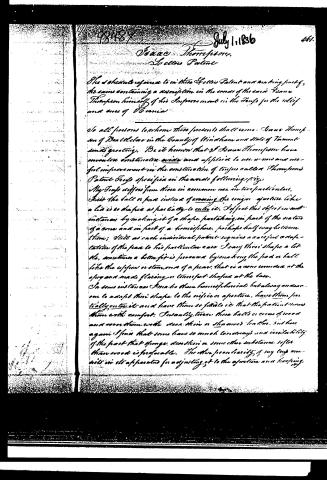
The sheets referred to in the Secton Patent and accompanying, the same containing a description in the words of the said Isaac Thompson himself of his Improvement in the Tongs for the relief and cure of Viscera.
To all persons to whom these presents shall come, Isaac Thompson of Beattelaw in the County of Windham and State of Vermont send greeting. Be it known that said Isaac Thompson have invented, constructed, made and applied to use, a new and useful improvement in the construction of tongs called Thompson's Patent Tongs specified in the words following, viz:
My Tongs differ from those in common use in two particulars. First, the ball or pad instead of covering the entire aperture like a lid is so shaped as partially to enter it. I affect this object in most instances by making it of a shape partaking in part of the nature of a cone and in part of a hemisphere, perhaps half way between them; still as each individual patient requires a careful adaptation of the pad to his particular case I vary their shape a little, sometimes a better fit is procured by making the pad or ball like the upper or stem end of a pear, that is a cone conical at the apex and made flaring or conical shaped at the base.
In some instances I make them hemispherical but always endeavor to adapt their shape to the surface or aperture, have them partially enter it and have them so fitted to it that the patient wears them with comfort. I usually have these balls or cones of wood and cover them with steel, skin or shavings leather, but have again found that some have so much laxity and irritability of the part that sponge, deer skin or some other substance softer than wood is preferable. The other peculiarity of my tongs consists in its apparatus for adjusting it to the aperture and keeping
Page 3.
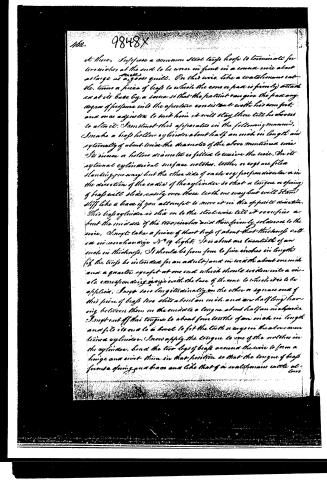
at there, Suppose a common steel brads brads to terminate for two inches at the end to be worn in front in a round wire about as large as a goose quill. On this wire, like a watchman's cat-tle, turns a piece of brads to which the cone or pad is firmly attached at its base by a screw so that the patient can give the pad any degree of pressure into the aperture consistent with his comfort, and once adjusted to suit him it will stay there till he chooses to alter it. I construct this apparatus in the following manner. I make a brads hollow cylinder about half an inch in length and cylindrically of about twice the diameter of the above mentioned wire. Its inner or hollow diameter is fitted to receive the wire. On its external cylindrical surface notches, teeth, or cogs are filed slanting one way but the other side of each cog perpendicular or in the direction of the axis of the cylinder so that a tongue or spring of brads will slide easily over these teeth one way but will stand stiff like a brace if you attempt to move it in the opposite direction. This brads cylinder is slid on to the steel wire till it occupies about the middle of the wire and then firmly soldered to the wire. I next take a piece of sheet brads of about that thickness cut in wire or band size 3/16 light. It is about one twentieth of an inch in thickness. It should be from four to five inches in length (if the brads be intended for an adult) and in width about one inch and a quarter except at one end which should widen into a circle corresponding in size with the base of the cone to which it is to be applied. I next saw longitudinally on the other or square end of this piece of brads two slits about an inch and an half long having between them in the middle a tongue about half an inch wide. I next cut off this tongue to about four tenths of an inch in length and file its end to a bevel to fit the teeth or cogs in the above mentioned cylinder. I now apply the tongue to one of the notches in the cylinder, bend the two legs of brads around the wire to form a hinge and twist them in that position so that the tongue of brads forms a spring and brace and like that of a watchman's cat-tle at
Page 4.
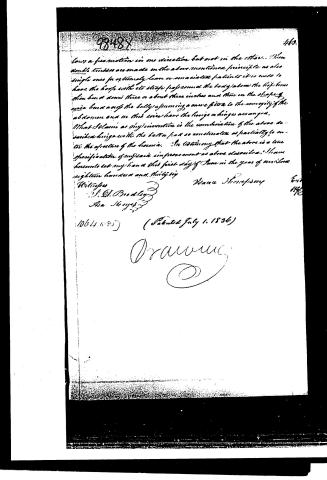
has a free motion in one direction but not in the other. When double trusses are made on the above mentioned principle, as also single ones for extremely lean or emaciated patients, it is well to have the horse with its straps fastened at the body above the hip bone then bend down three or about three inches and then in the shape of a wire band over the belly assuming a curve prior to the convexity of the abdomen and on this curve have the hinge or hinges arranged. What I claim as my invention is the combination of the above described hinge with the ball or joint so constructed as partially to answer the operation of the hernia. In testimony that the above is a true specification of my said improvement as above described, I have hereunto set my hand this first day of June in the year of our Lord eight hundred and thirty-six.
Witnesses:
W. O. Brodley
A. Hayes
W. A. Horsfsony
(10644.1.83) (Patented July 1, 1836)
Orawnie
Published accounts: journal notice
Notice in the monthly list of patents
Journal of the Franklin Institute, new ser., vol. 18 (1836), p. 359 · View the page
556. Truss for hernia. Isaac Thompson, Brattleborough, Vt.
About this record
- Patentee
- DATAMP
- Date
- the Name and Date index of patents, DATAMP, USPTO records
- Invention
- DATAMP
- Listed in
- the Name and Date index of patents, DATAMP, USPTO records, Jim Shaw's X-patent list, the Journal of the Franklin Institute, Burke's List of Patents (1847)
- Burke's 1847 Patent Office list gives the same patent.