

Drawings and documents
National Archives restored drawings: drawing
F.P. Knowlton's Patent Drawing for a Steam Feather Dresser

National Archives, Restored Patent Drawings (Record Group 241) · Full-size scan at the National Archives · Catalog record
Show the text on the drawing Hide (46 words)
Words on the drawing as machine-read by the National Archives; not checked. Useful mainly for searching.
34. DRJERS. / Trough & Beater. / CLASS Terosts / 9879.1 / DIVISION. / 9879 / STEAM FMATHER IDIRIE SSER / Patented 2""July 11 / 1836 / oq / chind of line water / here train the for the / when fact in The cyclose
USPTO scan
The patent as scanned by the USPTO
-
 Page 1
-
 Page 2
-
 Page 3
-
 Page 4


U.S. Patent and Trademark Office · Google Patents
Show the transcription Hide (873 words)
Machine transcription (LightOnOCR) of the pages as scanned by the USPTO, most of them the handwritten copies made when the records were restored after the 1836 fire. Not checked; it can misread handwriting, so compare it with the scan.
Page 1.
No Printed Specification Available.
9879X F. P. KNOWLTON.
FEATHER DRESSER.
Patented July 2, 1836.
THE NORRIS PETERS CO., PHOTO-LITHO., WASHINGTON, D. C.
Page 2.
9879X July 2, 1936 237
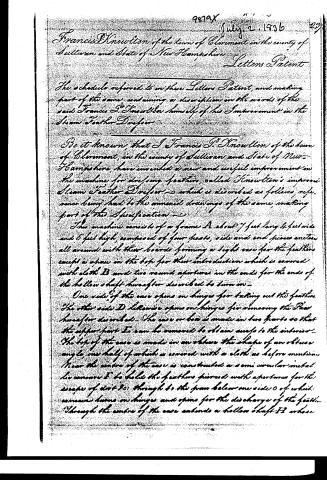
Francis Knowlton of the town of Claremont in the county of Sullivan and State of New Hampshire Letters Patent
The schedule referred to in these Letters Patent, and making part of the same, containing a description in the words of the said Francis J. Knowlton himself of his Improvement in the Steam Feather Dresser.
Be it known, that I Francis J. Knowlton of the town of Claremont, in the county of Sullivan and State of New Hampshire, have invented a new and useful improvement in the machine for dressing feathers, called Knowlton’s improved Steam Feather Dresser — which is described as follows, reference being had to the annexed drawings of the same, making part of this Specification —
This machine consists of a frame A about 7 feet long 4 feet wide and 6 feet high, composed of four posts, side and end pieces and all around with their boards forming a light case for the feathers except a space on the top for their introduction which is covered with cloth B and two round apertures in the ends for the ends of the hollow shaft hereafter described to turn on —
One side of the case opens on hinges for taking out the feathers. The other side D likewise opens on hinges for removing the Pans hereafter described. The case or box is made in two parts so that the upper part E can be removed to obtain access to the interior. The top of the case is made in an oblique shape of an obtuse angle, one half of which is covered with a cloth as before mentioned. Near the centre of the case is constructed a semi-circular metal bar covered E to hold the feathers pierced with apertures for the escape of dust &c. through to the pan below one side O of which revolves turns on hinges and opens for the discharge of the feathers. Through the centre of the case extends a hollow shaft F2 whose
Page 3.
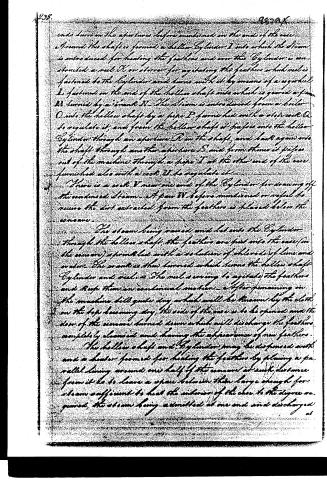
ends down on the aperture before mentioned in the ends of the case. Around this shaft is formed a hollow Cylinder I into which the steam is introduced for heating the feathers and over this Cylinder is constructed a reel K or stirrer for agitating the feathers which reel is fastened to the Cylinder and turns with it by means of a cogwheel L fastened on the end of the hollow shaft onto which is geared a pinion BB turned by a crank N. The steam is introduced from a boiler O into the hollow shaft by a pipe P furnished with a stopcock Q to regulate it, and from the hollow shaft it passes into the hollow Cylinder through an aperture R in the shaft, and back again into the shaft through another aperture S and from thence it passes out of the machine through a pipe T at the other end of the case furnished also with a cock W to regulate it.
There is a cock V near one end of the Cylinder for drawing off the condensed steam. A pan W before mentioned or vessel to receive the dirt extracted from the feathers is placed below the concave.
The steam being raised and let into the Cylinder through the hollow shaft, the feathers are put into the case (in the concave) sprinkled with a solution of chloride of lime and water. The crank is then turned which turns the hollow shaft Cylinder and reel, so the reel serving to agitate the feathers and keep them in continual motion. After remaining on the machine till quite dry, which will be known by the cloth on the top becoming dry, the side of the case is to be opened and the door of the concave turned down which will discharge the feathers completely cleaned and having the appearance of new feathers.
The hollow shaft and Cylinder may be dispensed with and a heater formed for heating the feathers by placing a parallel lining around one half of the concave at such distance from it as to leave a space between them large enough for steam sufficient to heat the interior of the case to the degree required, the steam being admitted at one end and discharged at
Page 4.
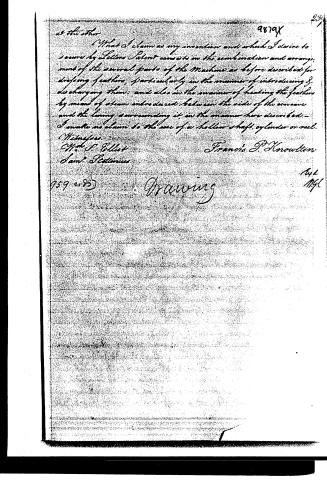
at the other
What I claim as my invention and which I desire to secure by Letters Patent consists in the combination and arrangement of the several parts of the Machine as before described for dressing feathers, particularly in the manner of introducing & discharging them; and also in the manner of heating the feathers by means of steam introduced between the side of the concave and the lining surrounding it, in the manner here described. I make no claim to the use of a hollow shaft, cylinder or reel.
Witnesses:
Wm. S. Elliot
Sam. Stollman
Francis P. Knowlton
Drawing
Sept
1856
959 a. 853
9879X
234
Published accounts: journal notice
Notice in the monthly list of patents
Journal of the Franklin Institute, new ser., vol. 18 (1836), p. 359 · View the page
578. Feather dresser.-T. P. Knowlton, Clermont, N. H.
About this record
- Patentee
- Jim Shaw's X-patent list
- Date
- the Name and Date index of patents, USPTO records, Jim Shaw's X-patent list
- Invention
- the Name and Date index of patents
- Listed in
- the Name and Date index of patents, USPTO records, Jim Shaw's X-patent list, the Journal of the Franklin Institute, Burke's List of Patents (1847)
- Burke's 1847 Patent Office list gives the same patent.