

Drawings and documents
Published accounts: specification
Specification printed in the Mirror of the Patent Office (1828) with its plate
American Journal of Improvements in the Useful Arts, and Mirror of the Patent Office, vol. 1 (Washington, 1828) · View the page
Show the transcription Hide (727 words)
Text of the specification as printed in the Mirror of the Patent Office, machine-transcribed from the page scans (GLM-OCR); not proofread. Check the scan for figures and reference letters.
IMPROVEMENT IN THE HORSE-SHOE.
By Stephen R. Kean, of Washington City, District of Columbia.
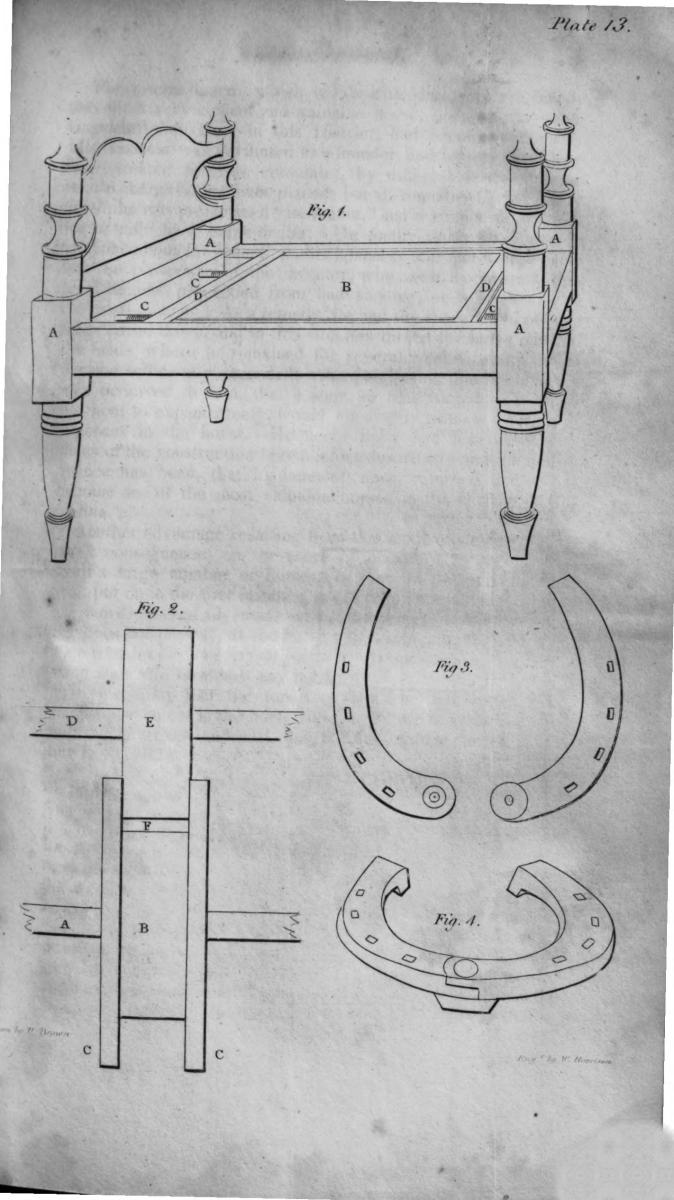
See Plate XIII. figs. 3 & 4.
Specification.—Be it known, that I, Stephen R. Kean, of the City of Washington, in the District of Columbia, have invented and applied to use, a new and useful improvement in the horse-shoe, called "The self-expanding, or swivel-joint horse-shoe," not known or used before this, my said discovery; specified and described in the words following, viz.
This shoe is formed, by simply uniting two sections, (one for each side of the hoof) in the centre, at the toe, by means of a rivet, which may be a separate piece of iron or steel; or it may be a projection from the upper side of the lower half of the hinge joint. The rivet must be counter-sunk into the shoe, at the upper end, and made flush with the upper surface of the shoe, to prevent it from bearing too hard, or sinking into the hoof; and must be made to work freely in the joint—laterally.
The benefits of this kind of shoe are practically known to the inventor, and consist in the certainty of its obviating or removing the difficulty too often experienced, of the horse becoming what is called "hoof bound," by the shoe of the usual form now used. The frog, in the centre of the hoof, naturally endeavors to expand; but, being confined, by reason of the shoe binding the hoof close upon it, often produces lameness in the horse, of the above description, which, no doubt, is frequently attributed to quite different causes than the real one; and which might be completely prevented or removed, by using shoes of the form here proposed; as the following facts will more satisfactorily prove:— Plate 13.
Fig. 1.
A B C D A
Fig. 2.
D E F G H I J K L M N O P Q R S T U V W X Y Z
Fig. 3.
Frog by W. Harrison.
Fig. 4.
Frog by W. Harrison.
The circumstances which led to this discovery are briefly these:—A very elegant and valuable horse, belonging to a distinguished individual in this District, had become very lame. His lameness was attributed to a founder, and he was, for a long time, treated for this complaint, by different farriers, under whose charge he had been placed; but all remedies having finally failed, he was pronounced "incurable," and was accordingly sold for a trifle to a horse-dealer. He finally (after having been hawked about for some time, his lameness still increasing) came into the possession of the inventor, who soon discovered, that his lameness proceeded from bad shoeing, or from shoeeing in the usual manner. As a remedy, he had the shoes taken off, the frogs pared down, and in this situation turned the horse out into the fields, where he remained for several weeks, till his hoofs became sufficiently expanded; when, on having him re-shod, the idea occurred to him, that a shoe, so constructed, as to allow the hoof to expand freely, would effectually prevent a return of lameness in the horse. He accordingly had him shod with shoes of the construction hereinbefore described; and the consequence has been, that his lameness never rattured, and he has become one of the most valuable horses in the District of Columbia.
Another advantage resulting from this mode of shoeing, (of no small consequence, on the score of economy, to persons who keep a large number of horses,) is, that the shoes, if they are well put on in the first instance, never require removing, till they are worn out—an advantage which the present method of shoeing does not possess, as the horse will become hoof-bound if the shoe remains too long in one position. It is also evident, that the same shoe will fit almost any hoof.
In testimony that the foregoing is a true description of my said improvement in the horse-shoe, as by me described, I hereunto set my hand and seal, this 9th day of June, in the year of our Lord, 1828.
STEPHEN R. KEAN.
In presence of
URIAH BROWN,
JOHN F. FOSTER.
About this record
- Listed in
- the Mirror of the Patent Office (1828)
- This patent has no X number: it is not in the list of patents restored after the 1836 fire. It is known only from the printed lists named below. The reference number (U…) is the IP Mall’s own.
- Listed in the Journal of the Franklin Institute or the Mirror of the Patent Office at the time of issue.