

Drawings and documents
National Archives restored drawings: drawing
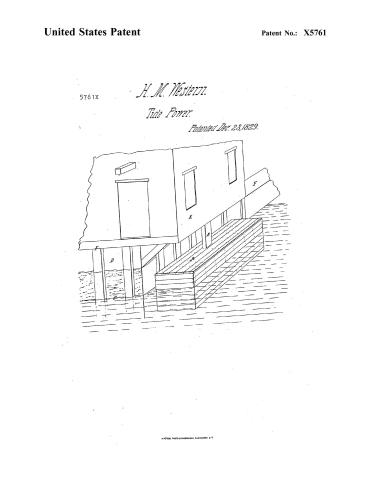
Henry M. Western's Patent Drawing for Tide Power

National Archives, Restored Patent Drawings (Record Group 241) · Full-size scan at the National Archives · Catalog record
Show the text on the drawing Hide (82 words)
Words on the drawing as machine-read by the National Archives; not checked. Useful mainly for searching.
INGINEERING. / Powers. / Henry M. Western / Tide Power / Vol.8.p.20g. / 5761-4 / Patented & Dect 1829, / References, / A.vessel or float.co ntaining great weight buoyancy. / Beam or leaver. / g.7.delt / C. low tide. / Made under the dirution of the / Patent Office 31 In / D. high ", Ebuitding projecting crert loat A. / into which leaver B,foes, F.wharf. / Patents in conformity with act of CouppoMa / Commifioner of Futent
USPTO scan
The patent as scanned by the USPTO
-
 Page 1
-
 Page 2


U.S. Patent and Trademark Office · Google Patents
Show the transcription Hide (68 words)
Machine transcription (LightOnOCR) of the pages as scanned by the USPTO, most of them the handwritten copies made when the records were restored after the 1836 fire. Not checked; it can misread handwriting, so compare it with the scan.
Page 2.
United States Patent
Patent No.: X5761
5761X
H. M. Western.
Tide Power.
Patented Dec. 23, 1829.
![Diagram of a tide power structure with labeled parts A, B, C, D, E, F]
Published accounts: journal notice
Notice in the monthly list of patents, with remarks
Journal of the Franklin Institute, new ser., vol. 5 (1830), p. 165 · View the page
"The mode of supporting bridges on piles, by metallic or stone segments, to prevent their rotting between wind and water, which may be roofed." The above improvements are also claimed as applied to revolving bridges over canals, &c. 27. For a Tide Power; Henry M. Western, New York, December 23.
Remarks. (See the specification.)
Published accounts: specification
Specification printed in the Journal of the Franklin Institute
Journal of the Franklin Institute, new ser., vol. 5 (1830), p. 154 · View the page
Text of the specification as printed in the Journal, from OCR; not proofread.
Specification of a patent for a Tide Power, or the application of the power of tide water, connected with the principles of Buoyancy and Gravity, for the purpose of applying power to machinery, or any other required use. Granted to HENRY M. WESTERN, New York, December 23, 1829. THE object which the subscriber purposes to effect, is to bring into value and use the rise and fall of the tide water on the sea board, and particularly in the principal cities of the union, to be employed in manufacturing, and other purposes. The plan in which this object is to be effected, is by the use, or construction, of vessels, or floats, of great weight and buoyancy, so that, in the instance of the fall of the tide, by their weight, or the weights contained in them, and in the rise of the floats, by their floatAmerican Patents for December, with Remarks. ing, they may apply, both ways, a force proportioned to their weight and magnitude; and which, being connected to a lever, or beam, may be applied to driving, or putting in operation, any species of machinery, and thereby saving animal, steam, or other powers, and possessing the very important advantage of contiguity to the marts of the manufactured article. The invention may be put in use by the affixing of a condemned, or other hulk of a ship of required size. Or floats, with proportionate weights in them, properly affixed in one of our usual slips, or in any tide water, and the beam, or lever, extended into a building projecting over it, or by the side of it, or on the side of streets fronting on the slips, and in other situations contiguous to the tide water; the extent of the power to be regulated by the size and weight of the float. HENRY M. WESTERN.
Editor's remarks. The power to be obtained upon the foregoing plan, supposing such an arrangement to be made as shall place it all under command, may readily be computed, its elements being the weight which rises and falls, and the distance of this rise and fall, with every tide. It is not, however, to this point that we intend to direct our remarks, but to the question of the form which the specification assumes. A patent cannot be sustained for an abstract principle, and it is incumbent on a patentee to furnish such a practical description as shall enable a person of skill to carry the thing patented into operation. Is this the case in the foregoing specification? We think not; for ourselves, we should feel that the first thing we had to do in carrying it into effect, would be to invent a mode of doing so. The words of the law, are, "And in case of any machine, he shall fully explain the principles, and the several modes in which he has contemplated the application of the principle, or character by which it may be distinguished from other inventions; and he shall accompany the whole with drawings and written references, where the nature of the case admits of drawings." As in this case there are no drawings, no machine is patented; what then is left to be claimed, but the mere principle of obtaining motion from the rise and fall of the tide? This power the patentee claims to apply to machinery, "or any other required use." It has been repeatedly applied to use in raising sunken vessels, and in removing rocks, and other obstructions, from the bottoms of rivers. If, therefore, the claim is intended to be made abstractedly, it seems to us that it cannot be sustained. LIST OF AMERICAN PATENTS WHICH ISSUED IN DECEMBER, 1829. With Remarks and Exemplifications, by the Editor. 1. For an improvement in Propelling Vessels of every description by means of INSIDE PROPELLING LEVER WHEELS, with the assistance (at pleasure) of the wind-and-steam-assisting-shippipes; John James Giraud, Baltimore, Maryland, December 1. We have read the description, and examined the drawing of the above named apparatus, but have been unable to understand the views of the patentee. Sometimes we have thought that we had caught a leading idea, but on finding that it was essentially visionary or absurd, we have dismissed it, choosing rather to submit to the imputation of dulness, than to suspect the inventor of this machinery of having a confused mind, upon a subject to which he must have given much thought, as he has previously obtained two patents for similar objects. There is a wheel within a wheel, and there are steam tubes within air tubes, and we believe that, from these latter, it is intended, sometimes, to blow steam, or air, upon the water in which the boat floats, or upon the sails with which she is to be furnished. When a vessel arrives at Washington, propelled by this machinery, we engage to devote all our powers to its examination, and to give a full report of all our discoveries. 2. For an improvement in Bramah's Hydrostatic Press; David H. Mason and Matthew W. Baldwin, Philadelphia, Pennsylvania, December 2. The patentees say, that "In our improved press the main cylinder, and the plunger, or piston, are constructed as formerly; the principle upon which the instrument acts, also remains unchanged, our improvement consisting in such an arrangement of the forcing pump, or pumps, and its, or their, appendages, as shall give to them greater stability, and render them more compact, and less liable to get out of order, in consequence of the greater simplicity of their parts; thus fitting them the better for general use, and affording them at a reduced cost." The claim is to "the using of the main cylinder, or the plunger, as a stand, or support, to the forcing pump, or pumps, with their appendages; thereby dispensing with the separate stand ordinarily employed; by which arrange
About this record
- Patentee
- Jim Shaw's X-patent list
- Date
- the Name and Date index of patents, USPTO records, Jim Shaw's X-patent list
- Invention
- the Name and Date index of patents
- Listed in
- the Name and Date index of patents, USPTO records, Jim Shaw's X-patent list, the Journal of the Franklin Institute, Burke's List of Patents (1847), the Journal of the Franklin Institute, Journal
- The Franklin Institute's journal spells the name differently.
- The residence comes from the Franklin Institute's journal.
- Burke's 1847 Patent Office list gives the same patent.