

Drawings and documents
USPTO scan
The patent as scanned by the USPTO
-
 Page 1
-
 Page 2
-
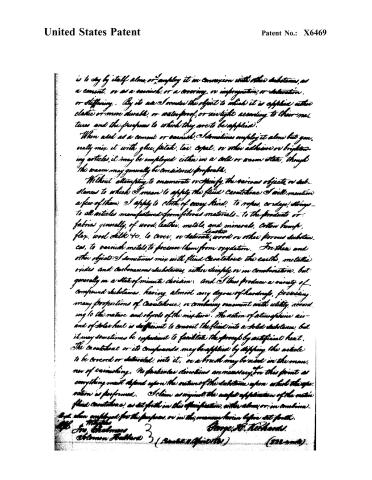 Page 3


U.S. Patent and Trademark Office · Google Patents
Show the transcription Hide (814 words)
Machine transcription (LightOnOCR) of the pages as scanned by the USPTO, most of them the handwritten copies made when the records were restored after the 1836 fire. Not checked; it can misread handwriting, so compare it with the scan.
Page 2.
United States Patent
Patent No.: X6469
George H. Richards
Letters Patent.
The Schedule referred to in these Letters Patent and making part of the same containing a description in the words of the said George H. Richards himself of his improvement in the mode of rendering a variety of articles Water Proof by means of fluid Caoutchouc, and of otherwise using that substance so as to produce new and valuable results.
To all whom it may concern: Be it known that I George H. Richards have discovered a new and useful mode, or new and useful modes of rendering a variety of articles water proof by means of fluid Caoutchouc, and of otherwise using that substance so as to produce new and valuable results, and that the following is a full and exact description of my said invention or discovery — It is well known that the substance, called gum elastic or india rubber, but more correctly Caoutchouc is produced by the distillation of the sap or juice of several plants and trees, and particularly of Hevea Caoutchouc and Hevea Elastica, growing in the South-east part of this Continent, and from the Hevea Elastica of Asia.
This substance in the fluid form has never been applied to the purposes of manufacturing or preparing of many things to which it is peculiarly applicable, like altho’ bottles, boots, shoes, belts, and shirts have been formed thereof in the places where the above named and similar plants grow. It is true that for the purposes of philosophical experiment small portions of the juice have been taken to Europe and brought to this Country, but it has never been advantageously employed for the purposes of utility until it was done by me.
Solutions of the indurated substance as usually imported, have been made in ether, naphtha, oil of turpentine, spirits of turpentine, spirits of coal tar and other liquids and a varnish has been thus made which has been occasionally applied to useful purposes, and so far as I have applied, the solution is thus excepted from my use and application of Caoutchouc.
My application of Caoutchouc consists principally in the application of it from its original fluid state, and I use it either substantially, that
Page 3.
United States Patent
Patent No.: X6469
is to dry by itself alone, or employ it in connection with other substances, as a cement, or as a varnish, or a covering, or impregnation, or saturation, or stiffening. By its use I render the object to which it is applied either elastic or more durable, or waterproof, or air-tight according to their natures and the purposes to which they are to be applied.
When used as a cement or varnish, I sometimes employ it alone but generally mix it with glue, pitch, tar, copal, or other adhesive or brightening articles, it may be employed either in a cold or warm state, though the warm may generally be considered preferable.
Without attempting to enumerate or specify the various objects or substances to which I mean to apply the fluid Cænotohoe, I will mention a few of them. I apply to cloth, of every kind, to ropes, cordage, strings — to all articles manufactured from fibrous materials — to the products or fabrics generally, of wood, leathers, metals, and minerals, cotton humps, flax, wool, silk &c, to cover, or saturate, wood or other porous substances, to varnish metals, to preserve them from oxidation. For these and other objects I sometimes mix with fluid Cænotohoe the earths, metallic oxides and carbonaceous substances, either simply or in combination, but generally in a state of minute division; and I thus produce a variety of compound substances, having almost any degree of hardness, possessing many proportions of Cænotohoe, or combining ornament with utility, according to the nature and objects of the mixture. The action of atmospheric air and of solar heat is sufficient to convert the fluid into a solid substance, but it may sometimes be expedient to facilitate the process by artificial heat. The Cænotohoe or its compounds may be applied by dipping the article to be covered or saturated, into it, or a brush may be used in the manner of varnishing. No particular directions are necessary, for this point as everything must depend upon the nature of the substance upon which the operation is performed. I claim as original, the useful application of the native fluid Cænotohoe, as set forth in this specification, either alone, or in combination.
But when employed for the purposes, or in the manner herein before set forth.
Witnesses:
Jno. Thalmann
Solomon Hubbard
George W. Richards.
(3) (Bentley & Girdler) (502 words)
Published accounts: journal notice
Notice in the monthly list of patents, with remarks
Journal of the Franklin Institute, new ser., vol. 8 (1831), p. 117 · View the page
28. For a new and useful mode of rendering a variety of articles water proof, by means of fluid caoutchouc; George H. Richards, city of Washington, D. C., April 11.
Remarks. (See the specification.)
Published accounts: journal notice
Notice in the monthly list of patents, with remarks
Journal of the Franklin Institute, new ser., vol. 8 (1831), p. 130 · View the page
This press may be inverted, in which case the wheel will, by its own weight, rest upon the rollers. It may also, if desired, be made to press in a lateral direction. It is applicable to the purposes of cutting; of raising by means of dies; of printing; pressing bricks, or cheese; and, in fine, to any purpose where great power, and a moderate range, are required. Cutters, dies, a platten, or follower, &c. may be attached to the end of the shaft, which passes through the intermediate piece above described. What I claim as my invention, and for which I ask a patent, is the application of friction rollers on the indented edge of a wheel, in the manner, and for the purposes above described. LUTHER CARMAN. : Carman's Press. f a. The wheel on the rim of which the pressure is exerted. b, b. Friction rollers bearing against the rim. c, c. Springs by which the weight of a may be sustained. d. The shaft conveying the pressure by its descent. e. Pinion, turned by a lever and act ing on the teeth of the wheel a. f. A weight which may be substituted for the springs c, c. Specification of a patent for a mode of rendering a variety of articles water proof, by means of Fluid Caoutchouc, and of otherwise using that substance so as to produce new and valuable results. Granted to George H. RICHARDS, Washington, District of Columbia, April 11, 1831.
Remarks. It is well known that the substance commonly called gum elastic, or India rubber, but more correctly Caoutchouc, is produced by the desiccation of the sap or juice of several plants, and particularly of the Haevia Caoutchouc, and Jatropha Elastica, growing in the southern part of this continent, and from the Urceola Elastica of Asia. This substance, in the fluid form, has never been applied to the purposes of manufacturing or preparing of many things to which it is peculiarly applicable, although bottles, shoes, boots, balls, and sheets, have been formed thereof in the places where the above named and similar plants grow. It is true, that for the purposes of philosophical experiment, small portions of the juice have been taken to Europe, and brought to this country, but it has never been advantageously employed for purposes of utility, until the same was done by me. Solutions of the indurated substance, as usually imported, have been made in ether, naphtha, oil of sassafras, spirits of turpentine, the spirits of coal tar, and in other liquids, and a varnish has been thus made which has been occasionally applied to useful purposes. I therefore except from my application and use of caoutchouc, the aforesaid or other solutions, made from the solid material. In my application of caoutchouc, I obtain it in its original fluid state, and I use it either substantively, that is to say, by itself alone, or I employ it in connexion with other substances, as a cement, or as a varnish, for covering, impregnation, saturation, or stiffening. By its use I render the objects to which it is applied either elastic, durable, water proof, or air tight, according to their natures, and the purposes to which they are to be applied. When used as a cement I sometimes employ it alone, and someDEMING'S mode of constructing Ships or Vessels. times I mix it with glue, pitch, tar, or other adhesive articles, and employ it either in a cold or warm state, the latter, or warm state, being in most instances the best. Without attempting to enumerate, or specify the various objects, or substances, to which I mean to apply the fluid caoutchouc, I will mention a few of them. I intend to apply it to cloth of every kind, to silk, cotton, ropes, cordage, strings, and all other articles manufactured from fibrous materials. As a varnish to leather, wood, or other porous substances, so as to cover or saturate the same. As a varnish to protect metals from oxidation. I sometimes mix with the fluid caoutchouc, the metals, metallic oxides, earths, or other solid substances, either simply, or in combination, but generally in a state of minute division, and I thus produce a variety of compound substances, possessing any desired degree of hardness, or combining ornament with utility, according to the nature and objects of the mixture.
Published accounts: specification
Specification printed in the Journal of the Franklin Institute
Journal of the Franklin Institute, new ser., vol. 8 (1831), p. 131 · View the page
Text of the specification as printed in the Journal, from OCR; not proofread.
Specification of a patent for a mode of rendering a variety of articles water proof, by means of Fluid Caoutchouc, and of otherwise using that substance so as to produce new and valuable results. Granted to George H. RICHARDS, Washington, District of Columbia, April 11, 1831. It is well known that the substance commonly called gum elastic, or India rubber, but more correctly Caoutchouc, is produced by the desiccation of the sap or juice of several plants, and particularly of the Haevia Caoutchouc, and Jatropha Elastica, growing in the southern part of this continent, and from the Urceola Elastica of Asia. This substance, in the fluid form, has never been applied to the purposes of manufacturing or preparing of many things to which it is peculiarly applicable, although bottles, shoes, boots, balls, and sheets, have been formed thereof in the places where the above named and similar plants grow. It is true, that for the purposes of philosophical experiment, small portions of the juice have been taken to Europe, and brought to this country, but it has never been advantageously employed for purposes of utility, until the same was done by me. Solutions of the indurated substance, as usually imported, have been made in ether, naphtha, oil of sassafras, spirits of turpentine, the spirits of coal tar, and in other liquids, and a varnish has been thus made which has been occasionally applied to useful purposes. I therefore except from my application and use of caoutchouc, the aforesaid or other solutions, made from the solid material. In my application of caoutchouc, I obtain it in its original fluid state, and I use it either substantively, that is to say, by itself alone, or I employ it in connexion with other substances, as a cement, or as a varnish, for covering, impregnation, saturation, or stiffening. By its use I render the objects to which it is applied either elastic, durable, water proof, or air tight, according to their natures, and the purposes to which they are to be applied. When used as a cement I sometimes employ it alone, and someDEMING'S mode of constructing Ships or Vessels. times I mix it with glue, pitch, tar, or other adhesive articles, and employ it either in a cold or warm state, the latter, or warm state, being in most instances the best. Without attempting to enumerate, or specify the various objects, or substances, to which I mean to apply the fluid caoutchouc, I will mention a few of them. I intend to apply it to cloth of every kind, to silk, cotton, ropes, cordage, strings, and all other articles manufactured from fibrous materials. As a varnish to leather, wood, or other porous substances, so as to cover or saturate the same. As a varnish to protect metals from oxidation. I sometimes mix with the fluid caoutchouc, the metals, metallic oxides, earths, or other solid substances, either simply, or in combination, but generally in a state of minute division, and I thus produce a variety of compound substances, possessing any desired degree of hardness, or combining ornament with utility, according to the nature and objects of the mixture. The action of atmospheric air, and of solar heat, is sufficient to convert the fluid into a solid substance; but it is best, in general, to facilitate the process, by exposing it to artificial heat. The caoutchouc, or its compounds, may be applied by dipping the article to be covered, or saturated, into it; or a brush may be used in the manner of varnishing. No particular directions are necessary upon this point, as every thing must depend upon the nature of the substance upon which the operation is performed. I claim as original the useful application of the native fluid caoutchouc, as set forth in this specification, either alone or in combination, when employed for the purposes, or in the manner hereinbefore set forth. GEORGE H. RICHARDS. Abstract of the specification of a patent for an improvement in the manner of constructing Ships and Vessels of every description, either for the purposes of War or Commerce. Granted to JOSEPH R. DEMING, City of New York, April 15th, 1831. THE improvement consists in uniting together what may be called sundry horizontal frames of suitable timber, placing them one upon another, in such a manner as to make the hull or external part of the ship or vessel, one solid wall of timber, with the exception of the bolts and nuts of metal necessary to secure the said frames firmly together. The grain of the timber is, of course, as near as may be in the direction of the line of a figure forming a horizontal section of that portion of the ship or vessel to which it belongs. The frames above mentioned, and which I have spoken of as being horizontal, are not, however, of necessity, of the same vertical thickness one with another; nor as regards any one frame is the vertical thickness thereof, of necessity, the same in its different parts. For as the verDEMING'S mode of constructing Ships or Vessels. tical depth in all, or nearly all, ships or vessels, is greater at the head and stern than it is amidships, it follows, of course, if a ship or vessel be wholly made of entire frames, piled upon, and firmly secured to one another, that the vertical thickness of these frames will be greater at their extremities than in the middle. In some instances it is proposed to interpose pieces of timber between one or more pairs of frames, particularly at the stern; the grain to run as nearly as may be in the direction of the length of the ship, and also of the curvature of the part in which it is placed. Two methods of securing the deck beams are given. One by permitting their ends to extend through the sides of the ship, the beams having, if desired, a shoulder on the inside; they are then to be made fast to the hull by screw bolts, dagger-knees, hanger-knees, &c. The other mode is the making the frame in that particular part of the hull sufficiently thick to extend inwards and allow the deck beams to rest on them, and then securing them as above. This mode of building dispenses altogether with plank, either on the inside, or outside; and also with standing timbers, except it be a stern post, and one or more short pieces underneath the cut water, to serve as a protection from injury to the part called the gripe. The mode of building is to shape and lay down the keel much in the usual way. At each end of the upper surface, a piece of timber of proper size and shape, forming the dead wood, is attached by screw bolts. Pieces extending from one dead wood to the other are made fast to the keel, by screw bolts; these are to be fitted to the dead wood, and to each other, by butt joints, scarf joints, or hook scarf joints. The bolts being so placed that when the vessel is caulked no part of them will be exposed to the action of the water. These pieces, when so fixed, may be considered as constituting the first frame. A second frame, with dead wood pieces, is then to be laid on the former, and secured by screw bolts long enough to reach through both frames. Pieces of canvass, dipped in white lead paint, or other suitable preservative matter, are to be laid between the timbers as they are bolted together, but this is not to be done to any greater height. The frames are to be laid successively in this way, recesses being made for the heads of the bolts, and the joints all having the canvass, &c. interposed. Tree nails may also be driven as the work proceeds, boring holes diagonally for this purpose. When built to the proper height, the deck beams are to be secured in their places by one or other of the modes above indicated. When the vessel is completed, the seams are to be caulked, although, from the manner of screw bolting together, it is nearly impossible that any leak can exist. The timbers are, of course, to be so arranged as to break joints. The advantages proposed to be attained are, the using of less timber, and the obtaining of greater strength; to insure tightness even without caulking; to be able to work on the inside, even at sea, by a temporary removal of the cargo, should a leak occur; to make iron bolts less liable to decay, by protecting them from contact with the WOODWORTH'S Machine for Cleaning Fur. water; greater security to persons and property; greater durability, and avoiding the recesses in which foul air is generated. " I claim as new, the foregoing described method of constructing the hull of a ship, or vessel, by uniting timbers piled upon and secured to one another in such manner that the grain of each piece of wood, shall, as near as may be, be in the direction of the part of the said ship or vessel to which it belongs, dispensing with the use of planking, except it be for the decks." "1 claim as new, the application of canvass and white lead, or other similar substance, laid in the seams between the timbers, so piled upon and secured to one another by the screw-bolts and treenails heretofore and herein described." " I claim as new, the use of screw bolts to fasten together the various series of frames of timber, above described, in manner such that they may be wholly protected from coming in contact with the water; and," I claim as new, the plan herein referred to, of constructing the trunks, as they are usually termed, made use of when centre boards are employed in ships or vessels; the advantage which this plan offers consisting in the trunk being made of a series of separate pieces of timber, piled upon and secured to each other by screw bolts, &c. as above mentioned, but each piece being morticed through, to receive the centre board; thus making it practicable to render the trunk perfectly tight; a fact which now seldom or never happens." JOSEPH R. DEMING.
About this record
- Patentee
- DATAMP
- Date
- the Name and Date index of patents, DATAMP, USPTO records
- Invention
- DATAMP
- Listed in
- the Name and Date index of patents, DATAMP, USPTO records, Jim Shaw's X-patent list, the Journal of the Franklin Institute, Burke's List of Patents (1847), the Journal of the Franklin Institute, Journal
- Burke's 1847 Patent Office list gives the same patent.