

Drawings and documents
USPTO scan
The patent as scanned by the USPTO
-
 Page 1

U.S. Patent and Trademark Office · Google Patents
Show the transcription Hide (718 words)
Machine transcription (LightOnOCR) of the pages as scanned by the USPTO, most of them the handwritten copies made when the records were restored after the 1836 fire. Not checked; it can misread handwriting, so compare it with the scan.
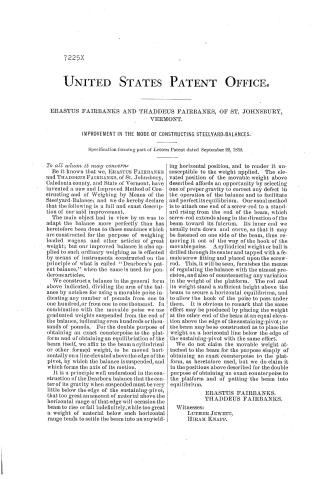
Page 1.
7225X
UNITED STATES PATENT OFFICE.
ERASTUS FAIRBANKS AND THADDEUS FAIRBANKS, OF ST. JOHNSBURY, VERMONT.
IMPROVEMENT IN THE MODE OF CONSTRUCTING STEELYARD-BALANCES.
Specification forming part of Letters Patent dated September 22, 1832.
To all whom it may concern:
Be it known that we, ERASTUS FAIRBANKS and THADDEUS FAIRBANKS, of St. Johnsbury, Caledonia county, and State of Vermont, have invented a new and Improved Method of Constructing and of Weighing by Means of the Steelyard-Balance; and we do hereby declare that the following is a full and exact description of our said improvement.
The main object had in view by us was to adapt the balance more perfectly than has heretofore been done to those machines which are constructed for the purpose of weighing loaded wagons and other articles of great weight; but our improved balance is also applied to such ordinary weighing as is effected by means of instruments constructed on the principle of what is called “Dearborn’s patent balance,” when the same is used for ponderous articles.
We construct a balance in the general form above indicated, dividing the arm of the balance by notches for using a movable poise indicating any number of pounds from one to one hundred, or from one to one thousand. In combination with the movable poise we use graduated weights suspended from the end of the balance, indicating even hundreds or thousands of pounds. For the double purpose of obtaining an exact counterpoise to the platform and of obtaining an equilibration of the beam itself, we affix to the beam a cylindrical or other formed weight, to be moved horizontally on a line elevated above the edge of the pivot, by which the balance is suspended, and which forms the axis of its motion.
It is a principle well understood in the construction of the Dearborn balance that the center of its gravity when suspended must be very little below the edge of the sustaining-pivot, that too great an amount of material above the horizontal range of that edge will occasion the beam to rise or fall indefinitely, while too great a weight of material below such horizontal range tends to settle the beam into an unyielding horizontal position, and to render it unsusceptible to the weight applied. The elevated position of the movable weight above described affords an opportunity by selecting one of proper gravity to correct any defect in the operation of the balance and to facilitate and perfect its equilibrium. Our usual method is to attach one end of a screw-rod to a standard rising from the end of the beam, which screw-rod extends along in the direction of the beam toward its fulcrum. Its inner end we usually turn down and curve, so that it may be fastened on one side of the beam, thus removing it out of the way of the hook of the movable poise. A cylindrical weight or ball is drilled through its center and tapped with a female screw fitting and placed upon the screw-rod. This, it will be seen, furnishes the means of regulating the balance with the utmost precision, and also of counteracting any variation in the weight of the platform. The rod and its weight stand a sufficient height above the beam to secure a horizontal equilibrium, and to allow the hook of the poise to pass under them. It is obvious to remark that the same effect may be produced by placing the weight at the other end of the beam at an equal elevation above the edge of the sustaining-pivot; or the beam may be so constructed as to place the weight on a horizontal line below the edge of the sustaining-pivot with the same effect.
We do not claim the movable weight attached to the beam for the purpose simply of obtaining an exact counterpoise to the platform, as heretofore used, but we do claim it in the positions above described for the double purpose of obtaining an exact counterpoise to the platform and of putting the beam into equilibrium.
ERASTUS FAIRBANKS.
THADDEUS FAIRBANKS.
Witnesses:
LUTHER JEWETT,
HIRAM KNAPP.
Published accounts: journal notice
Notice in the monthly list of patents
Journal of the Franklin Institute, new ser., vol. 11 (1833), p. 174 · View the page
10. For an improvement in the Construction of, and Weighing by, the Steelyard Balance; Erastus and Thaddeus Fairbanks, St. Johnsbury, Caledonia county, Vermont, September 22.
Published accounts: journal notice
Notice in the monthly list of patents
Journal of the Franklin Institute, new ser., vol. 11 (1833), p. 398 · View the page
I have given the foregoing description of the machinery which I use in order to enable any competent workman to carry the same into effect, agreeably to the modes represented in the drawings deposited in the patent office, but without intending to claim those machines in their general arrangement as my invention; or to confine myself to the exact arrangement there represented; but what I claim as my invention, and for which I ask a patent, is the forcing the cutFAIRBANKS' Improved Balance. ters and drills forward by means of a rack and pinion, or by a screw or other mechanical instrument producing a similar effect, and having their advancing motion communicated to them by their connexion with the other parts of the machinery, for the purposes hereinbefore described. DEAN WALKER. Specification of a Patent for an improvement in the mode of constructing and weighing by the Steelyard Balance. Granted to ERASTUS and THADDEUS FAIRBANKS, St. Johnsbury, Caledonia county, Vermont, September 22, 1832.
Published accounts: specification
Specification printed in the Journal of the Franklin Institute
Journal of the Franklin Institute, new ser., vol. 11 (1833), p. 399 · View the page
Text of the specification as printed in the Journal, from OCR; not proofread.
Specification of a Patent for an improvement in the mode of constructing and weighing by the Steelyard Balance. Granted to ERASTUS and THADDEUS FAIRBANKS, St. Johnsbury, Caledonia county, Vermont, September 22, 1832. To all whom it may concern be it known, that we, Erastus Fairbanks and Thaddeus Fairbanks, of St. Johnsbury, Caledonia county, Vermont, have invented a new and improved mode of constructing, and of weighing by means of, the steelyard balance, and that the following is a full and exact description of our said improvement. The main object had in view by us was to adapt the balance, more perfectly than has heretofore been done, to those machines which are constructed for the purpose of weighing loaded wagons and other articles of great weight; but our improved balance is also applicable to such ordinary weighing as is effected by means of instruments constructed on the general principles of the steelyard, or of what is called Dearborn's patent balance, when the same is used for ponderous articles. We construct a balance in the general form above indicated, but to the extreme end of it we give that shape which is usually given to the points of suspension in a scale beam. This is done for the purpose of hanging thereto a pendulous rod having a flanch at its lower end, or other contrivance, to support weights, to be presently described. arm. The arm of the balance is divided, and has a moveable poise and hook, formed in the usual way. Weights, bearing a given ratio to each other, are prepared, to be placed upon the flanched rod at the end of the We will now suppose the balance with its moveable poise to be graduated so as to weigh any number of pounds from one to a hundred; the weight to be placed upon the rod may indicate 100, 200, 500, 1000, or any other number of pounds, whilst the moveable poise will point out the number of pounds intermediate between any of the hundreds. These numbers are given merely for the purpose of explaining the principle upon which we proceed in this part of our invention; its applicability to weights of any required amount, and graduated to any scale which may be preferred, will be at once apparent. For the purpose of obtaining an exact counterpoise counterp to the platform, and, bringing the beam into the due horizontal position, we attach one end of a screw rod to a standard, usually rising from one end of the FAIRBANKS' Improved Balance. beam, which screw rod extends along in the direction of the beam, towards its fulcrum; its inner end we usually bend down, and curve, so that it may be fastened on one side of the beam, thus removing it out of the way of the hook of the moveable poise. A cylindrical, or other formed weight, is drilled through its centre, and tapped with a female screw, fitting to, and placed upon, the screw upon the rod. This, it will be seen, furnishes the means of regulating the beam with the utmost precision, and with perfect ease. The rod and its weight, stand at a sufficient height above the beam to allow the hook of the poise to pass under them. What we claim as our invention, and for which we ask a patent, is the combination of the graduated weights to be suspended from the end of the beam, with the ordinary moveable poise, operating in the manner, and upon the principle hereinbefore set forth. We also claim the before described manner of counterpoising the platform, and putting the beam in equilibrium, preparatory to weighing therewith. ERASTUS FAIRBANKS. THADDEUS FAIRBANKS. Fairbanks' Improved Balance. 4 10 20 30 40 50 60 70 80 90 100 a 1 2 1. Common poise. 2. Rod to support the Weights. 4.001 3 200 3. Weights. 4. Adjusting weight.
Editor's remarks. The Messrs. Fairbanks, some time since, obtained a patent for a platform weighing machine, and the foregoing mode of adjusting, and of graduating the beam of the balance, and the weights, was devised by them with a view to its employment with the beforementioned machine. We have had an opportunity of examining one of their balances, and have been much pleased with it; this examination, however, was not necessary to the conviction that it possesses a just claim to the character of a real improvement, the whole arrangement Saltpetre of Chili. being so simple, as to enable any person to perceive that it is well adapted to the purpose contemplated, that of facilitating the business of weighing, and more especially that of heavy articles. TRANSLATIONS FROM FOREIGN JOURNALS. [TRANSLATED FOR THIS JOURNAL.*] Method of giving a black and glossy coating to cast iron trinkets, and other articles of the same material. The desire expressed by some of our subscribers to have the receipt for the varnish employed on the cast iron trinkets of Berlin iron, so called, induced us to request a person conversant with the different processes of the arts, to ascertain the best method of making that varnish. We now give a recipe, not for the varnish itself, but for a black coating which can be applied to any description of cast iron articles. This composition is simple, and offers the invaluable advantage of efficaciously resisting the action of the atmosphere, and even of weak acids, so that the process may be employed for coating a great variety of cast utensils commonly used in our families. The coating easily fixes itself on cast iron, and may also be used on hammered iron, but with less certainty of success in the latter case than in the former. Attach each of the articles to be coated to an iron wire bent above into a hook, and apply a thin coat of linseed oil; the coat must be thin to prevent the oil from running, forming asperities or knots where it collects. Hang them eight or ten inches above a wood fire, so that they may be completely enveloped in the smoke. When they have been thus exposed to a brisk fire for about an hour, lower them so that they shall be near the burning coals, without touching them; at the expiration of about fifteen minutes remove the articles, and immediately immerse them in cold spirits of turpentine. Any articles which, after this last operation, may be found deficient in brilliancy, or not sufficiently black, are to be re-exposed to the burning coals for a few minutes, and again dipped in the spirits of turpentine. This process, which may be variously modified to suit different articles, may, from its simplicity, be extensively applied, and will prove useful in all the cases in which cast utensils are subject to rapid oxidation. [Journal des Connaissances Usuelles. On the Saltpetre of Chili, (Nitrate of Soda.) A question of some importance to a class of manufacturers, is now pending; it relates to the substitution of nitrate of soda, (saltpetre of Chili,) for nitrate of potash. * By request of the Committee on Publications. VOL. XI. No. 6. -JUNE, 1833. 51 Green Pigments. There are in several commercial towns of France, large quantities of nitrate of soda, imported from the district of Atacama, in Peru. This salt, known as Chilian saltpetre, pays an import duty one-third less than that paid by common saltpetre. Some of the manufacturers of Paris, Rouen, &c. having attempted to obtain nitric acid from this article by the process employed when nitrate of potash is used, obtained unfavourable results. This is owing to the fact that the constituents of nitrate of soda are combined in different proportions from those of common saltpetre, and require different doses of sulphuric acid for their separation. 1263 parts, by weight, of nitrate of potash contain 676 parts of nitr
About this record
- Patentee
- DATAMP
- Date
- the Name and Date index of patents, DATAMP, USPTO records
- Invention
- DATAMP
- Listed in
- the Name and Date index of patents, DATAMP, USPTO records, Jim Shaw's X-patent list, the Journal of the Franklin Institute, Burke's List of Patents (1847), the Journal of the Franklin Institute, Journal
- Burke's 1847 Patent Office list gives the same patent.