

Drawings and documents
USPTO scan
The patent as scanned by the USPTO
-
 Page 1
-
 Page 2
-
 Page 3


U.S. Patent and Trademark Office · Google Patents
Show the transcription Hide (512 words)
Machine transcription (LightOnOCR) of the pages as scanned by the USPTO, most of them the handwritten copies made when the records were restored after the 1836 fire. Not checked; it can misread handwriting, so compare it with the scan.
Page 1.
7635X
E. Nott.
Dancer.
Patented Jan. 29, 1833.
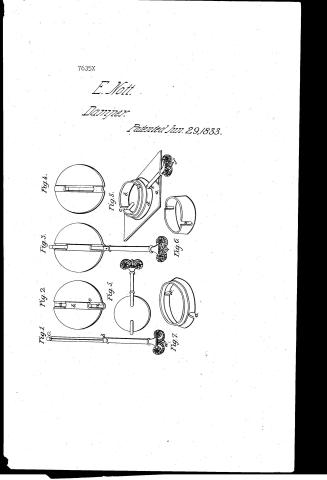
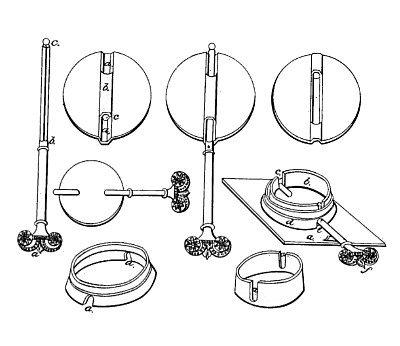
Fig. 1.
Fig. 2.
Fig. 3.
Fig. 4.
Fig. 5.
Fig. 6.
Fig. 7.
Fig. 8.
Page 2.
7635X
June 29, 1833
221.
Case "1."
Elphinstone's Note.
Letters Patent.
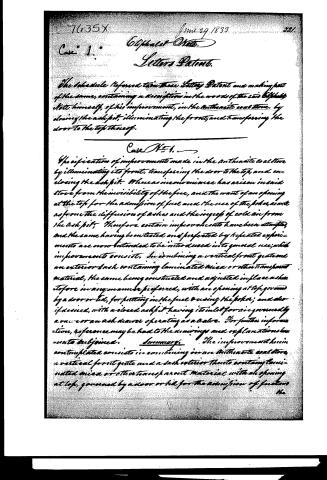
The schedule referred to in these Letters Patent and making part of the same, containing a description in the words of the said Elphinstone himself, of his improvement, in the authentic coal stove, by closing the ash pit, illuminating the front, and transferring the door to the top thereof.
Case No. 1.
Specification of improvements made in the authentic coal stove by illuminating its front, transferring the door to the top, and enclosing the ash pit. Whereas inconvenience has arisen in said stove from the invisibility of the fire, and the want of an opening at the top for the admission of fuel and the use of the poker, as well as from the diffusion of ashes and the ingress of cold air from the ash pit; Therefore certain improvements have been attempted, and the same having been tested and perfected by repeated experiments are now intended to be introduced into general use; which improvements consist, in combining a vertical front grate and an exterior dash containing laminated mica or other transparent material, the same being constructed and adjusted in place as heretofore in any manner preferred, with an opening at top, governed by a door or lid, for putting in the fuel & using the poker; and also if desired, with a closed ash pit having its inlet for air governed by a valve or an ash drawer operating as a valve. For further information, reference may be had to the drawings and explanatory sheets hereto subjoined.
Summary. The improvement herein contemplated consists in combining in an authentic coal stove, a vertical front grate and a dash exterior thereto containing laminated mica or other transparent material, with an opening at top, governed by a door or lid for the admission of fuel and the
Page 3.
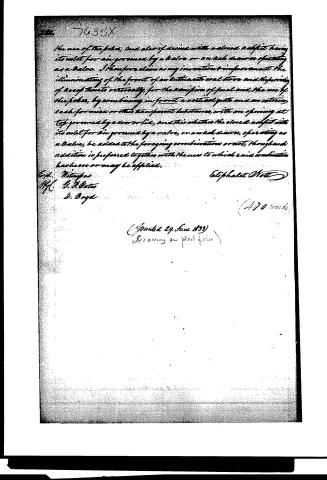
The use of the poker; and also of doors with a closed adapt having its inlet for air governed by a valve or a wick drawn operating as a valve. I therefore claim as my invention and improvement the illuminating of the front of an anthracite coal stove and the burning of coal thereto vertically, for the admission of fuel and the use of the poker, by combining in front a vertical glass and an exterior back for mica or other transparent substance, with an opening at top governed by a door or lid, and this whether the closed adapt with its inlet for air governed by a valve, or a wick drawn, operating as a valve, be added to the foregoing combinations or not, though such addition is preferred together with the uses to which said combination has been or may be applied.
Eliphalet Nott
(470 words)
(Granted 29 June 1833)
Drawing on back folio
Published accounts: journal notice
Notice in the monthly list of patents, with remarks
Journal of the Franklin Institute, new ser., vol. 12 (1833), p. 404 · View the page
26. For an Improvement in the Anthracite Coal Stove, by closing the ash pit, illuminating the front, and transferring the door to the top thereof; Eliphalet Nott, Schenectady, state of New York, June 29.
Remarks. This is the first of a series of eleven patents, the remainder of which will follow the account of this, in regular succession, as they were all applied for and issued at the same time. Our readers will recollect the notices of three patents previously obtained for Dr. Nott's stoves for the combustion of anthracite; and among those who live in our cities there are but few who have not seen them in actual operation. The greater number of these new patents are taken for the individual improvements which in their combined state are to be found in the stove as it already exists. The reason for obtaining these several patents, we have been informed, is the frequent invasion of the right of the patentee by manufacturers who adopt one or more of his improvements in their stoves, and seem to think that this may be done with impunity, provided they do not take the whole. Although, in this point, they are grossly mistaken, it has been thought better to exhibit each of the parts as patented in its individual character; for should this procedure not secure the rights of the inventor more perfectly, it has been supposed that it might serve as a beacon to invaders, and thus prevent the necessity of resorting to the courts of law. We shall do but little more than give the claims set up in these new patents, as in so doing we must occupy quite as much room as we can conveniently devote to an individual subject, and ask quite as much from our readers as most of them will be willing to give. The claim appended to the specification of the patent, the title of which is given above, is in the following words. "I therefore claim as my improvement the illuminating of the front of an anthracite coal stove, and the providing of access thereto vertically, for the admission of fuel, and the use of the poker, by combining in front a vertical grate, and an exterior sash for mica, or other transparent substance, with an opening at top governed by a door or lid, and this whether the closed ash pit, with its inlet for air, governed by a valve, or an ash drawer operating as a valve, be added to the foregoing combination or not, though such addition is preferred; together with the uses to which said combination has been, or may be applied."
Published accounts: specification
Specification printed in the Journal of the Franklin Institute
Journal of the Franklin Institute, new ser., vol. 12 (1833), p. 421 · View the page
Text of the specification as printed in the Journal, from OCR; not proofread.
Specification of a patent for increasing the Evolution of Heat from Anthracite Coal, and for rendering the whole of the heat evolved from fuel of any sort, available to the production of useful effect, in the treatment of bodies at rest. Granted to ELIPHALET NOTT, Schenectady, New York, June 29, 1833. It having been discovered that the heat of an anthracite coal fire may be increased by more fully igniting its contained hydrogen; and it having also been discovered that the heat of a fire of any sort may be advantageously applied successively to the treatment of successive bodies; certain improvements have therefore been made for carrying the same into effect; which consist, in providing for the more comNott's Management of Heat. plete combustion of the hydrogen produced in the use of anthracite coal; and in concentrating several processes to which the heat produced in the use of fuel of any sort can be conveniently applied;always beginning with a process that requires a high temperature, as the reduction of ore, and the manufacture of metals, or the subsequent melting or heating thereof, for the purpose of being cast or wrought into other forms; and proceeding thereafter to processes requiring a lower temperature, as iron to be annealed, or pit coal, or rosin, to be decomposed for the production of gas: by interposing between a cupola, forge, furnace, or chamber of combustion and a boiler, or a chimney if no boiler be in use, an elongated chamber of treatment, of nonconducting material, either vertical, inclined, or horizontal; or in part the one, and in part the other; the same being exhibited either in a single channel, having, when required, recesses formed along the line thereof, that certain bodies, or bodies in certain localities, can be placed more or less out of the main current of the contained flame; and having also inspecting apertures, and apertures for the ingress and egress of bodies, or for the admission of air for the cooling of the interior, or the ignition of the contained hydrogen, all governed by valves:-or the same, or some part thereof, being exhibited in two or more channels, placed side by side, or one above the other, and so divided into compartments, and furnished with additional interior inlets and outlets governed by valves, that bodies under treatment can be passed from one end to the other, and that the flame can be passed in the one channel, or the other, and caused to bear with greater or less intensity on the bodies in any locality of either, or carried off from them all to the chimney through a separate flue governed by a valve: and in the keeping up the temperature along the line of said chamber of treatment after the process of melting in the cupola has ceased; -by converting a section of said chamber of treatment into an occasional chamber of combustion, and separating the same by a valve from the cupola, unless it be deemed preferable to make use of the cupola itself, in such case, as a mere chamber of combustion; and in causing the entire volume of flame, however divided in its passage, to bear upon the boiler, (if a boiler be employed,) which is always to be placed late, if not last, in the series of bodies to be treated, and the steam thereof, besides driving an engine employed in heating water to be used in other processes, as drying, bleaching, &c.: and in providing, adjoining the boiler, an auxiliary furnace, to be used when necessary; and in governing by valves the inlet to the boiler from the cupola, and the inlet to the furnace from the external air, so that when the flame from the cupola ceases, the inlet to the boiler may be closed; and when the flame from the cupola is sufficient for the boiler, the inlet to the furnace from the external air may be closed; unless when opened for igniting the hydrogen from the cupola, or for cooling the interior. It is understood, that, when practicable, the air introduced for the ignition of gas, should be heated, by being passed between the crust of the fabric, and an exterior, or second crust, so enveloping the whole as to form an air chamber. And it also being understood that Nort's Management of Heat. a double arrangement is to be preferred, so that as one apparatus is repairing, the other may be in use. For further information reference must be had to the drawings hereunto annexed. ['The specification next contains a "summary" of the improvements, in which the foregoing is recapitulated, but somewhat condensed; this part we omit, and proceed to the claim, which varies but little from the summary.] I therefore claim as my invention and improvement, the invention of the increasing of the evolution of heat in the use of anthracite coal, and the rendering the entire heat evolved in the use of fuel of any sort available to the production of useful effects, by concentrating and arranging in the order aforesaid, the several processes to which the said heat can be conveniently applied in the treatment of successive bodies, or of bodies divided into successive portions at rest; by interposing between a cupola, forge, or furnace, a chamber of combustion and a boiler, or a chimney if no boiler be in use, an intermediate chamber of treatment, exhibited and furnished as aforesaid, or exhibited and furnished in any other manner, provided adequate provision be made thereby for the ignition of the hydrogen of anthracite, and for rendering the entire heat from fuel of any sort productive of useful effect, by applying the same successively to such several processes as can be conveniently carried forward by the treatment of successive bodies at rest.-Also the preventing the injurious effects of the flame of a cupola upon a boiler in contact therewith; and the diminishing of the reduction of the temperature to which it is exposed while charging the cupola, by the removal of the same to a distance therefrom. Also the protecting of the boiler, however situated, against the action of the flame of a cupola, when too intense, by passing off a portion of the heat thereof through a separate flue governed by a valve: and also the governing of the inlet to a boiler from a cupola, by a valve; and the furnishing of a boiler by means of an auxiliary furnace, with the requisite heat when the cupola is not in blast, or when the heat thereof is insufficient, together with the uses to which the same has been, or may hereafter be, applied. ELIPHALET NOTT.
Published accounts: specification
Specification printed in the Journal of the Franklin Institute
Journal of the Franklin Institute, new ser., vol. 12 (1833), p. 423 · View the page
Text of the specification as printed in the Journal, from OCR; not proofread.
Specification of a patent for improvements made in the treatment of metallic bodies generally; as well those that admit of motion while under treatment, as those which require to be at rest. Granted to ELIPHALET NOTT, Schenectady, New York, June 29, 1833. It having been discovered that metallic bodies oxidize less when exposed to the action of the products of combustion, than when exposed to the action of the elements of combustion; and it also having been discovered that contiguous bodies at different temperatures, and Norr's Management of Heat. moving in opposite directions, exchange temperatures, therefore certain improvements for carrying these discoveries into effect have been made: which improvements consist;--In preventing the oxidizing of metallic bodies by treating the same in all cases in a chamber separate from the chamber of combustion: and in economising the expenditure of heat generally by concentrating the processes to which the same can be conveniently applied; and in arranging the whole in a series according to the degree of temperature required in each, always proceeding from the greater to the less, and in dividing the material to be treated into portions, and arranging the same in successive localities, and in passing the same (so far as they admit of being moved from one compartment to another) towards the chamber of treatment along the same channel through which the flame is caused to escape therefrom, and to act as it escapes on successive bodies under treatment, till the whole available temperature has been expended before the same enters the chimney; all of which is effected either by means of a vertical reverberatory, or zig zag chamber of treatment, consisting of a series of compartments separated by solid and fixed floors, more or less inclined and arranged one above another, and furnished with appropriate rests or ways, for sustaining incumbent bodies under treatment, and for passing the same down to the next locality when treated; and furnished also with apertures for inspection, and for the ingress and egress of bodies, and the introduction of the requisite instruments for adjusting and removing the same-or by means of a vertical, reverberatory chamber of treatment, consisting, in like manner, in a series of compartments arranged one above another, and separated by floors in part solid and fixed, and in part open and movable, either by levers, or eccentric axes, piercing the crust and worked from without, in such manner, that the contents of each superior compartment can at pleasure be passed down into the next inferior compartment; or by means of a vertical chamber of treatment without reverberations, consisting in like manner of a series of compartments arranged one above another and separated by floors, more or less open, and wholly movable, either by eccentric or by central axes, piercing the crust, and worked as aforesaid, from without, in such manner that the contents of each superior compartment can be emptied by a revolution of its floor into the compartment under it:-which several chambers of treatment must be connected, each at its lower extremity, with the outlet for flame from the chamber of combustion; or with the outlet for flame from a cupola, having an inlet for flame thereto from a separate chamber of combustion; or with a cupola, or other furnace, constructed in the usual manner: and each must also be connected at its upper extremity with an additional section of a horizontal chamber of treatment exhibited in one or more channels for the application of the surplus heat in the treatment of additional bodies requiring lower temperatures, as pit coal and rosin contained in retorts for the production of gas: and water in boilers for the generation of steam, to be employed for driving an engine, and thereafter for heating additional water for drying, bleaching, or any other process. BALDWIN'S Manufacture of Wheels. For further information reference must be had to the drawings and explanations deposited in the patent office. [Summary.] I therefore claim as my invention and improvement the diminishing of the oxidizing of metallic bodies, by treating them, whether in cupolas, forges, or other furnaces, in a chamber distinct from the chamber of combustion; and the economising of the expenditure of heat in the treatment of bodies generally, by concentrating all the processes to which the same heat can conveniently be applied, and arranging the order thereof according to the intensity of the temperature required by each; and the dividing of the bodies to be treated, exclusive of those contained in the cupola, forge, or other furnace, into portions, and arranging the same successively, in successive localities, and of moving the bodies that admit of motion which are under treatment, towards the chamber of combustion, along the same channel through which the flame is passing off from said chamber in an opposite direction; always putting the new material into the locality further from the chamber of combustion, and removing the material sufficiently treated, from the locality nearest the chamber of combustion, by means of a special chamber of treatment, constructed, connected, and managed, as already described; the same being interposed between a cupola, forge, or other furnace, and the boiler, or the chimney, if no boiler be in use; or by any other means, provided the chamber of treatment be separated from the chamber of combustion throughout; and provided the different processes to which the same heat can be applied be concentrated, and the succession ordered according to the degree of temperature required by each; and provided also, the material to be treated be divided into parcels arranged in successive localities; and, if capable of motion, be moved in one direction towards the chamber of combustion along the same channel through which the flame is passing from the chamber of combustion in an opposite direction; together with the uses to which the same has been, or may hereafter be, applied, in the reduction of ores, the manufacture of iron, or other metals, the melting, or heating, of the same, to be cast, or wrought, into different forms, together with the other processes of art, with which the same may be combined. ELIPHALET NOTT.
DATAMP: illustration
Illustrations from DATAMP
DATAMP (Directory of American Tool and Machinery Patents), via the Internet Archive · Archived DATAMP page
About this record
- Patentee
- DATAMP
- Date
- DATAMP, USPTO records, Burke's List of Patents (1847)
- Invention
- DATAMP
- Listed in
- the Name and Date index of patents, DATAMP, USPTO records, Jim Shaw's X-patent list, the Journal of the Franklin Institute, Burke's List of Patents (1847), the Journal of the Franklin Institute, Journal
- The sources give different dates; the date shown is the one most of them agree on.
- The Franklin Institute's journal confirms the date shown.
- Burke's 1847 Patent Office list gives the same patent.