The Kenneth J. Germeshausen Center
for the Law of Industrial Innovation
and Entrepreneurship Turns 20
 BY SHARON CALLAHAN
February 16, 2006
Twenty years ago, The Kenneth J. Germeshausen Center was created through the generosity of Kenneth J. and Pauline
Germeshausen.Today, under the direction of Karl F. Jorda, the David Rines Professor of Intellectual Property Law and Industrial
Innovation, it serves as the umbrella organization for Pierce Law's intellectual property specializations.
The Center is a driving force in the study of international and national intellectual property law and the transfer of technology.
It acts as a resource to business as well as scientific, legal and governmental interests in patent, trademark, trade secret, licensing,
copyright, computer law, and related fields.
The Center bears the name of its benefactor, Kenneth J. Germeshausen, one of New England's pioneering inventors and professor
of electrical engineering at the Massachusetts Institute of Technology. Germeshausen was also co-founder of the international
high technology firm of Edgerton, Germeshausen & Grier.
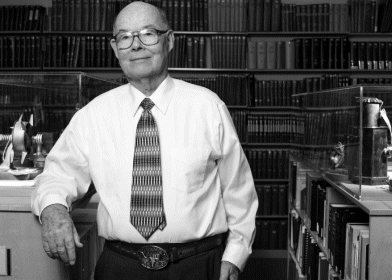
IN 1985, HOMER O. BLAIR BECAME THE CENTER'S FIRST DIRECTOR
and the school's first David Rines Professor of Intellectual
Property Law and Industrial Innovation. At the time, Blair was
vice president of patents and licensing for Itek Corporation,
Lexington, MA, a position he held for nearly two decades.
Prior to joining Itek, Blair had worked as a patent attorney
for several of the nation's major corporations, including:
Celanese Corporation, NY; Kaiser Aluminum and Chemical
Corporation, Oakland, CA; Boeing Airplane Company, Seattle,
WA; and Westinghouse Electric Corporation, Pittsburgh, PA.
Born in Tacoma,WA in 1925, Blair, a disabled infantry
veteran from the Battle of the Bulge in World War II, attended
the University of Washington where he earned a BS in chemistry
in 1948, BS in physics in 1951, and JD in 1953. After
graduation, he joined the Westinghouse Patent Department
where he started to learn the intellectual property business.
"Working in different companies, with their different
technologies, locations and corporate structures enabled me to
learn many aspects of intellectual property," explains Blair. "I
participated in a number of professional, U.S. government and
United Nations intellectual property activities. After Itek was
acquired by another company, at the invitation of Robert
Rines, I came to Pierce Law to teach what I had learned in
thirty years of intellectual property practice."
Blair's intellectual property training and scientific background
proved to be a perfect match for Pierce Law. He was
already familiar with and had participated in international
intellectual property exchange programs. In 1971, he served on
a five-member U.S. delegation to the U.S.S.R. charged with the
task of exchanging information on patent management and
patent licensing, a project sponsored by the United States
Patent and Trademark Office and the Licensing Executives
Society. He was the only member from private industry to
serve on the U.S. delegation to the United Nation's meetings in
Geneva, Switzerland in 1977, and the only U.S. participant at
the United Nation's World Intellectual Property Organization
(WIPO) meeting in 1981 on "Trademarks and Developing
Countries." During that same year, Blair also participated in a
WIPO meeting on "The Establishment of a Guide on the
Organization of Intellectual Property Activities in Enterprises
of Developing Countries."
"In these and other United Nations programs, I learned
about the lack of knowledge in developing nations of intellectual
property and how to use intellectual property in developing
technology products and international trade," explains Blair.
Blair developed and taught Pierce Law's first courses in
licensing and technology transfer. In addition to his teaching
responsibilities, Blair initiated a series of policy-making seminars
and conferences for the discussion of intellectual property
and policy studies. In keeping with the Center's initial mission
to improve through training and research, the climate for
commercialization of technology in the public interest, the
seminars addressed such topics as licensing of technology,
trademark protection, creative technology arrangements and
the role of technologically trained corporate lawyers in managing
risk. In 1987, Blair organized the first Patent Systems Major
Problems Conference attended by corporate and private attorneys
and judges from throughout the U.S.
During Blair's years at Pierce Law, intellectual property
issues gained greater national and international prominence
and Blair had the foresight to design the school's first Master
of Intellectual Property (MIP) degree program, drawing
students from around the world.
"The first students came from a number of developing
countries," says Blair. "I wrote to individuals from developing
nations whom I had met at the United Nations advising them
of the MIP degree program and inviting them to send students
to Pierce Law to learn about intellectual property and how it
could be used to help their countries. I believed Concord, NH
was a better place to learn about the United States than New
York or Washington, DC. Professor William Hennessey was
invaluable in this effort by attracting students from the
People's Republic of China due to his ability to speak and
write the Chinese language."
In just four years, Blair's accomplishments were countless.
Upon his retirement in 1989, Pierce Law awarded Blair an
honorary degree for his "major contributions to America's
economic well-being as president of the United States
Trademark Association (now the International Trademark
Association) and the Licensing Executives Society (US/Canada),
as advisor to committees of Congress and the Departments of
State and Commerce and as a member of international delegations
representing our country." The graduating class of 1989
cited Blair for his "efforts to help Franklin Pierce Law Center
achieve distinction as one of the country's leading intellectual
property law schools."
Blair approached his retirement as he did his life's work,
with thorough research. He wrote to 68 towns with populations
between 25,000 and 125,000 in the southwestern United
States posing the question, "Why should we retire to your city
and what retirement facilities do you have?" After visiting 22
communities, Homer and his wife Jean of 32 years (now 48),
chose San Angelo, located in semi-arid West Texas.
In 1996, the Blairs made a generous contribution of 28
patent models to Pierce Law. The models, dating from 1842 to
1883, are models of inventions used in industry, and range
from one of Elias Howe's improvements to his sewing machine
to the first manufactured red dye.
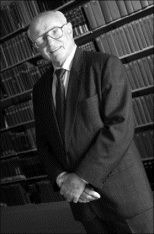 KARL F. JORDA, WAS SELECTED AS THE CENTER'S DIRECTOR AND THE
SCHOOL'S SECOND DAVID RINES PROFESSOR UPON BLAIR'S RETIREMENT
IN 1989.
"With over 30 years of corporate practice in intellectual
property and licensing behind me, and after heading up
CIBA-GEIGY's intellectual property operation for 26 years,
the question of whether or not to take early retirement had
crossed my mind," says Jorda. "The obvious alternatives were
retiring, leaving to join a law firm as 'of counsel,' or staying on
at CIBA-GEIGY for several more years."
"But the very best alternative of them all, namely, to
become an 'academic' and teach what I had practiced, did not
occur to me at all, until Homer Blair asked me to consider
replacing him as the David Rines Professor," explains Jorda.
"What an interesting and challenging position this turned
out to be!"
"Two realizations made it all easier," says Jorda. "One, I
could talk about something I had done for over 30 years, and
two, teaching-teaching inventors, R&D staffs, management,
members of the Patent Department and examiners of the
Patent Office, etc.-is an important part of running an intellectual
property operation.
Teaching at Pierce Law is great fun; students are dedicated
and committed; the faculty and staff are cooperative and
supportive," says Jorda.
Prior to joining Pierce Law, Jorda served as corporate
patent and trademark lawyer at Miles Laboratories (now
Bayer) in Indiana, and the chief intellectual property counsel
at CIBA-GEIGY Corporation (now Novartis) in New York.
Jorda's formal education includes a BA from the University
of Frankfurt, Germany and the University of Great Falls,
Montana, and MA and JD degrees from the University of
Notre Dame.
At Pierce Law, Jorda teaches Technology Licensing during
the fall semester and at the Intellectual Property Summer
Institute, and Intellectual Property Management during the
spring semester.
As head of the Center, Jorda directs the Center's mission
to act as a round table for the exchange of innovative ideas and
concepts which draws an international audience of lawyers and
administrators. Conferences held under its auspices address
such topics as advanced licensing techniques, intellectual property
litigation, environmental technology transfer, international
patent cooperation, and the valuation of intellectual property.
To date, sixteen Advanced Intellectual Property Practice
Symposia have been held at Pierce Law.
Under Jorda's vision and guidance, Pierce Law continues
to gain worldwide recognition for its intellectual property
faculty and programs, ranking among the top ten law schools
in the nation for the study of intellectual property law. Jorda
has hosted delegations of U.S. patent counsel at Japanese
Patent Office meetings, served as consultant to Indonesian and
Bulgarian Patent Offices, and participated in World Intellectual
Property Organization (WIPO) symposia around the world.
In 1993 and 1994, he conducted WIPO's annual two-week
academy for officials from developing countries.
In addition to teaching classes at Pierce Law, Jorda
served as adjunct professor at the Fletcher School of Law
and Diplomacy, Tufts University,Medford, MA, teaching
international intellectual property law from 1995 to 2003.
In 1997 and 1998, he served as co-director of a joint degree
program in intellectual property law with the Gulf Institute
for International Law, Dubai, United Arab Emirates, where
he taught Patent and Trade Secrets, International Intellectual
Property Law and Intellectual Property Licensing/Technology
Transfer.
In 1999, Jorda was appointed for three two-year terms
as U.S. representative to the Confidentiality Commission
(Commission on the Settlement of Disputes Relating to
Confidentiality) of the Organization for the Prohibition
of Chemical Weapons (OPCW), the implementing body
of the Chemical Weapons Convention (CWC), located in
The Hague, Holland.
Among his many honors, Jorda received the 1996
Jefferson Medal. Presented annually by the New Jersey
Intellectual Property Law Association, the Jefferson Medal is
the highest award in the intellectual property field. It is given
for exceptional contributions to the American intellectual
property law system, and only two other law professors have
ever received this recognition.
THE GERMESHAUSEN CENTER
OF THE FUTURE
This year, the Center will host its seventh Basic Patent Cooperation Treaty (PCT) Seminar on Friday and
Saturday, April 21 and 22, in cooperation with the World Intellectual Property Organization (WIPO) of
Geneva, Switzerland. Designed for patent attorneys, patent agents and patent administrators, the seminar
provides in-depth knowledge and understanding of the Patent Cooperation Treaty.
On July 17-21, the Center will hold its fifteenth Advanced Licensing Institute.
"Begun in 1992, it was an instant success," explains Jorda. "It features 16 lectures by top talent in the
licensing world and provides comprehensive, in-depth coverage of topical licensing subjects."
In addition to these programs, the series of Intellectual Property Systems Major Problems
Conference, started by Blair in 1987, will continue with the eighth conference to be held in March 2006 and will deal with patent
law reform proposals.
"The Germeshausen Center has a record of solid accomplishment over the past 20 years, reflected by the many-faceted
activities, and will endeavor to continue to preserve and enhance Pierce Law's national and international standing as a powerhouse
in intellectual property education and training," says Jorda.
<< Return to IP at Pierce Law