

Drawings and documents
USPTO scan
The patent as scanned by the USPTO
-
 Page 1
-
 Page 2
-
 Page 3
-
 Page 4
-
 Page 5


U.S. Patent and Trademark Office · Google Patents
Show the transcription Hide (904 words)
Machine transcription (LightOnOCR) of the pages as scanned by the USPTO, most of them the handwritten copies made when the records were restored after the 1836 fire. Not checked; it can misread handwriting, so compare it with the scan.
Page 2.
United States Patent
Patent No.: X1001
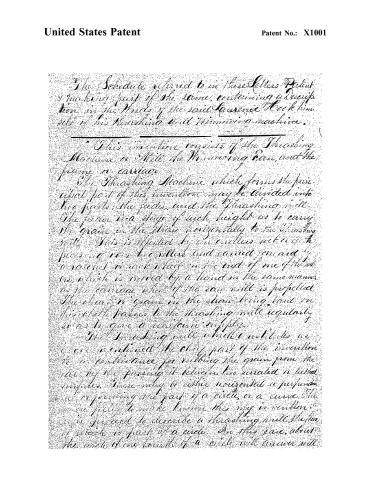
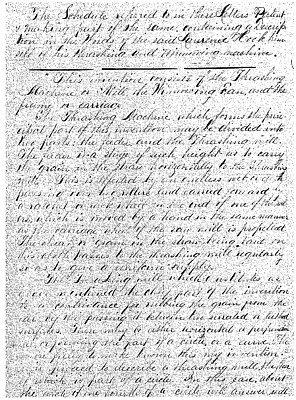
The Schedule referred to in these Letters Patent is making part of the same, containing a description in the Words of the said Lawrence Hook himself of his threshing and winnowing machine.
This invention consists of the Threshing Machine or Mill, the Winnowing Pan, and the frame or carriage.
The Threshing Machine which forms the principal part of this invention may be divided into two parts: the feeder, and the Threshing mill. The feeder is a stage of such height as to carry the grain in the straw horizontally to the Threshing mill. This is effected by one endless belt, or a pair of two rollers and carried on and a rod or work sheet on the end of one of the rollers, which is moved by a hand in the same manner as the carriage wheel if the saw mill is propelled. The wheat or grain in the straw being laid on this cloth passes to the threshing mill regularly so as to give a uniform supply.
The Threshing mill which constitutes the chief part of the invention is a contrivance for rubbing the grain from the ear by the passing it between two serrated or lathed surfaces. These may be either horizontal or perpendicular, or forming the part of a circle, or a curve. The same policy to make known this my invention.
It is proposed to describe a threshing mill, the form of which is part of a circle. In this case, about the arch of one fourth of a circle will answer well.
Page 3.
United States Patent
Patent No.: X1001
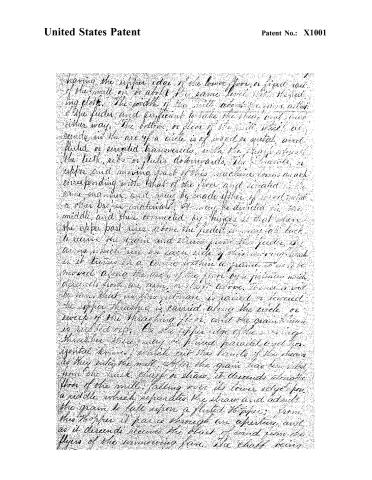
having the upper edge of the lower floor, or fixed part of the mill, or about the same level with the feeding cloth. The width of the mill above the floor is about of the feeder and sufficient to take the sheaf and turn either way. The bottom, or floor of the mill, which we denote in the arc of a circle is of wood or metal, and fluted or serrated transversely, with the flutes directed the teeth, ribs or flutes downwards. The thrasher, or ripper and moving part of this machine runs in a corresponding with that of the floor and serrated in the same manner, and may be made either of wood, metal or other proper materials. It may be divided in the middle, and thus connected by hinges so that when the upper part rises above the feeder it may fall back to receive the grain and straw from the feeder. As no, a wheel runs on each side of this moving part as it turns in a circle within a frame. These are moved along the arc of the floor by a pinion which descends from an arm, or shaft above. Hence it will be seen, that as this pinion is raised or lowered the upper thrasher is carried along the circle or sweep of the thrashing floor, and the grain is so reduced out. On the upper edge of the moving thrasher there may be fixed parallel and horizontal knives, which cut the bands of the sheaves as they enter the mill. After the grain has been lifted from the thick, chaff or straw, it descends almost floor of the mill, falling over its lower edge for a middle, which separates the straw and admits the grain to fall upon a fluted hopper; from this hopper it passes through an aperture, and as it descends receives the blast of wind from the flyers of the winnowing fan. The chaff being
Page 4.
United States Patent
Patent No.: X1001
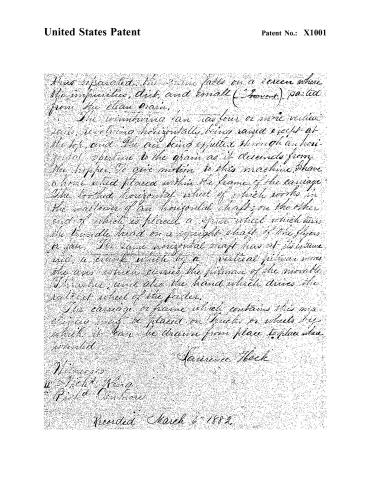
thus separated, the grain falls on a screen where the impurities, dirt, and small (foreign) parts from the clean grain.
The winnowing fan has four or more vertical rails, revolving horizontally, being raised except at the top, and the air being expelled through an horizontal aperture to the grain as it descends from the hopper. To give motion to this machine, I have a loose wheel placed within the frame of the carriage. The toothed horizontal wheel of which works in the manner of an horizontal shaft; on the other end of which is placed a spur wheel which turns the tumbler head on a vertical shaft of the flyers or fan. The same horizontal shaft has at its extreme end, a crank which by a vertical pinion moves the arms which curies the fulcrum of the movable Shaker; and also the hand which drives the ratchet wheel of the feeder.
The carriage or frame which contains this machine may be placed on trucks or wheels by which it can be drawn from place to place when wanted.
Savannah Stock
Witnesses:
W. J. King
P. O. D. D.
Recorded March 6th 1882.
Page 5.
United States Patent
Patent No.: X1001
DRAFTSMAN'S DIVISION.
All communications should be addressed to
"The Commissioner of Patents,
Washington, D. C."
2-328 a.
DEPARTMENT OF THE INTERIOR,
United States Patent Office.
Washington, D. C., ______________________, 189__
SIR:
The printed ______________________ of Patent No. _______________
____________________ exhausted.
As soon as reprinted a copy will be mailed you to complete your order.
By direction of the Commissioner:
Very respectfully,
___________________________
Chief Clerk.
3149b6-97-5m
DATAMP: illustration
Illustrations from DATAMP
DATAMP (Directory of American Tool and Machinery Patents), via the Internet Archive · Archived DATAMP page
About this record
- Patentee
- DATAMP
- Date
- the Name and Date index of patents, DATAMP, USPTO records
- Invention
- DATAMP
- Listed in
- the Name and Date index of patents, DATAMP, USPTO records, Jim Shaw's X-patent list, S. A. Elliot's printed list of patents, Burke's List of Patents (1847)
- S. A. Elliot's printed list of patents gives the same name and date.
- Burke's 1847 Patent Office list gives the same patent.