

Drawings and documents
National Archives restored drawings: drawing
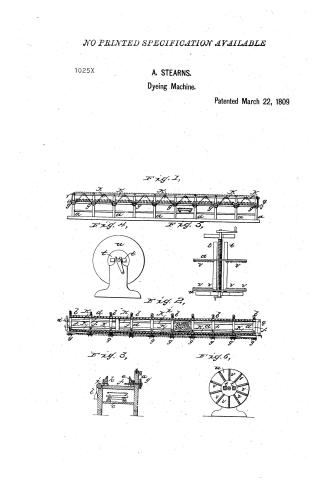
Abner Stern's Patent Drawing for a Machine to Color and Finish Silk Stuffs, etc.


National Archives, Restored Patent Drawings (Record Group 241) · Full-size scan at the National Archives · Catalog record
Show the text on the drawing Hide (165 words)
Words on the drawing as machine-read by the National Archives; not checked. Useful mainly for searching.
Sheet 1. 08 / 08 / 1.0.25.X. / Preferences. Signt Topoius. / Ainer Itearns / "ther Preel. Topoiew Ay.6 Seation. / betion This Indianaf / c.c.m. lomengirth. Machine to color and finish her stuffs. L. / didndide e front check screws. caswherls. / dwlight. KK.KKK.Ke... / Patental Mar 22 1809 / m cappiece. n. chairband. 0 oradle way withCoelpon. / Val. 2. ps. 337. / Raltitsaxie. u.u. heads. v.vvv. hanks. / medh has. s comporary much bar / Jy.5. / Jy.2, / 333333 / Sigb. / the / Correct / April igth 1845 / MiM.Kella, / Made under Instion of the of Parents / in conformity with Inaion Assy / Commpion of
Sheet 2. ACHING / NG. / CLASSIFICATION / & Bleach Vate. / & BLEACHING & DYEING. / 1,025x / Open Vats. / DI V ISION. / (2 Sheet. / Sheet / A. Stearns / Machine to color and finish Silk Stuffs / Patented Mar. 22 1809 / we / Fig. / us / Fig. 1 / Fig.4 / NO
Sheet 3. ING. / 8. BLEACHING & DYEING: / Bleach Pats / Open Vats / (2 Sheets) sheet 2 / # 1025X X / A. Stearns / Machine to color and finish Silk Stuffs / Patented Mar. 22°1809 / Income / ///////////////////////// / Fig. / Fig. / Fig.3
USPTO scan
The patent as scanned by the USPTO
-
 Page 1
-
 Page 2
-
 Page 3
-
 Page 4


U.S. Patent and Trademark Office · Google Patents
Show the transcription Hide (1,111 words)
Machine transcription (LightOnOCR) of the pages as scanned by the USPTO, most of them the handwritten copies made when the records were restored after the 1836 fire. Not checked; it can misread handwriting, so compare it with the scan.
Page 1.
NO PRINTED SPECIFICATION AVAILABLE
1025X
A. STEARNS.
Dyeing Machine.
Patented March 22, 1809
Fig. 1,
Fig. 4, Fig. 5,
Fig. 2,
Fig. 3, Fig. 6,
Page 2.
Albany Steam
Letters Patent. Spun Mar 22, 1869.
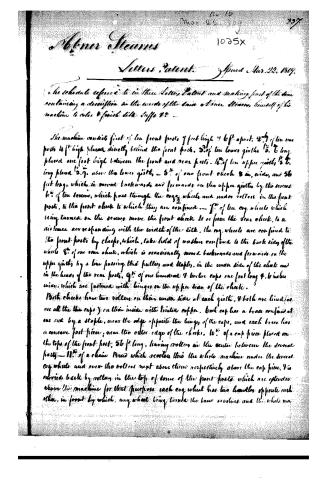
The schedule referred to in these Letters Patent and making part of the same containing a description in the words of the said Albany Steamer, himself of his machine to color & finish silk stuffs &c.
The machine consists first of two front posts 7 feet high & 6 ft. apart. 2-7/8 of two rear posts 4 ft. high placed directly behind the front posts. 3 of two lower girths 15 ft. long placed one foot high between the front and rear posts. 12 of two upper girths 15 ft. long placed 2-7/8 above the lower girths. 5 of one front check 8 in. wide, and 56 feet long, which is moved backwards and forwards on the upper girths by the screws 16 of two screws, which pass through the cog wheels and under rollers in the front posts, to the front check to which they are confined. 7 of the cog wheels which being turned on the screws move the front check 8 or from the rear check, to a distance corresponding with the width of the silk, the cog wheels are confined to the front posts by cleats, which take hold of washers confined to the back side of the wheels 8 of one rear check, which is occasionally moved backwards and forwards on the upper girths by a line passing through pulleys and staples, in the under side of the check and in the heads of the rear posts. 9 of one humoral & twelve caps one foot long & 16 inches wide, which are fastened with hinges on the upper side of the check.
Both checks have two rollers on their under side at each girth. 9 both are lined (as are all the caps) on their inside with jointed paper. Each cap has a brace confined at one end by a staple, near the edge opposite the hinge of the caps, and each brace has a concave foot piece, near the outer edge of the checks. 10 of a cap piece placed on the tops of the front posts, 56 ft. long, leaving rollers in the center between the several parts. 11 of a chain band which revolves through the whole machine under the several cog wheels and over the rollers next above them respectively above the cap piece. 9 is carried back by rollers in the top of some of the front posts which are extended above the machine for that purpose each cog wheel has two handles opposite each other, in front by which, any wheel being turned the band revolves and the whole ma
Page 3.
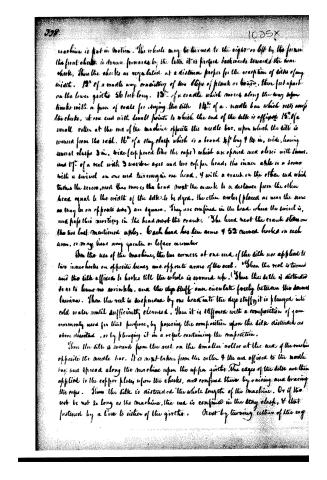
machine is put in motion. The wheels may be turned to the right or left by the frame; the front checks is drawn forwards by the latter it is forced backwards towards the rear checks. Thus the checks are regulated at a distance proper for the reception of silks of any width. 13" of a cradle way consisting of two lips of plank or brass, three feet apart on the lower girdle 56 feet long. 13" of a cradle which moves along the way upon trucks with a pair of scales for trying the silk. 11½" of a needle bar which rests upon the checks, at one end with small points to which the end of the silk is affixed. 15" of a small roller at the end of the machine opposite the needle bar, upon which the silk is wound from the reel. 16" of a stay clamp which is a board 4½' long 4 ft. in. wide, having several clasps 3 in. wide (opened like the caps) which are opened and closed with levers. and 17" of a reel with 3 wooden axes and two copper heads, the inner axle is a screw with a swivel on one end turning in one head, 4 with a crank on the other end which turns the screw, and thus moves the head next the crank to a distance from the other head equal to the width of the silk to be dyed. The other axles (placed as near the screw as may be on opposite sides) are square. They are confined in the head where the swivel is, and pass this mortices in the head next the crank. The head next the crank slides on the two last mentioned axles. Each head has ten arms & 52 curved hooks on each arm, or may have any greater or lesser number.
In the use of the machine, the two corners at one end of the silk are applied to two inner hooks on opposite heads and opposite arms of the reel. Then the reel is turned and the silk affixed to hooks till the whole is wound up. Thus the silk is distended so as to have no wrinkles, and the dye stuff can circulate freely between the several laminae. Then the reel is suspended by one head into the dye stuff, it is plunged into cold water until sufficiently cleansed. Then it is stiffened with a composition of gum commonly used for that purpose, by pouring the composition upon the silk distended as above directed, or by plunging it in a vessel containing the composition.
Then the silk is wound from the reel on the smaller roller at the end of the machine opposite the needle bar. It is next taken from the roller & the end affixed to the needle bar and spread along the machine upon the upper girdle. The edges of the silk are then applied to the copper plates upon the checks, and confined there by raising and bracing the caps. Thus the silk is distended the whole length of the machine. Or if the web be not so long as the machine, the end is confined in the stay clamp, & that fastened by a line to either of the girdles. Next by turning either of the cog
Page 4.
102.5x
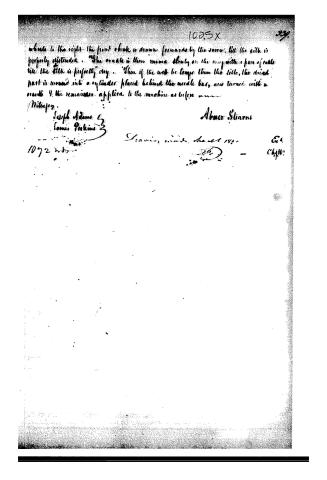
where is the right—the front cheek is drawn forwards by the screw, till the silk is properly distended. “She cradle is then moved slowly on the way with a pan of cable till the silk is perfectly dry. “Then if the web be longer than the silk, the dried part is wound into a cylinder placed behind the needle bars, and turned with a crank. 4. the remainder applied to the machine as before.
Nithupay.
Joseph Adams 6
James Perkins 3
Abner Starns
1072 no.
Sealing, mld. March 1860.
Ex.
CHIN:
About this record
- Patentee
- DATAMP
- Date
- the Name and Date index of patents, DATAMP, USPTO records
- Invention
- DATAMP
- Listed in
- the Name and Date index of patents, DATAMP, USPTO records, Jim Shaw's X-patent list, S. A. Elliot's printed list of patents, Burke's List of Patents (1847)
- S. A. Elliot's printed list of patents gives the same name and date.
- Burke's 1847 Patent Office list gives the same patent.