

Drawings and documents
USPTO scan
The patent as scanned by the USPTO
-
 Page 1
-
 Page 2
-
 Page 3
-
 Page 4
-
 Page 5
-
 Page 6


U.S. Patent and Trademark Office · Google Patents
Show the transcription Hide (2,244 words)
Machine transcription (LightOnOCR) of the pages as scanned by the USPTO, most of them the handwritten copies made when the records were restored after the 1836 fire. Not checked; it can misread handwriting, so compare it with the scan.
Page 2.
United States Patent
Patent No.: X1038
Samuel Parker
Letter Patent
April 9, 1868.
The Schedule referred to in these Letters Patent making part of the same, containing a description in the words of the said Samuel Parker himself, of his mode of carrying and finishing leather of all kinds — —
This consists in extending, smoothing, consolidating, splitting, scarring, cutting, cramping, oiling, stuffing, stamping, or printing, blacking, sizing, slicking, straining, polishing, glazing or finishing — which is performed by a machine or machines contained in a frame; the size of which may be according to the work. That is to say, if whole hides are intended to be done at one operation, in each part of the finishing, the frame of the machine must be as wide as the hide and the rollers or nuts, and all the parts of the machine; must be proportioned to the size of the frame, but, the whole work may be performed equally as well, by a frame six feet wide and six and half high in the clear by making the ends of the rollers or nuts and beam smaller; to admit the outer sides of the skin to be doubled while the single part only passes between the rollers and nuts and beam — repeating the same and performing a part at a time. The frame if larger or smaller will alter the proportion only not the construction or principle of the machine. Which consist principally of a certain number of rollers, to perform the different parts of the work; all at the same time, placed in different parts, and although an horizontal position hath been preserved, it is not a matter of consequence; as the rollers may be placed in any position or number, the constructor pleases, that will perform the work. The different sets of rollers, are for different work, and may generally be placed as the first. The number proportion and movement being nearly the same. Two large and one small, the small one in the centre, placed horizontally, to be from one to two thirds less than the large; to have a cog wheel on the outside of one end of each roller of equal size, or one on the centre roller; on the inside and next to the part, of the same size, or larger — which will make the large rollers turn an equal or greater number of times with the small, which motion performs a sliding slicking abstraction. H. 1:1 + 1:1 “
Page 3.
United States Patent
Patent No.: X1038
to extend smooth, consolidate, and slick the skins or hides, after being properly prepared, which operation fits or prepares them for splitting. The second set of rollers or nuts are intended for scouring and washing skins or hides. The nuts or rollers may be placed in a circular form the small. Three or more placed round it, one under and two at the side of the under and centre all having a proper bearing on the centre one, forming half-circle and one placed above the centre, which are enclosed in a cistern. They may also be placed in a circle having one placed in the centre then two or more courses round it: to have a proper bearing on each other. And to one or more of the nuts or rollers may be attached slickers, or scrapers brush or brushes, or some of the rollers may be fluted or any other article. The operator may choose to substitute by de-lacking the slickers scrapers brushes, and so forth from the above, the principle may be applied to the washing of linen, woolen, or any other pliable substance. The ends of the rollers may turn on trundles or small rollers or multiplying wheels, or being capped the ends of the rollers with steel or other metal or hard points may turn in sockets of any suitable metal all of which would reduce the friction of necessary. The third set of rollers or nuts are to receive the articles from the cistern and are to be furnished with slickers or scrapers, to strike the leather dry. There will be also a brush, moving from side to side of the skin or hide, with a quick alternate motion to cleanse and loosen the same the skins or leather having passed through the last process, is then cut into gaiters for men, women, or children, and are cut in one entire piece or two pieces except the soles, the same to be cramped on a boot tree, made for that particular purpose either of wood or iron or any substance suitable for the purpose with a joint in the foot or instep in such a manner, as that the toe instep or foot shall drop or turn downward until the leg is placed on the tree and tacked at the heel and the tree brought to its proper place again. Or there may be a joint in the ankle the foot split in two parts and turn up each way, or it may be done by the leg and foot being in two parts, or it may be done by a movable piece or pieces of wood, iron or any other substance suitable placed at the heel and running each or either way, stretched by screws, keys, axes or wedges after the leather is tacked thereto, being thus placed smooth on the boot tree remain in that
Page 4.
United States Patent
Patent No.: X1038
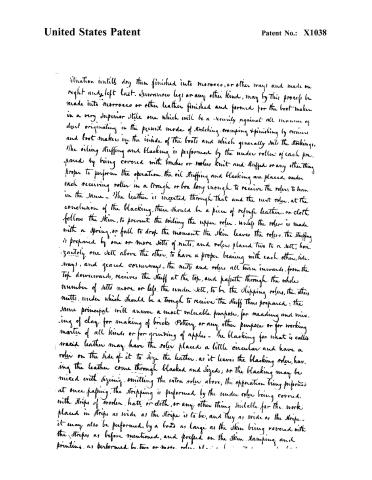
*ilitation until dry then finished into morocco, or other ways and made on right and left last. Unknown legs or any other kind, may by this process be made into morocco or other leather finished and formed for the boot-maker in a very superior style one which will be a security against all manner of dust originating in the present mode of stretching, cramping & finishing by criers and boot-makers in the inside of the boots and which generally soils the stockings. The oiling, stuffing and blacking is performed by the under rollers of each prepared by being covered with brushes or rollers knit and dipped or any other thing proper to perform the operation. The oil, stuffing and blacking are placed under each receiving roller in a trough or box long enough to receive the rollers to turn in the same. The leather is inserted through that and the next roller, at the conclusion of the blacking, there should be a piece of refuse leather, or cloth follow the skin, to prevent the soiling the upper roller. Unless the roller is made with a spring, or fail to drop the moment the skin leaves the rollers. The stuffing is prepared by one or more sets of nuts, and rollers placed two to a set, horizontally, one set above the other, to have a proper bearing with each other, sideways, and geared cornerways. The nuts and rollers all turn inwards, from the top downwards, receives the stuff at the top, and passes through the whole number of sets more or less, the under set, to be the slipping rollers, the others nuts, under which should be a trough to receive the stuff thus prepared: the same principal will answer a most valuable purpose, for making and mixing of clay, for making of bricks, pottery or any other purpose or for working matter of all kinds, or for grinding of apples. The blacking for what is called waxed leather may have the roller placed a little circular and have a roller on the side of it to size the leather, as it leaves the blacking roller, having the leather come through blacked and sized; or the blacking may be mixed with sizing, omitting the extra roller above, the operation being performed at once passing. The stripping is performed by the under roller being covered with strips of woolen, hait, or cloth, or any other thing suitable for the work placed in strips as wide as the stripe is to be, and they as wide as the stripe. It may also be performed, by a board as large as the skin being covered with the stripes as before mentioned, and pressed on the skin stamping and printing, as performed by two or more rollers.
Page 5.
United States Patent
Patent No.: X1038
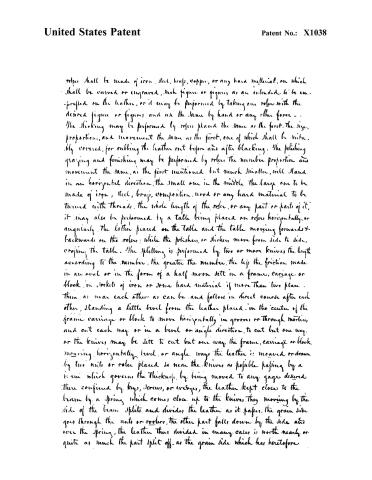
rolls shall be made of iron, steel, brass, copper, or any hard material, on which shall be carved or engraved, such figure or figures as are intended to be imprinted on the leather, or it may be performed by taking one roller with the desired figure or figures and use the same by hand or any other force. The sticking may be performed by rollers placed the same as the first, the size, proportion, and movement the same as the first, one of which shall be suitably covered, for rubbing the leather out before and after blacking. The polishing, graying and finishing may be performed by rollers, the number proportion and movement the same, as the first mentioned but much smaller, will stand in an horizontal direction, the small one in the middle, the large one to be made of iron, steel, brass, composition, wood or any hard material to be turned with threads, the whole length of the roller, or any part or parts of it; it may also be performed by a table being placed on rollers horizontally or angularly, the leather placed on the table and the table moving forwards & backwards on the rollers; while the polishers, or stickers move from side to side, crossing the table. The splitting is performed by two or more knives, the length according to the number, the greater the number, the less the friction made in an oval or in the form of a half moon set in a frame, carriage or block, in sockets of iron or some hard material if more than two places. Then as near each other as can be, and follow in direct course after each other, standing a little level from the leather placed in the center of the frame, carriage or block to move horizontally in grooves or through mortices and cut each way or in a level or angle direction, to cut but one way or the knives may be set to cut but one way, the frame, carriage or block moving horizontally, level, or angle ways the leather is moved or drawn by two nuts or rollers placed so near the knives as possible passing by a beam which governs the thickness, by being moved to any gage desired then confined by keys, screws, or wedges, the leather kept close to the beam by a spring which comes close up to the knives, they moving by the side of the beam splits and divides the leather as it passes, the grain side goes through the nuts or rollers, the other part falls down by the side and over the spring, the leather thus divided in many cases is worth nearly or quite as much the part split off as the grain side which has heretofore
Page 6.
United States Patent
Patent No.: X1038
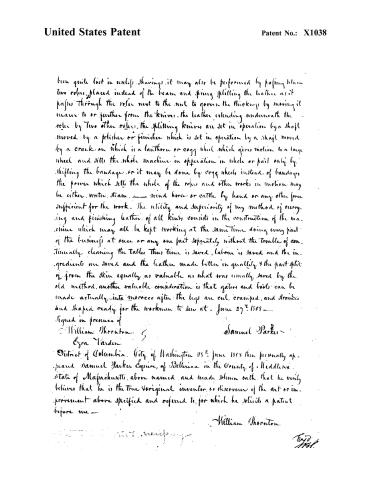
been quite lost in useless shavings, it may also be performed by passing between two rollers, placed instead of the beam and spring splitting the leather as it passes through the roller next to the nut to govern the thickness by moving it nearer to or further from the knives, the leather extending underneath the roller by two other rollers, the splitting knives are set in operation by a shaft moved by a polisher or finisher which is set in operation by a shaft moved by a crank on which is a lantern or cog wheel which gives motion to a large wheel and sets the whole machine in operation in whole or part only by shifting the bandage, or it may be done by cog wheels instead of bandages, the power which sets the whole of the rollers and other works in motion may be either water, steam, wind, horse or cattle by hand or any other force sufficient for the work. The utility and superiority of my method of curing and finishing leather of all kinds consists in the construction of the machine which may all be kept working at the same time doing every part of the business at once or any one part separately without the trouble of continually cleaning the tables, thus time is saved, labor is saved and the ingredients are saved and the leather made better in quality & the part split off from the skin equally as valuable as what was usually saved by the old method, another valuable consideration is that gaiters and boots can be made actually into morocco after the legs are cut, crimped, and strained and shaped ready for the workmen to sew at. June 27th 1808.
Signed in presence of
William Thornton
Ezra Tarden
Samuel Parker
District of Columbia. City of Washington 28th June 1808 then personally appeared Samuel Parker Esquire, of Bellinca in the County of Middlesex State of Massachusetts, above named, and made solemn oath that he verily believes that he is the true original inventor or discoverer of the art or improvement above specified and referred to, for which he solicits a patent before me.
William Thornton
End
DATAMP: illustration
Illustrations from DATAMP

DATAMP (Directory of American Tool and Machinery Patents), via the Internet Archive · Archived DATAMP page
About this record
- Patentee
- DATAMP
- Date
- the Name and Date index of patents, DATAMP, USPTO records
- Invention
- DATAMP
- Listed in
- the Name and Date index of patents, DATAMP, USPTO records, Jim Shaw's X-patent list, S. A. Elliot's printed list of patents, Burke's List of Patents (1847)
- S. A. Elliot's printed list of patents gives the same name and date.
- Burke's 1847 Patent Office list gives the same patent.