

Drawings and documents
USPTO scan
The patent as scanned by the USPTO
-
 Page 1
-
 Page 2
-
 Page 3


U.S. Patent and Trademark Office · Google Patents
Show the transcription Hide (571 words)
Machine transcription (LightOnOCR) of the pages as scanned by the USPTO, most of them the handwritten copies made when the records were restored after the 1836 fire. Not checked; it can misread handwriting, so compare it with the scan.
Page 2.
United States Patent
Patent No.: X1125
Israel Hillyer — Patentee
Letters Patent
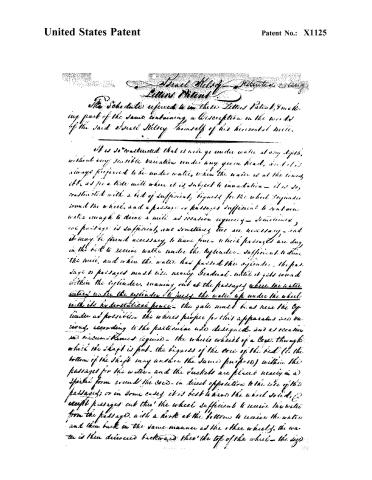
The Schedule referred to in these Letters Patent, making part of the same containing a Description in the words of the said Israel Hillyer himself of his horizontal mill.
It is so constructed that it will go under water at any depth, without any sensible variation under any given head, and it is always preferred to be under water, when the water is at the lowest, etc., as for a tide mill where it is subject to inundation — it is so constructed with a bed of sufficient height for the wheel to remain round the wheel, and a passage or passages sufficient to contain water enough to drive a mill as occasion requires — sometimes one passage is sufficient, and sometimes two are necessary — and it may be found necessary to have four — which passages are dug in the bed to receive water under the cylinder — sufficient to drive the mill, and when the water has passed the cylinder — the passage or passages must rise nearly gradual — until it gets round within the cylinder, running out at the passage where the water enters under the cylinder to push the water up under the wheel with its hydrostatical force — the gate must be as near the cylinder as possible — the wheels proper for this apparatus are various, according to the particular use designed, and as occasion and circumstances require — the wheel consist of a cone, through which the shaft is put — the bigness of the cone of the bed (to the bottom of the shaft may answer the same purpose) within the passages for the water — and the buckets are placed nearly in a spiral form round the cone — in direct opposition to the rise of the passage; or in some cases it is best to have the wheel solid, except passages cut thru’ the wheel sufficient to receive the water from the passage, with a hook at the bottom to receive the water and then back in the same manner as the other wheel — the water is then delivered backward thru’ the top of the wheel — the sign
Page 3.
United States Patent
Patent No.: X1125
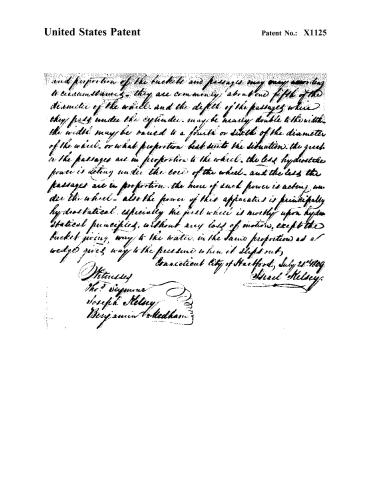
and proportion of the buckets and passages may vary according to circumstances. They are commonly about one fifth of the diameter of the wheel, and the depth of the passages where they pass under the cylinder may be nearly double the width. The width may be varied to a fourth or sixth of the diameter of the wheel, or what proportion best suits the situation. The greater the passages are in proportion to the wheel, the less hydrostatic power is acting under the core of the wheel, and the less the passages are in proportion, the more of such power is acting under the wheel. Also the power of this apparatus is principally hydrostatical, especially the first wheel is mostly upon hydrostatical principles, without any loss of motion, except the bucket giving way to the water, in the same proportion as a wedge gives way to the pressure when it slips out.
Inancient City of Hartford, July 21st, 1809
Joseph Halsey
Witnesses
Thos. Seymour
Joseph Halsey
Benjamin Vedderham
About this record
- Patentee
- DATAMP
- Date
- the Name and Date index of patents, DATAMP, USPTO records
- Invention
- DATAMP
- Listed in
- the Name and Date index of patents, DATAMP, USPTO records, Jim Shaw's X-patent list, S. A. Elliot's printed list of patents, Burke's List of Patents (1847)
- S. A. Elliot's printed list of patents gives the same name and date.
- Burke's 1847 Patent Office list gives the same patent.