

Drawings and documents
USPTO scan
The patent as scanned by the USPTO
-
 Page 1
-
 Page 2
-
 Page 3
-
 Page 4


U.S. Patent and Trademark Office · Google Patents
Show the transcription Hide (1,197 words)
Machine transcription (LightOnOCR) of the pages as scanned by the USPTO, most of them the handwritten copies made when the records were restored after the 1836 fire. Not checked; it can misread handwriting, so compare it with the scan.
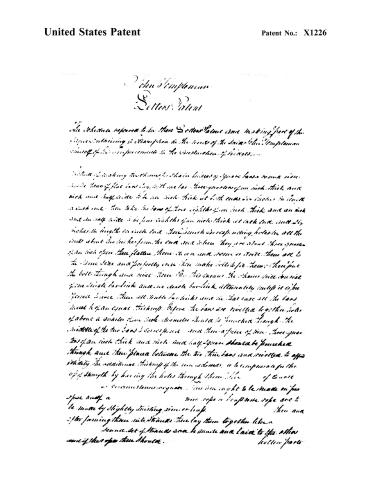
Page 2.
United States Patent
Patent No.: X1226
John Templeman
Letters Patent
The invention referred to in these Letters Patent is one making part of the figures containing a description in the name of the said John Templeman himself of his improvements in the construction of bridges.
In making the chains for chain bridges, you have some iron rods, three quarters of an inch thick and one inch wide, with one bar three quarters of an inch thick and one inch wide. Take the bars of iron eightths of an inch thick and an inch wide, and lay them flat. Then punch corresponding holes in all the bars about three inches from the end, and when they are about three quarters of an inch open, then flatten them, then iron and drive them all to the same size and perfectly even. You make bolts to fit them; then put the bolt through and over them. By this means, the chains will consist of one single bar-link and one double bar-link ultimately, and if you prefer, you have them all double bar-links and in that case all the bars must be of an equal thickness. Before the bars are riveted together, holes of about a quarter of an inch diameter should be punched through the middle of the two bars to correspond, and then a piece of iron three quarters of an inch thick and one inch wide and half an inch long should be punched through and then placed between the two thin bars and riveted to oppose the additional thickness of the iron at those points, to compensate for the loss of strength by having the holes through them. All of course are circumstances required. This iron ought to be made of fine rope and a fine rope or braided rope are to be made by slightly twisting iron or rope. Then and after forming these into strands, then lay them together like a second set of strands can be made and laid to the other and if that rope then should be hollow parts.
Page 3.
United States Patent
Patent No.: X1226
...of any improvements in the construction of Bridges by these improved chains and... I have reference to the attached drawings by which I shall be enabled to understand the invention as by cast iron into a steel rod. These iron rods are the other mentioned chains are then... and perfectly... the may be formed by laying rods... and having... that may be a sufficient height... and then putting... to the plank and... But the best way is to make... there is more... of the... having... to have each section... with the rest... of timber... in the... that... chains... the... just... to be left long enough to... the... purpose of support to the... and the... which... connects... together with... joints... These... have... means of... to... in... some degree... corresponding with the... of the... chains... and... the... of any... improvements... to the... construction of Bridges... which... will be cheap and... for... of one... and... feet in length... without any... from chains... or... rods... which... are... set... on the... and... from the top of the... some... flat... but... to... a... day... take... plank... of... iron... thick... and... the... inches... wide... These... bars... are to be of various lengths and to be connected with the... of the... Bridge in a... manner by... to... large... timber... by... adding... middle... up... right... lines... the... lot of... can be... and... when the... is... of... rods... are to be... about... the... inches... and... the... big... enough... to... receive a... lot of... in... diameter... and... then... on both sides of the... plank... at the... ends... of... plates of... of... about... half an... inch... thick... and... to... feet... long... to give... strength to the... where the... go... the... iron... and... iron... bars... above... described... I apply to... chains... for the... purpose of... supporting... and... to the... floor... as... well as... additional... strength to the... support of... iron... bars... as... for the... support of an old bridge... my... improvement is to have a... lot of... iron... chains... and... made... with... iron... plates... on the... and... with... iron... through... them... and to be put together like the... above... mentioned... flat... iron... chain... In... such... case the... must be of a... to... meet the... degree... of... strain... required... Another of my... improvements... applicable to... bars...
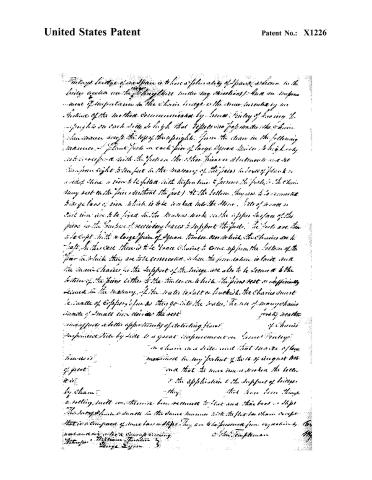
Page 4.
United States Patent
Patent No.: X1226
The bridge of one span is to have a plurality of spans, wherein in the bridge spans are the lengthwise under my direction. And an improvement of importance in the chain bridge is the same invention by me. Instead of the method communicated by Lewis Tinsley of having the uprights on each side so high that ropes are fastened to the chain, the chains are only the top of the uprights. From the chain in the following manner: A plank fast on each side of large square timber so high only as to correspond with the fasten the other chains or attachments and set the span right to the feet in the masonry of the piers in layers of plank or a solid stone, so now to be filled with timbering & pressure the fasten the chain may rest on the pier without the feet. At the bottom they are to be connected by large bars of iron which is to be worked into the stone. Bars of iron so set in are to be fixed to the masonry work on the upper surface of the piers in the manner of receiving braces to support the piers. The feet are then to be set with a large piece of square timber on which the chains are to rest. In this case there is to be space chains to come up from the bottom of the pier in which they are to be connected, when the foundation is laid and the main chains in the support of the bridge are also to be secured to the bottom of the piers either to the timber on which the piers rest or sufficiently secured in the masonry. If the water is salt or brackish, the chains must be made of copper, so far as they go into the water. The use of many chains instead of small iron divides the rest.
...provides a better opportunity of detecting flaws.
...improvement made by Tinsley is a great improvement on Lewis Tinsley.
...in chains on a side, and that more of the movement in my patent of the 16 of August 1808 and that the more iron is worked the better.
...the application to the support of bridges, they that have been things a rolling, such as timber, iron, etc., to fast and that bars or slips the top of chains is made in the same manner with the flat bar chain except that it is composed of small bars or slips. They are to be preserved from oxidation by...
...William Tinsley
George Lyon
3
...by
...Tinsley
About this record
- Patentee
- Jim Shaw's X-patent list
- Date
- the Name and Date index of patents, USPTO records, Jim Shaw's X-patent list
- Invention
- the Name and Date index of patents
- Listed in
- the Name and Date index of patents, USPTO records, Jim Shaw's X-patent list, S. A. Elliot's printed list of patents, Burke's List of Patents (1847)
- S. A. Elliot's printed list of patents gives the same name and date.
- Burke's 1847 Patent Office list gives the same patent.