

Drawings and documents
USPTO scan
The patent as scanned by the USPTO
-
 Page 1
-
 Page 2
-
 Page 3


U.S. Patent and Trademark Office · Google Patents
Show the transcription Hide (983 words)
Machine transcription (LightOnOCR) of the pages as scanned by the USPTO, most of them the handwritten copies made when the records were restored after the 1836 fire. Not checked; it can misread handwriting, so compare it with the scan.
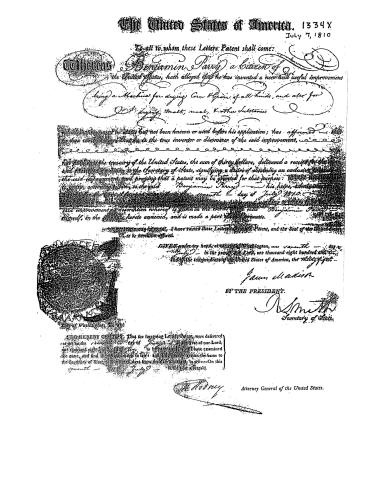
Page 1.
The United States of America. 1334X
July 7, 1810
To all to whom these Letters Patent shall come:
Know all men by these presents, that Benjamin Parry, a citizen of the United States, hath alleged that he has invented a new and useful improvement being a Machine for drying Corn & Grain of all kinds, and also for drying malt, meal, & other substances.
This improvement he states has not been known or used before his application; has affirmed that he does truly believe that he is the true inventor or discoverer of the said improvement, has paid into the treasury of the United States, the sum of thirty dollars, delivered a receipt for the same, and presented a petition to the Secretary of State, signifying a desire of obtaining an exclusive privilege for the said improvement, and praying that a patent may be granted for that purpose.
In witness whereof, I have caused these Letters Patent to be made, and the Seal of the United States to be hereunto affixed.
Given under my hand, at the City of Washington, this seventh day of July, in the year of our Lord, one thousand eight hundred and ten, and of the Independence of the United States of America, the thirty-fifth.
James Madison
BY THE PRESIDENT.
A. Smith
Secretary of State
I DO HEREBY CERTIFY, That the foregoing Letters Patent were delivered to me on the 22nd day of June, in the year of our Lord, one thousand eight hundred and ten, to be examined, and I have examined the same, and find them susceptible to law; and have thereupon returned the same to the Secretary of State, within fifteen days from the date aforesaid, to wit: On this seventh day of July, in the year aforesaid.
J. Rodney
Attorney General of the United States.
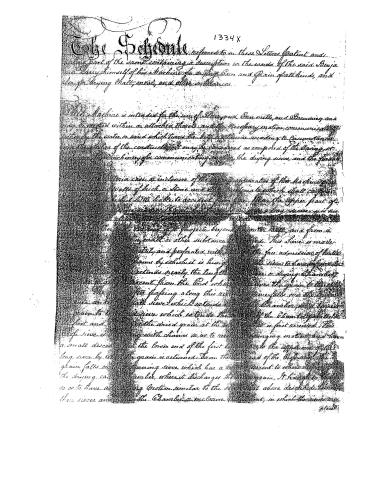
Page 2.
1334X
Case Schedule
referred to in these Letters patent and making part of the same containing a description in the words of the said Benjamin Barry himself of his machine for drying Corn and Grain of all kinds, and also for drying Malt, meal, and other substances.
This Machine is intended for the use of Flour and Corn mills, and Breweries, and may be erected within or attached thereto, and the necessary motion communicated to it by the water or wind which turns the belt, or otherwise according to circumstances. In the nature of the construction it may be considered as composed of the Drying or Drying Chamber, the machinery for communicating motion to the drying sieve, and the grain
The Drying case or enclosure of the drying apparatus of this Machine may be composed of walls of brick or stone, and may be of such a height as shall contain the grain to be dried. It is little likely to exceed four feet. Near the upper part of the case is an opening or aperture, which is covered by a long screen or gridiron, which is hinged at one end, and is supported by a rod or bar, which is attached to the top of the case. The screen is made of metal or other substance, and is perforated with holes for the free admission of heat. The screen is hinged by which it is hinged to the case to have a swinging motion. The screen extends nearly the length of the case or drying chamber, and is so positioned from the end which is near the grain to the other end. The grain is fed along this area by a conveyor over the upper surface of the screen, which extends into the chamber and comes to the grain to the end where which extends the length of the chamber parallel to the first and discharges the dried grain at the end which is first received. This first sieve is connected with chains so as to receive a swinging motion, and has a small discharge at the lower end of the first long sieve to the upper end of the long sieve by which the grain is returned from the lower end of the first sieve, the grain falls on the remaining sieve which has a similar descent to where the grain falls on the drying case or chamber, where it discharges the dried grain. It hangs in the so as to have a swinging motion similar to the first part above described. Beneath these sieves are placed the Chamber or enclosure for the heat, in which the sieves are placed.
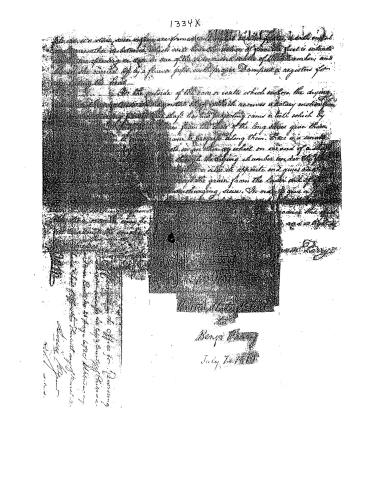
Page 3.
1334X
The case is a strong, iron, or other substance, which will bear the weight of grain, the floor is entered by an opening or door in one of the sides, and inside of the chamber, and the inside covered off by a floor or grate, with proper dampers or regulators for regulating the heat.
On the outside of the case or earth, which makes the drying, is a shaft, and a separate shaft, which receives a rotary motion from a horse or other power. This shaft has two projecting cams or teeth which by their motion, as they pass from the ends of the long bars, give them a motion to cause the grain to leap up along them. There is a small hopper or box, with an opening, on one end of a shaft, which is connected with the shaft, the drying chamber, under the floor, and the shaft is provided with an appropriate end, and gives an outlet to the grain from the lower end of the shaft, into a receiving, or discharging, area. In order to give a proper draft of air, the air is drawn in by a fan or other means, and the …
About this record
- Patentee
- DATAMP
- Date
- the Name and Date index of patents, DATAMP, USPTO records
- Invention
- DATAMP
- Listed in
- the Name and Date index of patents, DATAMP, USPTO records, Jim Shaw's X-patent list, S. A. Elliot's printed list of patents, Burke's List of Patents (1847)
- S. A. Elliot's printed list of patents gives the same name and date.
- Burke's 1847 Patent Office list gives the same patent.