

Drawings and documents
National Archives restored drawings: drawing
Phinehas Dow's Patent Drawing for a Leather Splitting Machine

National Archives, Restored Patent Drawings (Record Group 241) · Full-size scan at the National Archives · Catalog record
Show the text on the drawing Hide (133 words)
Words on the drawing as machine-read by the National Archives; not checked. Useful mainly for searching.
69. LEATHER. / Isso / [92] Splitting / 89, LEATTER. / [s2] Specifica / Phinchas Dow / CLASSIFICATION / 1336 X / DIVISION. / Leather splitting Machine. / Val.2. 47s. / Patented July is th 1810 / d. / sty.i. / 10000 / When knife cartn of ciglinder / Knibe Wedges. request el to lower cyle der as Gether may requin by / Aiy.2. / oiR / al / Preferences. Jij i. Lection Sig. 2 Topoien. / a.a. heads of cylindu. 6. axis. e permanent roller. d.d wedges to regulate the knife. / l.top i. roller. roller. of roller k. with what. spiral I. grooor g vibrating lever. h spreader Putent offier April igth 1845. / n upper roller. o knife. / conical the pinion m. connecting 20ad. mark under the direction of the Commision / of Patents in leon formity with actof March 1857 / Commitioner of Patents
USPTO scan
The patent as scanned by the USPTO
-
 Page 1
-
 Page 2
-
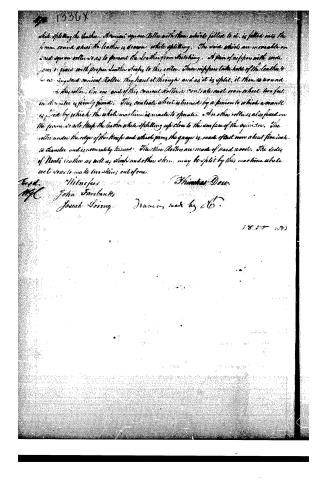 Page 3


U.S. Patent and Trademark Office · Google Patents
Show the transcription Hide (587 words)
Machine transcription (LightOnOCR) of the pages as scanned by the USPTO, most of them the handwritten copies made when the records were restored after the 1836 fire. Not checked; it can misread handwriting, so compare it with the scan.
Page 1.
No Printed Specification Available
1336X
P. Don,
Splitting Leather,
Patented July 12, 18.
Fig. 1.
Fig. 2.
Page 2.
1336 X
Thimble Dow
Letters Patent
July 12, 1810
The Schottel referred to in these Letters Patent and making part of the same containing a description in the words of the said Thimble Dow himself of his cylindrical Leather Splitting Mill.
The invention of the improvement called the "Cylindrical Leather Splitting Mill" consists in constructing the machine with a cylinder on which the knife is fixed to split the Leather. This cylinder is made of wood with an iron or wooden axis on which it turns. The ends of the cylinder may be made of wood, or least iron about two feet or more in diameter. The knife is fixed in the circumference of this cylinder parallel with said axis, and is made to move endways by a crank which communicates with the Roller round which the Leather is drawn when it is splitting. This cylinder is fixed in a proper frame. When in operation the knife is turned over the said cylinder so as to be under the centre of it. Directly under the knife a roller is permanently fixed on the frame which serves as the guide of the Leather while splitting and is made to fit the edge of the knife so as to allow half the thickness of the Leather to pass between it and the edge of the knife. The knife is regulated to this roller according as the Leather may require by tongues on the top of the boxes of the pivots of said cylinder axes. Above the edge of said knife another roller is fixed in said cylinder with springs on its pivots in the ends of said cylinder, so as to press said Roller down close to the edge of said knife and keep the Leather also pressed upon said Roller under the edge of said knife. The cylinder has only a quarter section of its circumference; the other part is left open. To this quarter section the knife is fixed and the machinery for giving motion to the knife. This motion to the knife is produced by a roller put into said cylinder with an oblique or spiral groove. A lever fixed in the cylinder so as to move said knife end ways is operated upon by said spiral groove, and is rotated one way and the other by a crank on said Roller to which crank an arm is fixed which communicates with the primary motion of the machine. Back of the knife is constructed a spreader which is made of wood splitting together like jaws having notches cut in them obliquely each way so as to spread the Leather as it is drawn in while splitting. The under jaw is on the frame; the upper is on the cylinder. When the Leather is to be put in the said cylinder is turned endwise to bring the knife upwards, or at the top of the cylinder which lies horizontally in which position it is easily taken out and sharpened and put in again. Two stopping notches are fixed to the end of the cylinder so as to allow the edge of the knife to come to its proper place and then to be kept firmly.
About this record
- Patentee
- DATAMP
- Date
- the Name and Date index of patents, DATAMP, USPTO records
- Invention
- DATAMP
- Listed in
- the Name and Date index of patents, DATAMP, USPTO records, Jim Shaw's X-patent list, S. A. Elliot's printed list of patents, Burke's List of Patents (1847)
- S. A. Elliot's printed list of patents gives the same name and date.
- Burke's 1847 Patent Office list gives the same patent.