

Drawings and documents
National Archives restored drawings: drawing
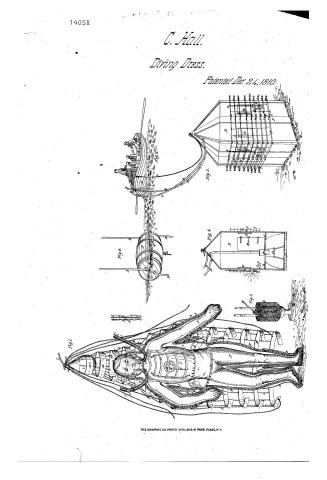
Chauncey Hall's Patent Drawing for a Diving Dress

National Archives, Restored Patent Drawings (Record Group 241) · Full-size scan at the National Archives · Catalog record
Show the text on the drawing Hide (365 words)
Words on the drawing as machine-read by the National Archives; not checked. Useful mainly for searching.
HYDRAULIC ENGINEERING / 82] Diving Armor / $4 / CLASS. ICATION / 1405X / CHAUNCY HALL. / DIVISION. / Eight, Diving Drep toworkin company with / Diving DUI / a boat / Patented Dec: 24.1810 Vol: 2. page 437 / Fight Transverse section of Diving drep / 2] Diving Armor / Egl / b,b, tur glapes, spectacles / a,a,a, Cap made of oil cloth & stiff bather / HYDRAULIC ENGINEERING. ENGIN EERING. / C,C, band of copper / dd, stiff bow / crofs bars. / A,A, dreps frock / I oil cloth / g, stout oil cloth ortarpotin / h, soft leather well stuffed with oil / f.g, h, stiched or quilted together at / B,B, tubes of cloth / Eight / 1114 rings tubes B,B, / C,C,C,,, screws for tubes B, / Fig.2., D boat / C, pipe of a double bellows, / B', tube open to the / E' pantaloons (Pigt) / G, half of a stout screw. / H, tube / K, chain / l, vest / 1, plate of copper to fastened at / the back with straps se buckles. / m,m, ac, small staples / n,n, se, stoul bows crofs bars. / J copyur hoop with staples / 0,0, 0,0, two rows of strapes on pantatoons / 13/2, QCI four rows of strapes dry / (Figi3 K, lanye / righ / Eig:5 / y were net / r, weights / L, rope (Fig:l) / M,M, Sec: Copper hoops with spikes / S,S, Oct links, or chains / N,N, Copper boots with joints / P, buckskin pantatoons / / glove air / и,и, blocks cords / Figh / Figh. A. hegshead / Rx / BB, copper tubes / l, planks / D, staple rope. / Figs: 546 E, Box / %, bars of iron / v,v,v,v,se staples erring bolts / w, glass / were netting / y,y, ye, hoops iron / B,B, capper tubes / G.G, seats / If H. shutters / I sliding shutter / I, weights / Note A drefs the to work alone, made like the above excipt instead of the / atent Office / H.K. lanyes / tubes / extending / to / boat & / bellows / they / fast / stout / coppertubes / B.B.) / Li, brafs cook / Eig.4.) and a pair of bellows to betaken under right arm for circulating / Nee 11th 1845 / M store / N, No door, door, / made under the direction of the Commissioner of Patents / in conformity with the act of 32 of march 1837- / August Deli / Elmind Durke / Commissioner of Patents,
USPTO scan
The patent as scanned by the USPTO
-
 Page 1
-
 Page 2
-
 Page 3
-
 Page 4
-
 Page 5
-
 Page 6


U.S. Patent and Trademark Office · Google Patents
Show the transcription Hide (2,623 words)
Machine transcription (LightOnOCR) of the pages as scanned by the USPTO, most of them the handwritten copies made when the records were restored after the 1836 fire. Not checked; it can misread handwriting, so compare it with the scan.
Page 1.
1405X
C. Hall.
Diving Dress.
Patented Dec. 24, 1810.
Fig. 1.
Fig. 2.
Fig. 3.
Fig. 4.
Fig. 5.
Fig. 6.
THE GRAPHIC CO. PHOTO-LITH. 39 & 41 PARK PLACE, N.Y.
Page 2.
Dec 24 1810
Chauncey Hall
Letter Patent
1405X
The Schedule referred to in this Letters Patent including part of the same, containing a description in the words of the said Chauncey Hall himself of his diving dress — to work in company with a boat, or alone —
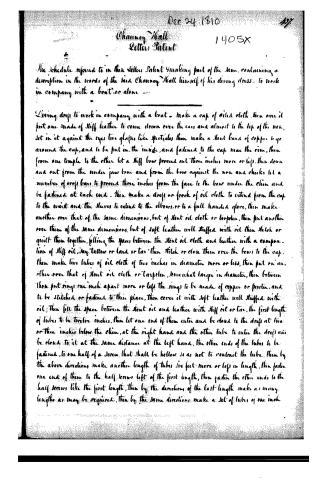
Diving dress to work in company with a boat — Make a cap of oiled cloth, then over it put one made of stiff leather to come down over the ears and almost to the tip of the nose, set in it against the eyes two glasses like spectacles, then make a stout band of copper to go around the cap, and to be put in the inside, and fastened to the cap near the rim, then from one temple to the other let a stiff bow proceed out three inches more or less, then down and out from the under jaw bone and from the bow against the nose and cheeks let a number of cross bars to proceed three inches from the face to the bone under the chin and be fastened at each end. Then make a dress or frock of oil cloth to extend from the cap to the waist and the sleeves to extend to the elbows, or to a full handed glove, then make another over that of the same dimensions, but of stout oil cloth or tarpaulin, then put another over them of the same dimensions, but of soft leather well stuffed with oil, then stitch or quilt them together, filling the space between the stout oil cloth and leather with a composition of stiff oil, tallow or lard or tar, then stitch or close them over the bows to the cap, then make two tubes of oil cloth of two inches in diameter more or less, then put on another over that of stout oil cloth or tarpaulin, somewhat larger in diameter, then between these put rings one inch apart more or less, the rings to be made of copper or pewter, and to be stitched or fastened to their place, then cover it with soft leather well stuffed with oil; then fill the space between the stout oil and leather with stiff oil or tar, the first length of tubes to be twelve inches, then let one end of them enter and be closed to the dress at two or three inches below the chin, at the right hand and the other tube to enter the dress and be closed to it at the same distance at the left hand, the other ends of the tubes to be fastened to one half of a screw, that shall be hollow so as not to contract the tube, then by the above directions make another length of tubes six feet more or less in length, then fasten one end of them to the half screw left of the first length, then fasten the other ends to the half screw, like the first length, then by the directions of the last length make as many lengths as may be required, then by the same directions make a set of tubes of one inch
Page 3.
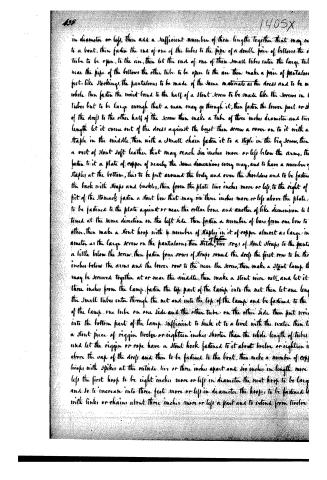
in diameter or less, then add a sufficient number of those lengths together that may equal to a boat, then fasten the end of one of the tubes to the pipe of a double pair of bellows, the other tube to be open to the air, then let the end of one of those small tubes enter the large tube near the pipe of the bellows, the other tube to be open to the air, then make a pair of pantaloons, like stockings, the pantaloons to be made of the same materials as the dress and to be in whole, then fasten the wind-bread to the half of a stout screw to be made like the screws in tubes but to be large enough that a man may go through it, then fasten the lower part or side of the dress to the other half of the screw, then make a tube of three inches diameter and ten length, let it come out of the dress against the breast, then screw a cover on to it with a staple in the middle, then with a small chain fasten it to a staple in the big screw, then a vest of stout soft leather that may reach six inches more or less below the arms, then fasten to it a plate of copper of nearly the same dimensions every way, and to have a number of staples at the bottom, this to be put around the body and over the shoulders and to be fastened the back with straps and buckles, then from the plate two inches more or less to the right of the pit of the stomach, fasten a stout bow that may six three inches more or less above the plate, to be fastened to the plate against or near the collar bone and another of like dimension to be tened at the same direction on the left side, then fasten a number of bars from one bow to another, then make a stout hoop with a number of staples in it of copper almost as large in diameter as the large screw on the pantaloons, then stitch two rows of stout straps to the pants a little below the screw, then fasten four rows of straps round the dress, the first row to be three inches below the arms and the lower row to the near the screw, then make a stout lamp, it may be sewed together at or near the middle, then make a stout wire net and let it three inches from the lamp, fasten the top part of the lamp into the net, then let one leg the small tubes enter through the net and into the top of the lamp and be fastened to the of the lamp, one tube on one side and the other tube on the other side, then put wire into the bottom part of the lamp sufficient to sink it to a level with the water, then let a stout piece of riggin, twelve or eighteen inches shorter than the whole length of tubes, and let the riggin or rope have a stout hook fastened to it about twelve or eighteen inches above the cap of the dress and then to be fastened to the boat, then make a number of copper hoops with spikes at the outside five or three inches apart and six inches in length more less, the first hoop to be eight inches more or less in diameter, the next hoop to be large and so to increase into three feet more or less in diameter, the hoops to be fastened to with links or chains about three inches more or less apart and to extend from twelve
Page 4.
eighteen inches above the cap down to the feet then make a pair of boots of copper with joints at the ankles then put on a flannel shirt without sleeves, then put on the vest, that is made of leather with the plate or copper fastened to it and have it buckled at the back then put on a pair of buckskin pantaloons with feet to them, let them come up to the vest and be fastened to the plate of copper, then put on the first named pantaloons, then fasten the large the large hoop to it with the straps that are below the screw, then screw together such length of tubes as may be required then fasten the hoop to those hoops that are chained together, then put in the top a globe of air sufficient to buoy it up, then fasten two or more blocks to the hook then put small cords through the blocks and fasten them to the lowermost hoop, then fasten two cords to the hook and fasten them to the hoop round the waist then put on the dress and screw it fast to the pantaloons, then screw of the cap, of the tube at the breast then make a bandage two or three inches in width of oil cloth and wind it three or more times around the arms above the elbows into the sleeves of the dress, then with another bandage bind the sleeves of the dress tight into the first bands above the elbows, then let down the cap and tie the first and second and the third and fourth row of straps together then put a stout pair of suspenders on the shoulders and fasten them to the hoop on the pantaloons then to fasten the two cords to the hoop then fasten bags of sand sufficient to sink the whole to the hoop, then screw on the tubes to the dress screw first that one that is fastened to the belows and let them be put in motion then screw on the other tube, then screw on the cap, to the short tube at the breast, then light the lamp and screw it to the top, then put on the boots made of copper and take a harpoon in hand and launch off, with a slack rope by it ride or sink at pleasure...
a drop to work alone to be made like the one before mentioned except instead of those tubes extending to the boat and bellows they must be made fast to stout copper tubes of ten or twelve feet in length and those copper tubes to go through a buoy and fastened to it by a hophead, and those copper tubes to go through both heads and extend six or eight feet above the hophead, then fasten the heads of the hophead tight around the tubes to be killed with balls; lay two thirds of her depth in the water, then that it may in no wise turn over fasten plank across each other, say six feet more or less in length and then fasten them to the hophead, then take a pair of bellows like hand bellows under the dress then all the straps in the dress to be let loose the bellows to be put under the right arm the clapper to be in the side towards the left hand and the pipe to be fastened into the tube on the right side then fasten the tube tight to the pipe of the bellows then instead of the small tubes extending to the top of the water to support the lamp one of them must enter the large
Page 5.
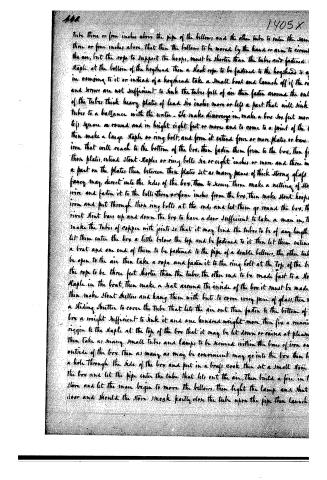
Take three or four inches above the pipe of the bellows, and the other tube to enter the same three or four inches above, that then the bellows to be moved by the hand or arm to circulate the air, but the rope to support the hoops, must be shorter than the tubes, and fastened staple at the bottom of the hophead. Then a slack rope to be fastened to the hophead is a in coming to it or instead of a hophead, take a small boat and launch off of the re and screws are not sufficient to sink the tubes full of air then fasten around the out of the tubes thick heavy plates of lead six inches more or less a part that will sink tubes to a balance with the water. To make discoveries, make a box six feet more less square or round and in height eight feet or more and to come to a point of the then make a large staple or ring bolt, and from it extend four or more plates or bars iron that will reach to the bottom of the box, then fasten them firm to the box, then fix those plates, extend stout staples or ring bolts six or eight inches or more and three in a part on the plates then between these plates set as many panes of thick strong glass fancy may direct into the sides of the box, then to secure them make a netting of thin wire and fasten it to the bolts three or four inches from the box, then make stout hoops iron and put through those ring bolts at the end, and let them go round the box, then rivet them bars up and down the box to have a door sufficient to take a man in, then make the tubes of copper with joints so that it may bend the tubes to be of any length, let them enter the box a little below the top and be fastened to it then let them extend a boat and one end of them to be fastened to the pipe of a double bellows, the other end be open to the air then take a rope and fasten it to the ring bolt at the top of the box the rope to be three feet shorter than the tubes, the other end to be made fast to a No staple in the boat, then make a seat around the inside of the box it must be made then make stout shutters and hang them with bolts to cover every pane of glass, then a sliding shutter to cover the tube that lets the air out then fasten to the bottom of box a weight sufficient to sink it and one hundred weight more, then fix a running riggin to the staple at the top of the box that it may be let down or raised at pleasure then take as many small tubes and lamps to be secured within the box of iron on outside of the box then as many as may be convenient may go into the box then bore a hole through the side of the box and put in a brass cock, then set a small stove the box and let the pipe enter the tube that lets out the air, then build a fire in the stove and let the man begin to move the bellows, then light the lamp and shut door and should the stove smoke partly close the tube upon the pipe then launch
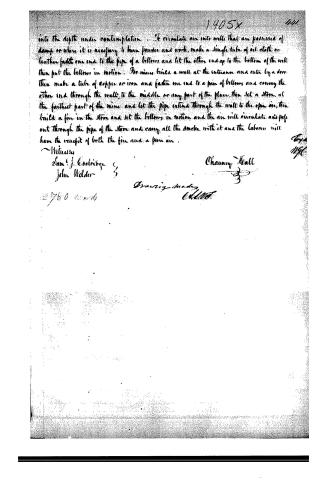
Page 6.
1405x
into the depth under contemplation. To circulate air into wells that are possessed of damp or when it is necessary to burn powder and work, make a single tube of oil cloth or leather fasten one end to the pipe of a bellows and let the other end go to the bottom of the well. Then put the bellows in motion. For mines, build a wall at the entrance and enter by a door. Then make a tube of copper or iron and fasten one end to a pair of bellows and convey the other end through the walls to the middle or any part of the place, then set a stove at the farthest part of the mine and let the pipe extend through the walls to the open air, then build a fire in the stove and set the bellows in motion and the air will circulate and pass out through the pipe of the stove and carry all the smoke with it and the laborers will have the benefit of both the fire and a pure air.
Witnesses
Sam. J. Coolidge
John Welder
Chauncey Wall
Drawing made 6/1/08
2780 words
Eyes
N.Y.
About this record
- Patentee
- DATAMP
- Date
- the Name and Date index of patents, DATAMP, USPTO records
- Invention
- DATAMP
- Listed in
- the Name and Date index of patents, DATAMP, USPTO records, Jim Shaw's X-patent list, S. A. Elliot's printed list of patents, Burke's List of Patents (1847)
- S. A. Elliot's printed list of patents gives the same name and date.
- Burke's 1847 Patent Office list gives the same patent.