

Drawings and documents
USPTO scan
The patent as scanned by the USPTO
-
 Page 1
-
 Page 2
-
 Page 3
-
 Page 4
-
 Page 5


U.S. Patent and Trademark Office · Google Patents
Show the transcription Hide (1,590 words)
Machine transcription (LightOnOCR) of the pages as scanned by the USPTO, most of them the handwritten copies made when the records were restored after the 1836 fire. Not checked; it can misread handwriting, so compare it with the scan.
Page 2.
United States Patent
Patent No.: X1501
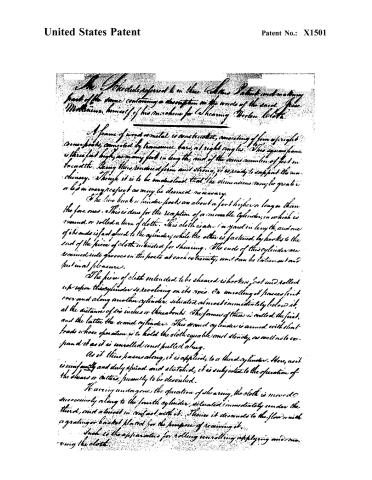
The Schedule referred to in these Letters Patent and making part of the same containing a description in the words of the said Jesse Middleton, himself of his machine for Shearing Woolen Cloth.
A frame of wood or metal is constructed, consisting of four upright corner posts, connected by transverse bars, at right angles. This square frame is three feet high, as many feet in length, and of the same number of feet in breadth. Being thus rendered firm and strong, it is ready to support the machinery. Though it is to be understood that the dimensions may be greater or less in every respect as may be deemed necessary.
The two back or hinder posts are about a foot higher or longer than the fore ones. This is done for the reception of a movable cylinder, in which is wound or rolled a turn of cloth. This cloth is at a yard in length, and one of its ends is fastened to the cylinder, while the other is fastened by hooks to the end of the piece of cloth intended for shearing. The ends of this cylinder are secured into grooves in the posts at each extremity, and can be taken out and put in at pleasure.
The piece of cloth intended to be sheared is hooked, fast and rolled up upon this cylinder as revolving on its axis. On unrolling it passes first over and along another cylinder, situated almost immediately below it, at the distance of six inches or thereabouts. The former of these is called the first, and the latter the second cylinder. This second cylinder is armed with slat-brads whose operation is to hold the cloth equable and steady, as well as to expand it as it is unrolled and pulled along.
As it thus passes along, it is applied, to a third cylinder. Here, as it is uniformly and duly guided and slat-chid, it is subjected to the operation of the shears or cutters, presently to be described.
Having undergone the operation of shearing, the cloth is moved successively along to the fourth cylinder, situated immediately under the third, and almost in contact with it. Thence it descends to the floor, with a grating or basket placed for the purpose of receiving it.
Such is the apparatus for rolling unrolling applying and measuring the cloth.
Page 3.
United States Patent
Patent No.: X1501
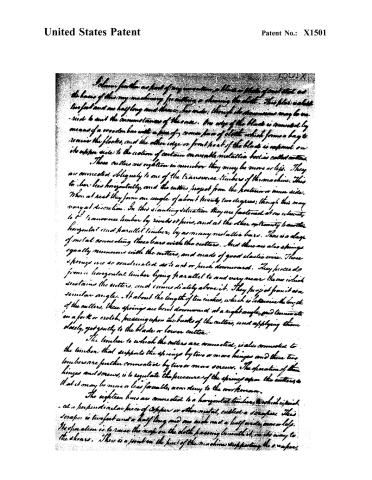
I claim further as part of my invention, a blade or plate of metal set at the base of this my machinery for cutting or shearing the cloth. This plate is about two feet and one half long and three inches wide; though the dimensions may be varied to suit the circumstances of the case. One edge of the blade is connected by means of a wooden bar with a pair of, or more pairs of cloth which forms a bag to receive the flakes, and the other edge or front part of the blade is exposed on its upper side to the action of certain movable metallic bodies called cutters.
These cutters are eighteen in number; they may be more or less. They are connected obliquely to one of the transverse timbers of the machine. This timber lies horizontally, and the cutters project from the posterior or inner side. When at rest they form an angle of about twenty-two degrees; though this may vary at discretion. In this standing situation they are fastened at one extremity to the transverse timber by rivets or pins, and at the other extremity to another horizontal and parallel timber, by as many metallic bars. There is a clamp of metal connecting these bars with the cutters. And there are also springs equally numerous with the cutters, and made of good elastic wire. These springs are so constructed as to act or push downward. They proceed from a horizontal timber lying parallel to and very near the one which sustains the cutters, and immediately above it. They project from it at a similar angle. At about the length of ten inches, which is likewise the length of the cutters, these springs are bent downward at a right angle, and terminate in a fork or crotch, pressing upon the backs of the cutters, and applying them closely, yet gently to the blade or lower cutter.
The timber to which the cutters are connected, is also connected to the timber that supports the springs by two or more hinges and these two timbers are further connected by two or more screws. The operation of these hinges and screws, is to regulate the pressure of the springs upon the cutters, so that it may be more or less favorable, according to the workman.
The eighteen bars are connected to a horizontal timber, to which is fixed a perpendicular piece of copper or other metal, called a scraper. This scraper is two feet and a half long and one inch and a half wide, one or half. Its operation is to raise the nap on the cloth passing beneath it, on its way to the shears. There is a joint on the front of the machine supporting the scraper,
Page 4.
United States Patent
Patent No.: X1501
have cutter and springs with them sufficient to be here by which they may all be drawn together where the blade and the third cylinder on which it rests, high enough to push in and adjust the force of cloth when it is to be sheared, and at the same time to facilitate repairs.
To enable the edge of the blade to lie closer to or further from the cloth and the cutter to shear more or less of the nap from the surface, there are two screws behind and in the rear of it which, by tightening and pushing it forward, make the instrument cut the longer, and by relaxing and suffering it to recoil, cause it to shear the closer.
For the purpose of enabling the fourth cylinder to perform its functions there are accurately in drawing the cloth regularly and smoothly along after the operation of the shears has been performed, the two extremities of its axis are suspended on wires which by their strength and elasticity, press it upwards towards the third cylinder with the requisite force.
And in like manner the two easy and rapid motion of the first cylinder is prevented and the cloth is forced to set tight to the blade by means of two levers acted upon by two springs which are supported by the two longer parts of the frame one is each.
The machine may be put into motion by man, horse or other animals or by wind or water. Its moving powers are cranks, axles, wheels, whirrs, pinions, cogs, chains, and bands.
One side of the apparatus is calculated to give motion to the cloth, as it passes from the first to the fourth cylinder, and the other side to give action to the cutter which flying upon the blade performs the office of shears.
The whole movements are so regulated as to bring the cloth successively and regularly along, so that its fringe or nap may be removed as it passes smoothly and neatly, from every portion of the surface.
That a great excellence, and indeed the most valuable peculiarity in this machine and invention, is that the cloth can never be cut to pieces or spoiled by the shears. For the cutters are so nicely regulated and graduated, that if by any accident the cloth should get between them and the blade, the springs will yield and give way, before the cloth can be damaged.
Page 5.
United States Patent
Patent No.: X1501
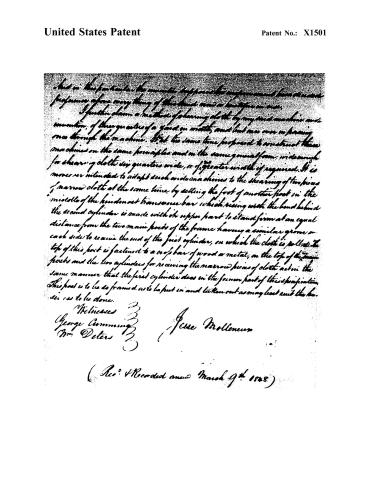
that in this particular, the inventor has found the improvement has decided preference above everything of the kind now in use.
I further claim a method of shearing cloth by my said machine and invention, of three quarters of a yard in width, and but one over in passing once through the machine. It is at the same time proposed to construct these machines on the same principles and in the same general form, wide enough for shearing cloth six quarters wide, or of greater width if required. It is moreover intended to adapt such wide machines to the shearing of two pieces of narrow cloth at the same time by setting the foot of another post in the middle of the hindmost transverse bar which rising with the bend behind the second cylinder is made with its upper part to stand firm at an equal distance from the two main posts of the frame having a similar groove on each side to receive the end of the first cylinder, on which the cloth is pulled. The top of this post is fastened to a cross bar of wood or metal, on the top of the main posts and the two cylinders for receiving the narrow pieces of cloth act in the same manner that the first cylinder does in the former part of this specification. This post is to be so framed as to be put in and taken out as may best suit the business to be done.
Witnesses
George Cumming
Wm. Peters
Jesse Molleneux
(Rec’d & Recorded annexed March 9th 1848)
About this record
- Patentee
- Jim Shaw's X-patent list
- Date
- the Name and Date index of patents, Jim Shaw's X-patent list
- Invention
- the Name and Date index of patents
- Listed in
- the Name and Date index of patents, USPTO records, Jim Shaw's X-patent list, Burke's List of Patents (1847)
- The sources give different dates; the date shown is the one most of them agree on.
- Burke's 1847 Patent Office list gives the same patent.
- Burke's 1847 Patent Office list gives a slightly different date; the date shown follows the standard lists.
- Residence from Burke's 1847 Patent Office list; the standard lists give none.