

Drawings and documents
National Archives restored drawings: drawing
William Thornton's Patent Drawing for a Rifle

National Archives, Restored Patent Drawings (Record Group 241) · Full-size scan at the National Archives · Catalog record
Show the text on the drawing Hide (33 words)
Words on the drawing as machine-read by the National Archives; not checked. Useful mainly for searching.
Bruch / FIRE-ARMS. / CLASSIFICATION / Breech-Loaders. / 1515.1 / DIVISION. / fm Thomtons / Rifle (see Thornton & Hall) / Patented May 21- 1811- / 23 / ii.):
USPTO scan
The patent as scanned by the USPTO
-
 Page 1
-
 Page 2
-
 Page 3
-
 Page 4
-
 Page 5


U.S. Patent and Trademark Office · Google Patents
Show the transcription Hide (933 words)
Machine transcription (LightOnOCR) of the pages as scanned by the USPTO, most of them the handwritten copies made when the records were restored after the 1836 fire. Not checked; it can misread handwriting, so compare it with the scan.
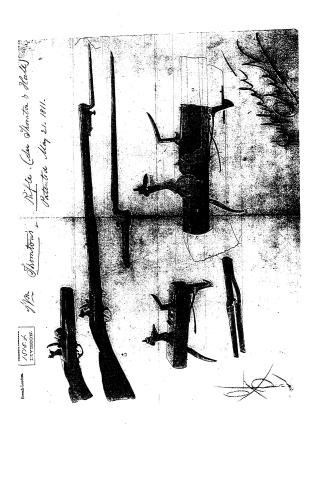
Page 1.
Breech-Loaders.
1876.4
DIVISION.
Rifle. (See Thornton & Halls)
Patented May 21, 1811.
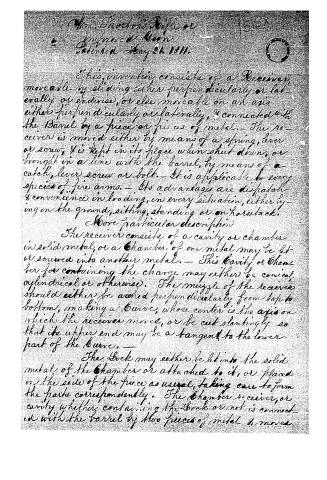
Page 2.
Improvement on
Patented May 24, 1811.
This invention consists of a Receiver, movable by sliding either perpendicularly or laterally or endwise, or else movable on an axis either perpendicularly or laterally, & connected with the Barrel by a piece or pieces of metal. The receiver is moved either by means of a spring, lever or screw, & is kept in its place when shut down, or brought in a line with the barrel, by means of a catch, lever, screw or bolt. It is applicable to every species of fire arms. Its advantages are dispatch & convenience in loading, in every situation, either lying on the ground, sitting, standing or on horseback.
More particular description
The receiver consists of a cavity or chamber in solid metal, or a chamber of one metal may be let or screwed into another metal. This cavity or chamber for containing the charge may either be conical, cylindrical or otherwise. The muzzle of the receiver should either be arched perpendicularly from top to bottom, making a curve, whose center is the axis on which the receiver moves, or be cut slantingly so that its upper end may be a tangent to the lower part of the curve.
The lock may either be let into the solid metal of the chamber or attached to it, or placed on the side of the piece as usual, taking care to form the parts correspondently. The chamber, receiver, or cavity whether containing the lock or not is connected with the barrel by two pieces of metal & moves.
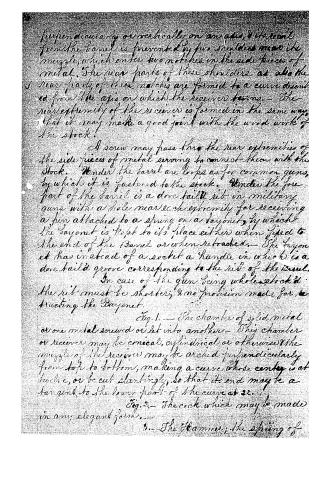
Page 3.
perpendicularly or vertically on an axis, & the want from the barrel is prevented by two shoulders near the muzzle, which enter two notches in the side pieces of metal. The near parts of these shoulders as also the rear parts of these notches are formed to a curve descended from the axis on which the receiver turns. The rear extremity of the receiver is formed in the same way that it may make a good joint with the wood work of the stock.
A screw may pass thro the rear extremities of the side pieces of metal serving to connect them with the stock. Under the barrel are loops as for common guns, by which it is fastened to the stock. Under the fore part of the barrel is a dove tailed slit in military guns with a hole near each extremity for receiving a pin attached to a spring on a bayonet, by which the bayonet is kept to its place either when fixed to the end of the barrel or when retracted. The bayonet has instead of a socket a handle in which is a dove tailed groove corresponding to the slit of the metal.
In case of the gun being wholestocked the slit must be shorter, & no provision made for retracting the Bayonet.
Fig. 1. — The chamber of solid metal or one metal screwed or let into another. This chamber or receiver may be conical, cylindrical or otherwise & the muzzle of the receiver may be arched perpendicularly from top to bottom, making a curve whose center is at twelve, or be cut slantingly, so that its end may be a tangent to the lower part of the curve at 22.
Fig. 2. — The cock which may be made in any elegant form.
3. — The Hammer, the spring of
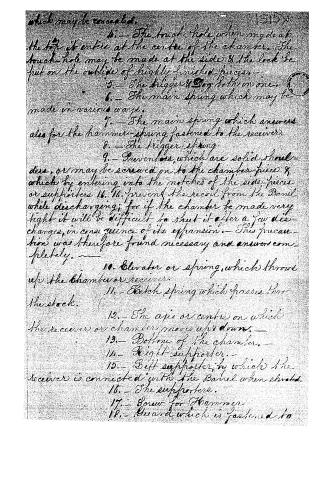
Page 4.
which may be removed.
4. — The touch-hole when made at the top, it enters at the centre of the chamber. The touch-hole may be made at the side & the lock be put on the outside of highly finished pieces.
5. — The trigger & Dog both in one.
6. — The main spring which may be made in various ways.
7. — The main spring which answers also for the hammer-spring fastened to the receiver.
8. — The trigger-spring.
9. — Preventers, which are solid shoulders, or may be screwed on to the chamber-piece & which by entering into the notches of the side-pieces or supporters 11, 16, prevent the recoil from the Barrel while discharging; for if the chamber be made very tight it will be difficult to shut it after a few discharges, in consequence of its expansion. — This precaution was therefore found necessary and answers completely.
10. Elevator or spring, which throws up the chamber or receiver.
11. — Catch spring which passes thro' the stock.
12. — The axis or centre on which the receiver or chamber moves up & down.
13. — Bottom of the chamber.
14. — Right supporter.
15. — Left supporter, by which the receiver is connected with the Barrel when elevated.
16. — The supporters.
17. — Screw for Hammer.
18. — Guard which is fastened to
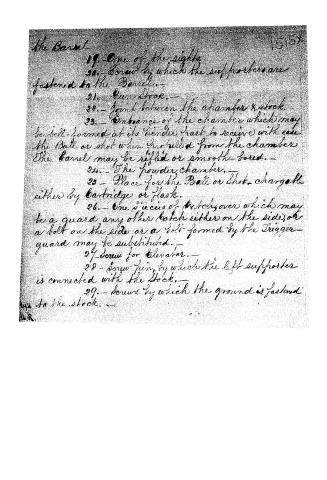
Page 5.
19. One of the sights.
20. Screw by which the left supporters are fastened to the Barrel.
21. Gun stock.
22. Joint between the chamber & stock.
23. Entrance of the chamber which may be well-formed at its hinder part to receive with ease the Ball or shot when shot out from the chamber. The Barrel may be rifled or smooth-bored.
24. The powder chamber.
25. Place for the Ball or shot, charged either by cartridge or flask.
26. One piece of latch-over which may be a guard any other latch either on the side, or a bolt on the side or a bolt formed by the trigger-guard may be substituted.
27. Screw for Elevator.
28. Screw-pin, by which the left supporter is connected with the stock.
29. Screws by which the ground is fastened to the stock.
DATAMP: illustration
Illustrations from DATAMP


DATAMP (Directory of American Tool and Machinery Patents), via the Internet Archive · Archived DATAMP page
About this record
- Patentee
- DATAMP
- Date
- the Name and Date index of patents, DATAMP, USPTO records
- Invention
- DATAMP
- Listed in
- the Name and Date index of patents, DATAMP, USPTO records, Jim Shaw's X-patent list, S. A. Elliot's printed list of patents, Burke's List of Patents (1847)
- S. A. Elliot's printed list of patents gives the same name and date.
- Burke's 1847 Patent Office list gives the same patent.