

Drawings and documents
National Archives restored drawings: drawing
E. Clark's Patent Drawing for a Buoy Forts

National Archives, Restored Patent Drawings (Record Group 241) · Full-size scan at the National Archives · Catalog record
Show the text on the drawing Hide (73 words)
Words on the drawing as machine-read by the National Archives; not checked. Useful mainly for searching.
14. SHIPS. / 81. / 1. CONSTRUCTION / E: O CLARK / [137] Scow / BUOY FORTS / CLASEIFICATION / Patented 2 / 1700 + / DIVISION. / 100000 / GROUP / O\R / Strickland Del / A E mply Casks. under dock / B: Deck over halp the Hoar / c Crojipeices / Patent office Nor of "1839 / Made under the direction of the commfrones proner of patients / me conformety with act of 3rd March 1837 / Minner Eusworth / Commyrower of patents
USPTO scan
The patent as scanned by the USPTO
-
 Page 1
-
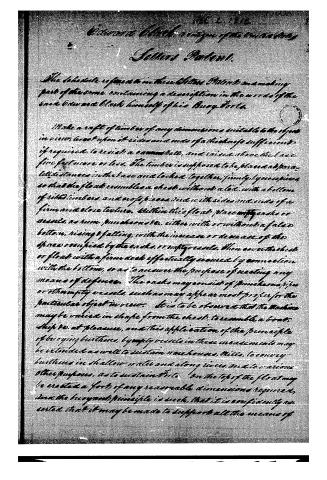 Page 2
-
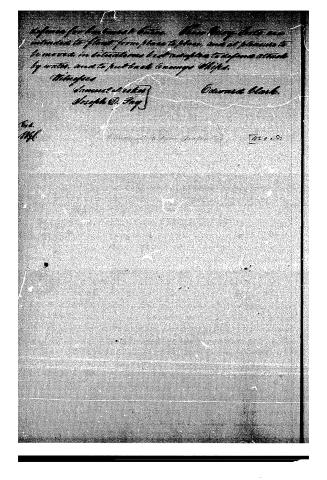 Page 3


U.S. Patent and Trademark Office · Google Patents
Show the transcription Hide (412 words)
Machine transcription (LightOnOCR) of the pages as scanned by the USPTO, most of them the handwritten copies made when the records were restored after the 1836 fire. Not checked; it can misread handwriting, so compare it with the scan.
Page 1.
1700X
E. Clark.
Scow.
Patented Apr. 21, 1812.
Page 2.
Patent No. 1,111.
Edward Clark, assignee of the inventors,
Letters Patent.
The schedule referred to in these Letters Patent, and making part of the same, containing a description in the words of the said Edward Clark himself of his buoy-bottle.
Make a raft of timber of any dimensions suitable to the object in view, erect upon it sides and ends of a thickness sufficient, if required, to resist a cannon-ball, and raised above the base five feet more or less. The timber is supposed to be placed at parallel distances in the base and locked together, firmly by cross-pins, so that the float resembles a chest without a lid, with a bottom of solid timber, and ends of pieces and with sides and ends of a firm and close texture. Within this float place empty casks or vessels, as rum-punch-boards, either with or without a false bottom, rising & falling, with the increase or decrease of the space occupied by the casks or empty vessels. Then cover the chest or float with a firm deck effectively secured by connection with the bottom, so as to answer the purpose of creating any means of defence. The casks may consist of punch-boards, pipes or other empty vessels, such as may appear most proper for the particular object in view. It is to be observed that the Machine may be varied in shape from the chest, to resemble a boat, ship &c. at pleasure, and this application of the principle of buoying buoys, by empty vessels in these measurements may be extended as well to sustain warehouses, Mills, to convey buoys in shallow waters and along rivers, and to various other purposes, as to sustain forts. On the top of the float may be erected a fort of any reasonable dimensions required, and the buoyant principle is such, that it is confidently asserted that it may be made to support all the means of
Page 3.
Defence for Continental States. These Barge-Boats are intended to float from place to place, and all places to be moved in distances but enough to defend attack by water, and to put back enemy ships.
Wilberforce
James L. Stocker
Joseph D. Fry
Oswara Clark.
About this record
- Patentee
- Jim Shaw's X-patent list
- Date
- the Name and Date index of patents, USPTO records, Jim Shaw's X-patent list
- Invention
- the Name and Date index of patents
- Listed in
- the Name and Date index of patents, USPTO records, Jim Shaw's X-patent list, S. A. Elliot's printed list of patents, Burke's List of Patents (1847)
- S. A. Elliot's printed list of patents gives the same name and date.
- Burke's 1847 Patent Office list gives the same patent.
- Residence from Burke's 1847 Patent Office list; the standard lists give none.