

Drawings and documents
National Archives restored drawings: drawing
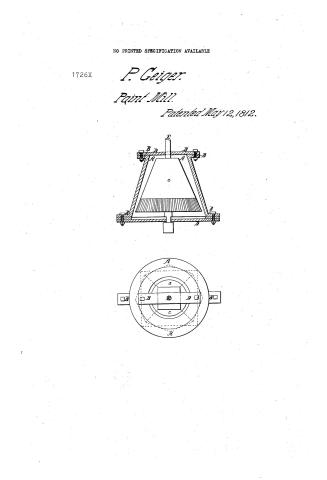
P. Geiger's Patent Drawing for a Machine for Breaking Plaster of Paris, etc.

National Archives, Restored Patent Drawings (Record Group 241) · Full-size scan at the National Archives · Catalog record
Show the text on the drawing Hide (69 words)
Words on the drawing as machine-read by the National Archives; not checked. Useful mainly for searching.
83. MILLS. / Grinding Mills. / Paint. / P O GEIGER / Breakinó Plasterof Paris &e / CLASSI ATION / Patented 12th May 1812 1812 / 1726- / DIVISION. / 41 / Red / Strickland Det / A Hopper / B. Arms / C. Nut / D. B ridges or stays / E. Shank / Patent office Dec rj / Made under the direction of the commysiones / of naturbs in conformity with act 3 tharch 1837
USPTO scan
The patent as scanned by the USPTO
-
 Page 1
-
 Page 2


U.S. Patent and Trademark Office · Google Patents
Show the transcription Hide (371 words)
Machine transcription (LightOnOCR) of the pages as scanned by the USPTO, most of them the handwritten copies made when the records were restored after the 1836 fire. Not checked; it can misread handwriting, so compare it with the scan.
Page 1.
NO PRINTED SPECIFICATION AVAILABLE
1726X
P. Geiger.
Paint Mill.
Patented May 12, 1812.

Page 2.
May 12, 1872
Paul Geyer
1726X
Letters Patent
The Volatile referred to in these Letters Patent and making part of the same containing a description in the Words of the said Paul Geyer himself of his Machine for breaking pieces of iron or other hard substances.
A hopper of cast iron in the form of a frustum of a cone, with four cross bars to it, two projecting from the top, and the other two from the base diametrically opposite each other. A cast iron nut of a frustumical or octagonal shape, at the base it assumes its diametrically opposite to about one fourth of its length, when it begins to change its form from an octagonal into a quadrangular shape, becoming regularly to the top. The octagonal sides are given round and into teeth or clefts, perpendicular to one side and not oblique to the other, which gives each face a sharp edge. The nut is worked in a retrograde motion by which motion the intervening substance is with an increasing pressure driven against the side of the hopper until small enough to fall through between it and the nut, which works the bar bridge or stay at the top and bottom of the hopper, two bridges or stays of wrought iron which extend across the top and bottom of the hopper to the extremities of the iron, to which they are fastened by screws. The lower bridge or stay on which the nut turns is separated from the hopper by plates of iron fastened of a sufficient thickness so as to effect a passage all round the hopper in the broken substance to fall away. The shaft of the nut passes through the lower bridge or stay in which it turns and is supported at the end to which the power that turns it is applied.
Witnesses
J. C. C. C.
John C. Roberts
Paul Geyer
(312 words)
About this record
- Patentee
- Jim Shaw's X-patent list
- Date
- the Name and Date index of patents, USPTO records, Jim Shaw's X-patent list
- Invention
- the Name and Date index of patents
- Listed in
- the Name and Date index of patents, USPTO records, Jim Shaw's X-patent list, S. A. Elliot's printed list of patents, Burke's List of Patents (1847)
- S. A. Elliot's printed list of patents gives the same name and date.
- Burke's 1847 Patent Office list gives the same patent.
- Residence from Burke's 1847 Patent Office list; the standard lists give none.