

Drawings and documents
USPTO scan
The patent as scanned by the USPTO
-
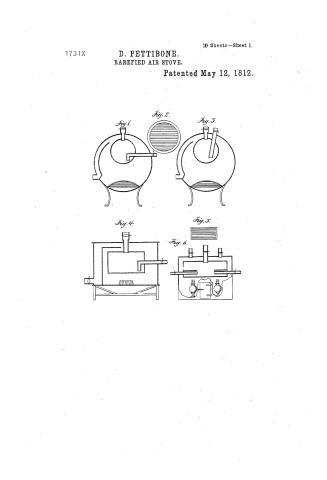 Page 1
-
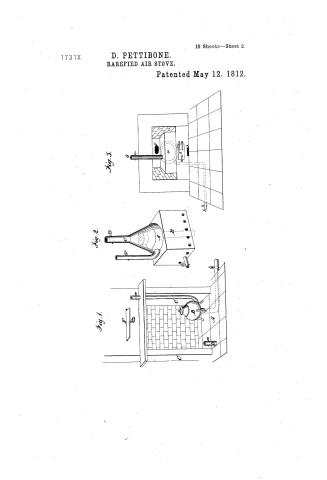 Page 2
-
 Page 3
-
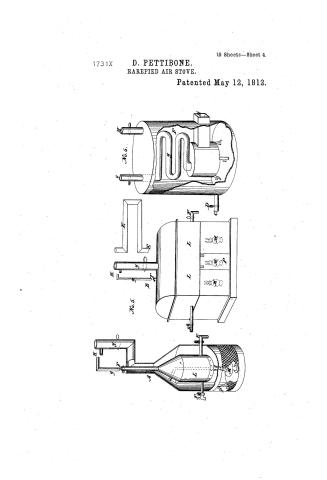 Page 4
-
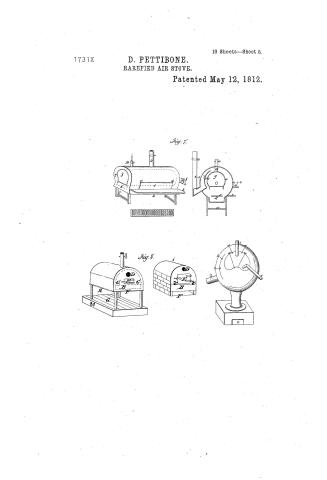 Page 5
-
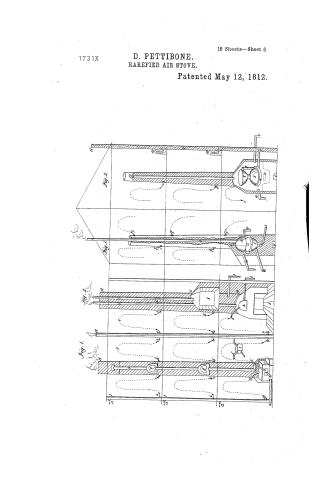 Page 6
-
 Page 7
-
 Page 8
-
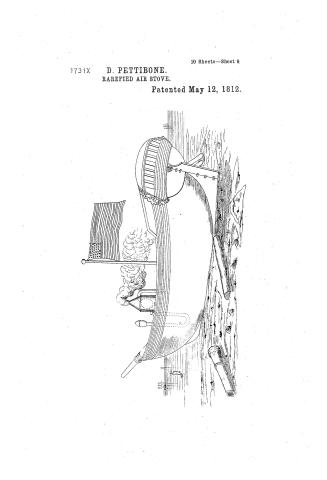 Page 9
-
 Page 10
-
 Page 11
-
 Page 12
-
 Page 13
-
 Page 14
-
 Page 15
-
 Page 16
-
 Page 17
-
 Page 18
-
 Page 19
-
 Page 20
-
 Page 21
-
 Page 22
-
 Page 23
-
 Page 24
-
 Page 25


U.S. Patent and Trademark Office · Google Patents
Show the transcription Hide (5,333 words)
Machine transcription (LightOnOCR) of the pages as scanned by the USPTO, most of them the handwritten copies made when the records were restored after the 1836 fire. Not checked; it can misread handwriting, so compare it with the scan.
Page 1.
1731X
D. PETTIBONE.
RAREFIED AIR STOVE.
Patented May 12, 1812.
10 Sheets—Sheet 1.
Fig. 1.
Fig. 2.
Fig. 3.
Fig. 4.
Fig. 5.
Fig. 6.
Page 2.
1731X
D. PETTIBONE.
RAREFIED AIR STOVE.
Patented May 12, 1812.
10 Sheets—Sheet 2.
Fig. 1.
Fig. 2.
Fig. 3.
Page 3.
1731X
D. PETTIBONE.
RAREFIED AIR STOVE.
Patented May 12, 1812.
10 Sheets—Sheet 3.

Page 4.
1731X
D. PETTIBONE.
RAREFIED AIR STOVE.
Patented May 12, 1812.
10 Sheets—Sheet 4.

Page 5.
1731X
D. PETTIBONE.
RAREFIED AIR STOVE.
Patented May 12, 1812.
10 Sheets—Sheet 5.
Fig. 7.
Fig. 8.
Page 6.
1731X
D. PETTIBONE.
RAREFIED AIR STOVE.
Patented May 12, 1812.
10 Sheets—Sheet 6.

Page 7.
1731X
D. PETTIBONE.
RAREFIED AIR STOVE.
Patented May 12, 1812.
10 Sheets—Sheet 7.
Fig. 4.
Fig. 3.
Fig. 2.
Fig. 1.
Page 8.
1731X
D. PETTIBONE.
RAREFIED AIR STOVE.
Patented May 12, 1812.
10 Sheets—Sheet 8.

Page 9.
1731X D. PETTIBONE.
RAREFIED AIR STOVE.
Patented May 12, 1812.
10 Sheets—Sheet 9.
Page 10.
1731X
D. PETTIBONE.
RAREFIED AIR STOVE.
Patented May 12, 1812.
10 Sheets—Sheet 10.
Fig. 8.
Fig. 7.
Fig. 10.
Page 11.
2399
Daniel Patterson.
To all to whom these presents shall come, Greeting:
I Certify, That the annexed is a true copy of a patent granted to Daniel Patterson for an improvement in warming rooms or apartments by means of rarefied air, applicable to ovens, drying, hot or green houses rooms &c.
In Witness Whereof, I James Monroe Secretary for the Department of State of the United States of America have signed these presents, and caused the seal of my office to be affixed hereto, at the City of Washington the twenty eighth day of April A.D. 1813 and in the thirty seventh year of the Independence of the said States.
Jno. Monroe
(Patented May 12, 1812)
The Schedule referred to in these letters patent and made part of the same containing a description in the words of the said Daniel Patterson himself of his improvements for warming Rooms or apartments by means of rarefied air, applicable to ovens drying, Hot or green-Houses, rooms &c.
These improvements of the rarefying air stove, or the invention of the same consists in the construction of a stove or fire-place with a large rarefying air vessel or chamber connected with the same, or things as hereinafter described. — These air-vessels or chambers, as so constructed, as to contain any kind of stove, or Steam pipe or an air-vessel is placed in any stove that the air is heated in contact with the outside of the stove or steam pipe, or within the stove in the air vessel.
The invention for this consists in applying to any air vessel any pot, kettle, boiler, tube, pipe, cylinder, or other apparatus for heating air the same as may be used for heating of water &c. These pots, kettles, or boilers may be set in an iron case with a hoop of three or four inches in width soldered or riveted to the sides near the bottom, or in a
Page 12.
double walls of bricks, similar to a still or boiler receiving into them at or near the bottom a large supply of pure, fresh, external atmospheric air from the streets, cellars, or yards by means of one or more tubes or pipes to conduct or convey the external air into the hot stove or boiler & from the hot stove or boiler into the rooms or rooms to be warmed, or into a cistern or reservoir, which may be lined with pulverized charcoal to prevent the escape of heat through its sides, charcoal being a bad conductor of heat. The heat may be conveyed in tin, paste-board, sheet iron or clay pipes, to any room or apartment. And more effectively to preserve or economize the heat, the pipes may also be coated with charcoal, or made double, so as to have a close column of air between, or be covered with several thin layers of broken cloth. All these pipes or tubes must have stop cocks, so as to regulate the passage of heat at pleasure. Hence this kind of stove may be so constructed as to produce heat sufficient to warm fifty rooms in a dwelling house or hospital &c. &c. or after the heat is conveyed to the ground or pit or cistern, it may be conveyed away by pipes, in a similar manner as a city is supplied with water from a fountain, and connected to any room or apartment, as wanted. It is to be observed, that rooms or apartments to be warmed should be ventilated at or near the floor. Small open fire places or tubes leading from the floor to the top of the building, will answer very well. These ventilating tubes or fire places should be so fitted with registers or valves as to regulate the ventilation, as circumstances may require.
Where it is found that the external air is warm and the apartment is overcrowded with people, it is proper that ventilation should take place at the top, at or near the ceiling. Whenever an apartment is fitted with con-
Page 13.
(173)X
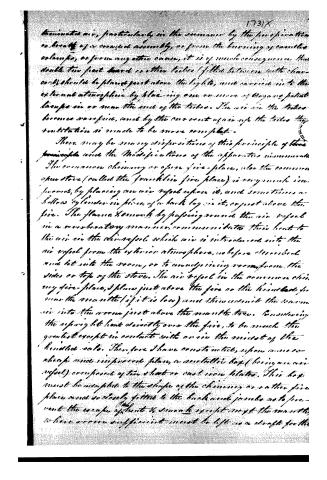
brominated air, particularly in the summer by the perspiration or breath of a crowded assembly, or from the burning of candles, salamps, or from any other cause, it is of much consequence that double tin pipe boards or other tubes (filled between with charcoal) should be placed just above the lights, and carried in to the external atmosphere by blowing one or more of Regnault's patent lamps in or near the end of the tubes. The air in the tubes becomes more pure, and by the current of air up the tubes the ventilation is made to be more complete.
There may be many dispositions of this principle of these principles and the Modifications of the apparatus immemorial.
The common chimney or open fire-place, also the common open stove (called the Franklin fire place) is very much improved, by placing an air vessel before it, and sometimes a hollow cylinder in place of a back log in it, or just above the fire. The flame & smoke by passing round the air vessel in a reverberatory manner, re-communicates their heat to the air in the air vessel, which air is introduced into the air vessel from the exterior atmosphere, as before described and let into the room, or to an adjoining room from the sides or top of the stove. The air vessel in the common chimney fire-place, I place just above the fire or the kindled fire near the mantel (if it is low) and then admit the warm air into the room just above the mantel stove. Considering the very slight heat directly over the fire, to be much the greatest except in contact with or in the vicinity of the kindled coals. Therefore I have constructed, upon a more sharp and improved plan, a metallic box (being an air vessel) composed of tin sheet or cast iron plates. This box must be adapted to the shape of the chimney or rather fire place and so closely fitted to the back and jambs as to prevent the escape of heat & smoke except through the mantel where warm sufficient must be left as a draft for the
Page 14.
1731X
smoke. It may be necessary to have several boxes, one above the other, connected with short tubes or pipes. The external air entering the lower box must issuing from the upper most by pipes into the room under or above the mantle, through a plate of iron or marble. If only one box is applied over the chimney, it is best to have the upper part double, leaving a dead column of air (being a non-conductor) to prevent the escape of heat. If these boxes are made of thin plates, they should be painted black, to prevent the escape of heat by reflection. In fitting these boxes, dampers or registers may be used, to preserve too great a draft or ventilation—and they might be of just their use if the chimney should happen to be unfire to prevent a part, or all the current from descending—by which means the fire would be immediately extinguished.
In some instances... I have caused air pipes to pass directly through the fire perpendicular or horizontally, among the kindled coals—just above them. I have made grates with hollow bars, for the purpose of heating either air or water.
A hollow cylinder, of six or eight inches diameter, made of the stoutest sheet-iron, or made of cast iron and in place of a back-log would answer better; the external air entering at one end, or at any other part of the cylinder, would pass into the air space above the fire, or immediately into the room, or rooms or to an adjoining room or room. At times, I introduce water into these grates or cylinders the steam of which I supply by means of pipes to many useful purposes. Such as heating air in tubs or casks in contact with the steam pipes or preserving warm baths in chambers &c. In all cases where there are open fires places the inlet of warm air should be in the proportion to that which is consumed, to prevent the cold
Page 15.
air rushing in at the doors, windows, or cracks &c.
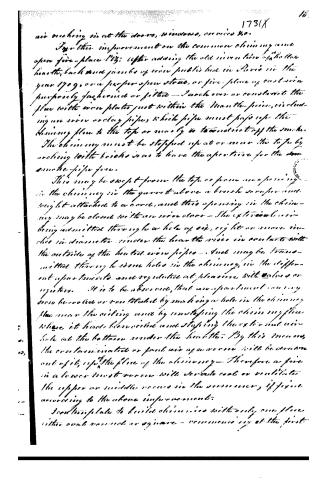
I give this improvement on the common chimney and open fire-place No. 1731X: (after adding the old invention of the low hearth, back and jambs of iron published in Paris in the year 1709, or a proper open stove, or fire-place of cast-iron purposely fashioned or fitted — I would now or construct the flue with iron plates just within the mantle-piece, including an iron or clay pipe, which pipe must pass up the chimney flue to the top or nearly so to conduct off the smoke. The chimney must be stopped up at or near the top by arching with bricks so as to have the aperture for the smoke-pipe free.
This may be swept from the top, or from an opening in the chimney in the garret above a brush scraper and weight attached to a cord, and this opening in the chimney may be closed with an iron door — The external air being admitted through a hole of six, eight or more inches in diameter under the hearth where in contact with the outside of the heated iron pipes — And may be transmitted through some holes in the chimney, in the different apartments and regulated at pleasure with valves or registers. It is to be observed, that an apartment can very soon be cooled or ventilated by making a hole in the chimney flue near the ceiling and by unstoping the chimney flue where it has been sealed and stopping the external air hole at the bottom under the hearth. By this means, the contaminated or foul air of a room will be drawn out of it, up the flue of the chimney — Therefore a fire in a lower most room will ventilate cool or ventilate the upper or middle rooms in the summer, if joint according to the above improvement.
I contemplate to build chimneys with only one flue in the oval round or square — commencing at the first
Page 16.
floor, without any divisions, sufficiently large to admit as many iron or clay pipes as there may be fire places, grates or stoves in the different stories as required in the common mode of laying chimneys. In those cases where the fire-place is erected without hollow backs, jambs, or hearths, the flue of the chimney must be closed just above the mantle-piece, so as to include an iron pipe or funnel as before described, to convey the smoke (the chimney being sealed above, as before mentioned). And to this pipe one or more air-ways may be constructed, which serve to retain an additional quantity of heat from the fuel. In this constructed fire-place, the external air must be admitted into the chimney flue, just above the enclosure near the mantle-piece to which may be adapted a damper or register; and the chimney flue is furnished with iron holes to allow the heated air to pass out into the different apartments.
It is of consequence to place pieces of iron pipe or funnel, in the chimney flue, especially opposite the lower or middle rooms, the inner ends of which spread wide, to catch the current of the heated air in its ascension within the flue.
I have constructed an apparatus, so as to convey the external air through the medium of tubes, or portable hollow backs or hearths terminating in several holes (supplied with dampers) so that the air may enter among the coals, placed in a fire-place grate or stove, and blow them in a similar manner to a smith's forge. Hence this is called the external blower.
Further, one or a number of common iron bottles may be placed, inverted, on a furnace erected for that purpose, over which an arch may be made with bricks, or a funnel made of sheet iron, tinplates double, or a wooden frame, properly lathed and plastered, (which is far better than bricks, if a suitable distance from the heated iron) this arch or funnel is suspended far above, so to have a sufficient space between the common part of the bottle and the concave part of the arch or funnel so as to admit a sufficient portion of external air, by
Page 17.
means of large tubes or openings, near the bottom, the bottles may be placed on a line, or in a cluster of three or four together.
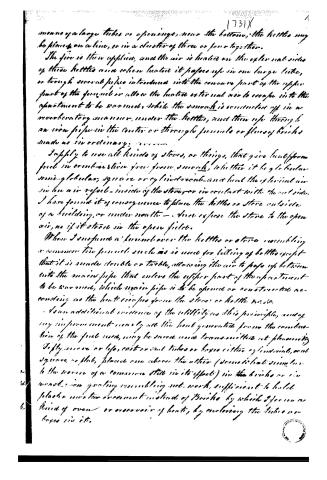
The fire is then applied, and the air is heated on the external sides of these bottles and when heated it passes up in one large tube, or through several pipes introduced into the concave part of the upper part of the furnace or allows the heated external air to escape into the apartment to be warmed, while the smoke is conducted off in a non-herbatory manner, under the bottles, and then up through an iron pipe in the center or through funnels or flues of bricks made as in ordinary.
I apply to use all kinds of stores, or things, that give heat from fuel in combustion free from smoke, whether it be globular, semi-globular, square or cylindrical, and heat the external air in an air vessel inside of the stove or in contact with the outside. I have found it of consequence to place the bottles or store outside of a building, or under vaults—since expose the store to the open air, as if it stood in the open field.
When I suspend a funnel over the bottles or store resembling a common tin funnel such as is used for filling of bottles except that it is made double or tubular, allowing the air to pass up between into the main pipe that enters the upper part of the apartment to be warmed, which main pipe is to be opened or constructed according as the heat escapes from the stove or bottle mass.
I am additional evidence of the utility as this principle, and of my improvement nearly all the heat generated from the combustion of the fuel used, may be saved and transmitted at pleasantly.
I apply square or box, cast or cast tubes or boxes either cylindrical, and square, or slab, placed one above the other (somewhat similar to the work of a common still in its effect) in the bricks or in masonry in grating resembling net work, sufficient to hold plates under the ground instead of bricks by which I form a kind of oven or reservoir of heat, by enclosing the tubes or boxes in it.
Page 18.
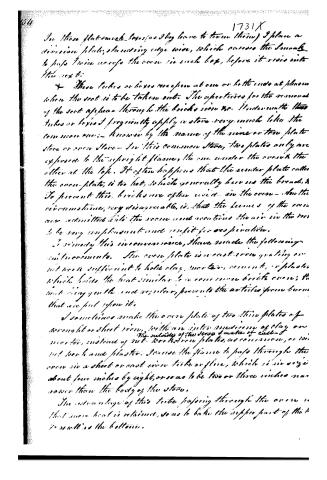
In these flat smooth boxes (as they have to turn them) I place a division plate, slanting edge wise, which causes the smoke to pass twice across the oven in each box, before it rises into the next.
These tubes or boxes are open at one or both ends at places when the sort is to be taken out. The apertures for the removal of the sort appear through the bricks iron &c. Underneath these tubes or boxes I frequently apply a stone very much like the common ones—known by the name of the nine or ten plate stone or oven stone—In this common stone, two plates only are exposed to the upright flame, the one under the oven & the other at the top. It often happens that the upper plate, called the oven-plate, is too hot, which generally burns the bread. To prevent this, bricks are often used in the oven. And the circumstance, very disagreeable, is, that the seams of the oven are admitted into the room and ventilate the air in the room to be very unpleasant and unfit for respiration.
To remedy this inconvenience, I have made the following improvements. The oven plate is a cast-iron grating or net work sufficient to hold clay, mortar, cement, or plaster which holds the heat similar to a common brick oven; the heat being gentle and regular, prevents the articles from burning that are put upon it.
I sometimes make the oven plate of two thin plates of wrought or sheet iron, with an intermedium of clay or mortar, instead of put work & iron plates, as common, or with put work and plaster. I cause the flame to pass through the oven in a sheet or cast iron tube or flue, which is in size about four inches by eight, or so as to be two or three inches narrower than the body of the stone.
The advantage of this tube passing through the oven is that more heat is retained, so as to bake the upper part of the bread as well as the bottom.
Page 19.
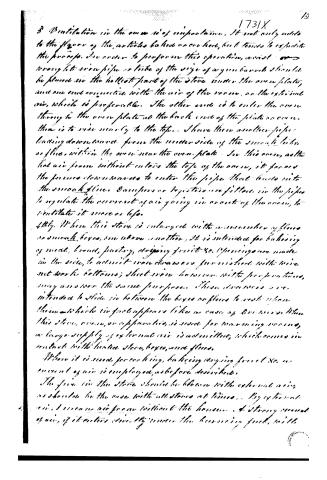
3. Ventilation is the essence of importance. It not only adds to the flavor of the articles baked or cooked, but tends to expedite the process. In order to perform this operation, a cast-iron pipe or tube of the size of a gun barrel should be placed in the hottest part of the stove under the oven plate, and one end connected with the air of the room, or the external air, which is preferable. The other end is to enter the oven through the oven plate at the back end of the plate so as to rise nearly to the top. I have there another pipe leading downwards from the underside of the smooth tube or flue, within the oven near the oven-plate. In this oven, as the hot air from without enters the top of the oven, it forces the furnace drawmances to enter the pipe that leads into the smooth flue. Dampers or registers are fitted in the pipes to regulate the current of air going in or out of the oven, to ventilate it more or less.
4thly. When this stove is enlarged with a number of flues or smooth boxes, one above another, it is intended for baking of meat, bread, pastry, drying fruit &c. Openings are made in the side, to admit iron drawers furnished with wire net work bottoms; sheet iron however, with perforations, may answer the same purpose. These drawers are intended to slide in between the boxes or flues to rest upon them—which in fact appears like a case of drawers. When this stove, oven, or apparatus, is used for warming rooms, a large supply of external air is admitted, which comes in contact with heated stove, boxes, and flues.
When it is used for cooking, baking, drying fruit &c. a current of air is employed, as before described.
The fire in the stove should be blown with external air, as should be the case with all stoves at times. By external air, I mean air from without the house. A strong current of air, if it enters directly under the burning fuel, will
Page 20.
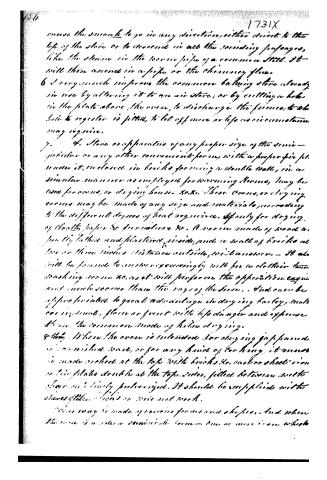
cause the smoke to go in any direction, either direct to the top of the stove or to ascend in all the winding passages, like the steam in the worm pipe of a common still. It will then ascend in a pipe or the chimney flue.
6. I very much improve the common baking stove already in use by altering it to an air stove; or by cutting a hole in the plate above the oven, to discharge the fumes. To this hole a register is fitted, to let off more or less as circumstances may require.
7. A stove or apparatus of any proper size of the semi-circular or any other convenient form, with a proper fire place under it, enclosed in bricks forming a double wall, in a similar manner as employed for warming rooms, may be used for ovens, or drying houses &c. These ovens, or drying rooms may be made of any size and materials, according to the different degrees of heat required. Especially for drying of clothes, paper &c for manufacture &c. A room made of wood or partly lathed and plastered inside, and a wall of bricks at two or three inches distance outside, will answer. It also will be found to answer exceedingly well for a clothes, tann, washing room &c, as it will perform the operation engine and much sooner than the rays of the sun. And can be appropriated to great advantage in drying barley, malt, corn, meal, flour or fruit with less danger and expense than the common mode of hot air drying.
8. When the oven is intended for drying paper and is furnished with, or for any kind of cooking, it must be made arched at the top with bricks &c, or other sheet iron or tin plates double at the top, sides, filled between with straw or finely pulverized. It should be supplied with shelves, tiles, iron or wire net work.
Ovens may be made of various forms and shapes, and when the oven is made a semicircle form—two or more iron wheels
Page 21.
1731X
(with an iron or brick rim, another suitable substance for the antichristian layer) may be placed in it horizontally on an upright shaft which wheels or wheels pass through the stone or oven, on one part of which embankment bread or other such as seeds of all kinds for the purpose of drying or oven may be placed, and by turning the wheel round the articles are carried through the heated air in the oven or stove and come out baked on the other side. These wheels may be moved by weights as a clock or by the hands.
Ideally, pleasure is introduced into the oven, stove or drying room hot air, steam, or cold air as circumstances may require and regulate the same by stopcocks, registers, or dampers. These different airs being all forced, completely ventilates the air in the drying room so as to carry off all kinds of vapors into the smoke flue, or by pipes into the open air.
For this to be done, viz. fuel. For warming rooms, the following method is proposed. A close stove or room more than fire-place, made of cast-iron bricks, stone, or other suitable materials, above which is constructed one, two or more plain square flues, of iron or of bricks, or of both, rising to any proportionable height, say four or five feet. The one flue to receive into it the external air and the other for the smoke, all the flues are securely closed at the top. The smoke at the top enters an iron pipe or the chimney flue in which pipe a register or damper is placed and the smoke is conveyed off as the common stove, or may be made to descend in another flue (which must be added) and rise again to the top... where it then cools. In these smoke flues are placed short pieces of square or round tubes or pipes made of sheet or cast iron, tin or clay. If of clay, they are most conveniently made round by the Potter's wheel, & burn to
Page 22.
1731 X
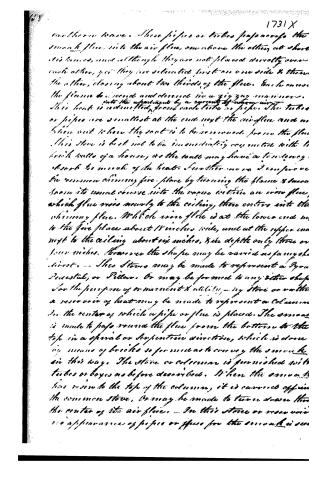
another wave. These pipes or tubes pass across the small flue into the air flue, one above the other at short distances, and although they are not placed directly over each other, yet they are situated just on one side & then the other, closing about two thirds of the flue. Each causes the flame to ascend and descend in a zig zag manner. This heat is admitted from small tubes or pipes. The tubes or pipes are smallest at the end next the air flue and widen out where the soot is to be removed from the flue. This stone is best not to be immediately connected with the brick walls of a house, as the walls may have a tendency to absorb too much of the heat. I am not sure if I can improve the common chimney fire-place by turning the flame & smoke from its usual course into the room within an iron flue, which flue rises nearly to the ceiling, then enters into the chimney flue. Which iron flue is at the lower end in to the fire place about 18 inches wide, and at the upper end next to the ceiling about six inches, & its depth only three or four inches. However the shape may be varied as fancy dictates. — These stones may be made to represent a Pyramidal, or Pillar, or may be formed to any other shape for the purpose of ornament & utility. — My stove or rather a reservoir of heat may be made to represent a column in the center of which a pipe or flue is placed. The smoke is made to pass round the flue from the bottom to the top in a spiral or serpentine direction, which is done by means of bricks so formed as to convey the smoke in this way. The stove or column is furnished with tubes or boxes as before described. When the smoke has risen to the top of the column, it is carried off into the common stove, or may be made to turn down into the center of the air flue. — In this stove or reservoir no appearance of pipes or flues for the smoke is seen.
Page 23.
as in other stores; on the contrary it may be so decorated as to render it an ornament to a Room.
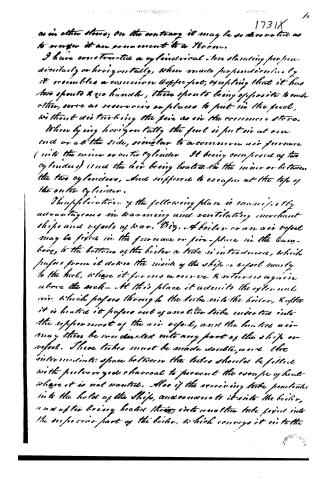
I have constructed a cylindrical stove standing perpendicularly or horizontally, when made perpendicularly it resembles a common coffee pot, excepting that it has two spouts & no handle, these spouts being opposite to each other, serve as reservoirs or places to put in the fuel, without disturbing the fire as in the common stove.
When lying horizontally the fuel is put in at one end or at the side, similar to a common air furnace (into the inner or outer cylinder. It being composed of two cylinders) (and the air being heated in the inner or between the two cylinders, and supposed to escape at the top of the outer cylinder.
The application of the following plan is manifestly advantageous in warming and ventilating merchant ships and vessels of war. Fig. A boiler or an air vessel may be fixed in the furnace or fire-place in the bottom, to the bottom of the boiler a tube is introduced, while passes from it down the inside of the ship or vessel nearly to the keel, where it forms a curve & returns again above the deck—At this place it admits the external air which passes through the tube into the boiler, & after it is heated it passes out of another tube inserted into the uppermost of the air vessel, and the heated air may then be conducted into any part of the ship or vessel. These tubes must be made double, and the intermediate space between the tubes should be filled with pulverized charcoal to prevent the escape of heat where it is not wanted. Also if the receiving tube penetrates into the hold of the ship, and connects it into the boiler, and after being heated flows into another tube fixed into the superior part of the boiler, which conveys it into the
Page 24.
atmosphere above the deck, when it mixes with the general air. This improvement can be very conveniently applied to ventilate mines, halls, school rooms, and any apartment or place impregnated with foul air. To effect this without warming the room, the boiler or stove should be placed above it. But to warm as well as to ventilate it should be placed below. In some places supply steam for warming & ventilating apartments, & particularly where the utmost safety is required, such as gas works, factories &c. But instead of steam-pipes being placed in that apartment the heat is emitted into them by current of of hot air, which air has been previously heated in contact with steam pipes, tubes or warm other apparatus—Supply boilers or things of various form to create steam (supplied with safety valves) grates with hot bars, or one or more hollow cylinders, to pass water through the fire, not only to prevent the grates or apparatus from being destroyed by the fire but also to create steam or hot water for the purpose of warming air.
I claim no particular improvement in heating or by steam passing in a worm or like pipe in the tube. I only say that the transporting of heat to apartments to be warmed by a current of fresh air heated by hot water, or steam what I claim. A boiler & worm pipe something similar to a common still, but never that is to say instead of applying steam into the upper end of the worm-pipe, the worm pipe being there so that the steam enters into it at the bottom. The tone of the condensing tube is upwards, which causes the worm-pipe as the steam rises from the boiler & top of the worm pipe being closed so that it cannot escape the steam is condensed with a current of cold air entering in contact with the steam pipe—Which air is
Page 25.
1731X 161
heated air through pipes to the apartments to be warmed, through the bottom of the consuming tub.
In all cases as the steam is condensed to water it returns back to the boiler, so that there is little or no waste of water from the boiler. Instead of a common pipe, a pipe passing in a zigzag manner within a hot water box, or one globe, box, pipe, or cylinder placed within another—either the steam entering the external globe or cylinder No. 8 warms air in the external globe or cylinder, or the steam entering the internal, and heating the air between the two. Further I supply tubes, casks, or boxes of any suitable size, into which tubes, casks or boxes I force steam or hot water, and through these tubes, casks, or boxes, I pass pipes or tubes of tin, or made of other proper substance, either perpendicularly or horizontally—at one end of these pipes or tubes the cold external air enters and by passing through the pipes or tubes within the hot water or steam, it becomes heated and (as before mentioned) rises by means of pipes to the apartments to be warmed.
In this way twenty or more apartments in one House can be warmed one or all at the same time by opening & shutting cocks or valves &c.
Portable drying rooms or ovens, constructed on this plan might be used for drying wet gun powder and wet cartridges in the army, and prevent many disasters that might result therefrom.
Witness
Daniel Pittsboro
Geo. Lyon
Rufus M. Adams
(5532 words)
Filed 11.9.6.
About this record
- Patentee
- Jim Shaw's X-patent list
- Date
- the Name and Date index of patents, USPTO records, Jim Shaw's X-patent list
- Invention
- the Name and Date index of patents
- Listed in
- the Name and Date index of patents, USPTO records, Jim Shaw's X-patent list, S. A. Elliot's printed list of patents, Burke's List of Patents (1847)
- S. A. Elliot's printed list of patents gives the same name and date.
- Burke's 1847 Patent Office list gives the same patent.
- Residence from Burke's 1847 Patent Office list; the standard lists give none.