

Drawings and documents
USPTO scan
The patent as scanned by the USPTO
-
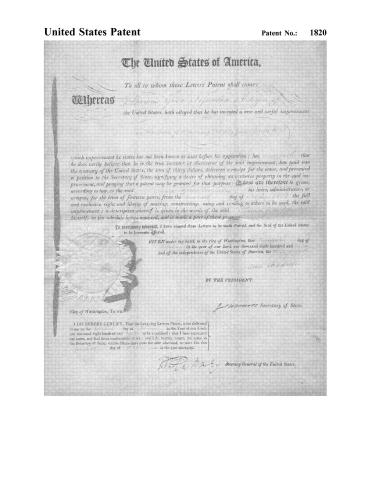 Page 1
-
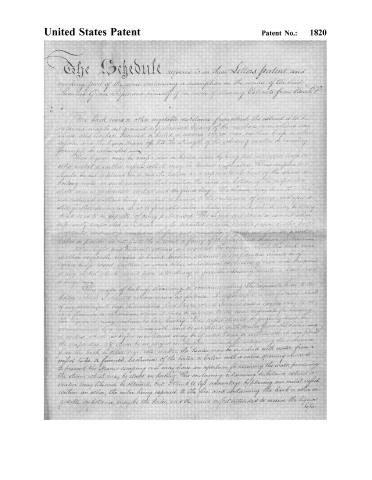 Page 2
-
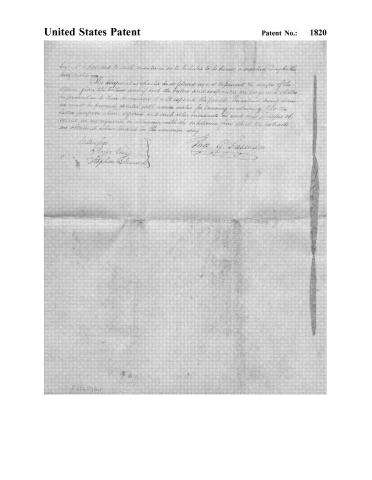 Page 3


U.S. Patent and Trademark Office · Google Patents
Show the transcription Hide (608 words)
Machine transcription (LightOnOCR) of the pages as scanned by the USPTO, most of them the handwritten copies made when the records were restored after the 1836 fire. Not checked; it can misread handwriting, so compare it with the scan.
Page 1.
United States Patent
Patent No.: 1820
The United States of America,
To all to whom these Letters Patent shall come:
Whereas
[Handwritten text, partially illegible]
the United States, hath alleged that he has invented a new and useful improvement
[Handwritten text, partially illegible]
which improvement he states has not been known or used before his application; has sworn or affirmed that he does verily believe that he is the true inventor or discoverer of the said improvement, has paid into the treasury of the United States, the sum of thirty dollars, delivered a receipt for the same, and presented a petition to the Secretary of State, signifying a desire of obtaining an exclusive property in the said improvement, and praying that a patent may be granted for that purpose: WHEREFORE it is granted, according to law, to the said [Handwritten text, partially illegible] his heirs, administrators, or assigns, for the term of fourteen years, from the [Handwritten text, partially illegible] day of [Handwritten text, …
Page 2.
United States Patent
Patent No.: 1820
The Schedule
regard to in their Letters patent and
making part of the same containing a description in the words of the said
thereof from a person himself of his own invention, Patentee from March 7
The book used as other vegetable substance from which the material is to be
extracted, may be not ground, by pressure, drying of the material, or in other ways
to be made suitable, however, a dried or cured, which can contain a large quantity
of the liquid from which the strength of the material is to be derived.
This liquid may be evaporated or boiled down by being put into open vessels or
other metal or other vessels which may be heated or heated. When the material
should be not in place, but a small quantity in a separate to the heat of the steam or
boiling water, so much as may be sufficient to boil the water, the steam or
other means in an amount, not less than the given charge. The steam being driven through
the material without being heated or heated, the temperature of the material is
still sufficient to cause it to be from water, which is better than water, which may be
used as a means of being pulverized. The object is to have an amount of
material which is to be heated or heated in order to make proper or other
material, and to be heated or heated in the form and manner of
material or powder, which is to be heated or heated in the form and manner of
Page 3.
United States Patent
Patent No.: 1820
The composition is to be so formed as not to prevent the escape of the steam from the boiler and if both the boilers are in operation and are to be used in conjunction with each other, it will be found that the pressure of the steam will be maintained at a constant level, and the boilers will be kept in proper proportion to each other, and the steam will be delivered at a constant pressure, and the boilers will be kept in proper proportion to each other, and the steam will be delivered at a constant pressure, and the boilers will be kept in proper proportion to each other, and the steam will be delivered at a constant pressure.
Signed by:
- John Smith
- Robert Johnson
- William Brown
Date: January 1, 1820
DATAMP: illustration
Illustrations from DATAMP
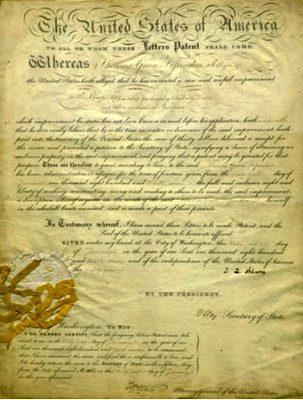
DATAMP (Directory of American Tool and Machinery Patents), via the Internet Archive · Archived DATAMP page
About this record
- Patentee
- DATAMP
- Date
- the Name and Date index of patents, DATAMP, USPTO records
- Invention
- DATAMP
- Listed in
- the Name and Date index of patents, DATAMP, USPTO records, Jim Shaw's X-patent list, S. A. Elliot's printed list of patents, Burke's List of Patents (1847)
- S. A. Elliot's printed list of patents gives the same name and date.
- Burke's 1847 Patent Office list gives the same patent.