

Drawings and documents
USPTO scan
The patent as scanned by the USPTO
-
 Page 1
-
 Page 2
-
 Page 3
-
 Page 4


U.S. Patent and Trademark Office · Google Patents
Show the transcription Hide (656 words)
Machine transcription (LightOnOCR) of the pages as scanned by the USPTO, most of them the handwritten copies made when the records were restored after the 1836 fire. Not checked; it can misread handwriting, so compare it with the scan.
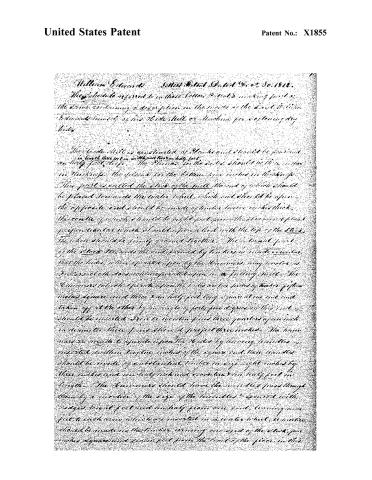
Page 2.
United States Patent
Patent No.: X1855
William Edwards — Letters Patent Dated Nov. 30, 1812.
The schedule referred to in these Letters Patent is making part of the same, containing a description on the papers of the said William Edwards himself, of his Tide Mill or Machine for softening dry hides.
The Tide Mill is constructed of Planks and should be formed in length three feet in width and two and a half feet in height. The Planks on the sides should be three inches in thickness. The planks on the bottom have notches in them for this part is called the stock of the mill, the end of which should be placed towards the water wheel, which end should be upon the opposite end and should be made of timber twelve inches thick, the centre of which should be eight feet from the other end of the plank perpendicular which should be placed with the top of the stock. The whole should be firmly joined together. The lower end part of the stock towards the end formed by the beam is made circular, that the hides, when operated upon by the Hammers, may rotate as rollers, which does not happen in a fulling mill. The Hammers which operate upon the hides are two pieces of timber fifteen inches square and three and a half feet long, square at one end and taken off at the other by an angle of forty-five degrees. In this end should be inserted iron or wooden pins three quarters of an inch in diameter, these pins should project three inches. The hammers are made to operate upon the hides by means of handles inserted within twelve inches of the square end. These handles should be made of substantial timber, in size eight inches by three inches and one half inch and one and a half feet in length. The Hammers should have the handles passed through them by a mortice of the size of the handles and secured with wedges eight feet and an half from one end, leaving nine feet to each arm which are inserted in a water wheel. Mortices should be made in the timber, forming one end of the stock, pins inches square and seven feet from the head of the pins in this
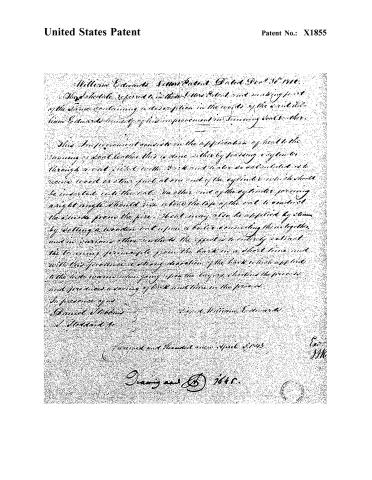
Page 3.
United States Patent
Patent No.: X1855
William Edwards, Letter Patent Dated Dec. 26th 1842.
The Schedule referred to in the Letter Patent, and making part of the same, containing a description in the words of the said William Edwards himself of his improvement in Tanning Leather.
This Improvement consists in the application of heat to the tanning of leather. This is done either by passing cylinders through a vat filled with bark and water, so calculated as to receive wood or other fuel at one end of the cylinder, which should be inserted into the vat. The other end of the cylinder, forming a right angle, should rise above the top of the vat to conduct the smoke from the fire. Heat may also be applied by steam, by setting a wooden vat upon a boiler, connecting them together, and in various other methods. The effect is to entirely extract the tanning principle from the bark in a short time, and with this produce a strong decoction of the bark which applied to the hide, warms when going upon the layers, shortens the process, and produces a saving of bark and time in the process.
In presence of us
Daniel Stibbins
J. H. H. H.
Signed: William Edwards
Received and Recorded in the April 3, 1843
End
JH
January 1845.
Page 4.
United States Patent
Patent No.: X1855
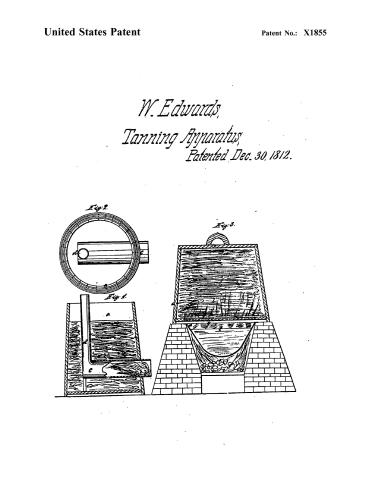
W. Edwards,
Tanning Apparatus,
Patented Dec. 30, 1812.

Fig. 1.
Fig. 2.
Fig. 3.
About this record
- Patentee
- Jim Shaw's X-patent list
- Date
- the Name and Date index of patents, USPTO records, Jim Shaw's X-patent list
- Invention
- the Name and Date index of patents
- Listed in
- the Name and Date index of patents, USPTO records, Jim Shaw's X-patent list, S. A. Elliot's printed list of patents, Burke's List of Patents (1847)
- S. A. Elliot's printed list of patents gives the same name and date.
- Burke's 1847 Patent Office list gives the same patent.