

Drawings and documents
National Archives restored drawings: drawing
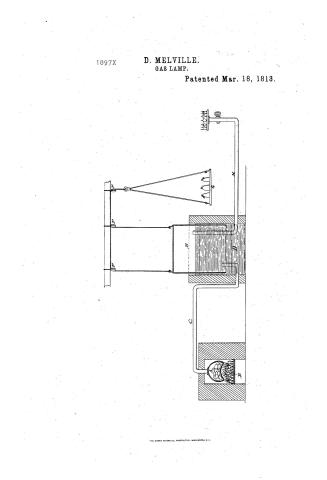
D. Melville's Patent Drawing for a Gas Lamp

National Archives, Restored Patent Drawings (Record Group 241) · Full-size scan at the National Archives · Catalog record
Show the text on the drawing Hide (94 words)
Words on the drawing as machine-read by the National Archives; not checked. Useful mainly for searching.
48. GAS. / Retorts and settings. / 4a. / Domestic plants. / XISE / 1897 / cross Holders / D O MELVILLE / 1897.1 / Vol.3.p.233. / p.233. / Gas Lamp / & Manufactiong Gas. / Patented 18th March 1813 / A Retort / B. Furnace / C. Pipe leading to cistoric / D. Pneumatic Cistern / E'. Reservoirar Gasometer / F. Pullies or chenves / G. Scale / H. Pt/ic leading from Gasometer / Strichland Det) / Patent Uffree fish 1ˢᵗ,1840 / Made under the direction of the commusuon of patients / Mr conformety with act of 3a March 1837 / Manyl Eusworth / Commysiour of patents / Jj
USPTO scan
The patent as scanned by the USPTO
-
 Page 1
-
 Page 2
-
 Page 3


U.S. Patent and Trademark Office · Google Patents
Show the transcription Hide (554 words)
Machine transcription (LightOnOCR) of the pages as scanned by the USPTO, most of them the handwritten copies made when the records were restored after the 1836 fire. Not checked; it can misread handwriting, so compare it with the scan.
Page 1.
1897X
D. MELVILLE.
GAS LAMP.
Patented Mar. 18, 1813.
THE NORRIS PETERS CO., PHOTO-LITHO., WASHINGTON, D.C.
Page 2.
David Melville
Letters Patent 1897
The Schedule referred to in this Letters Patent and making part of the same, containing a description in the words of the said David Melville himself of his improvement in the Gas Lamp.
The improved Gas Lamp, invented and improved by the subscriber is an apparatus for separating the hydrogenous gas or inflammable air from the coal, and to its volatile ingredients of coal for the production of gas light for the lighting of manufactories, mills, streets, theatres, light houses and other buildings in a more agreeable and less expensive & dangerous manner than has hitherto been done by any other method, all which objects he has found can be effected by an apparatus simple in its construction and easy in its management. The apparatus consists of a light cast iron retort set in a furnace pit, with a pipe leading to a pneumatic cistern filled with water, and a reservoir or gasometer, suspended in the cistern, by a rope or chain, leading over pulleys or sheaves, to a rod containing weights; and pipes or tubes leading from the gasometer to the apartments, & when the lights are wanted.
The apparatus being filled the mode of operation is as follows. A quantity of pit coal is placed in the retort, the door shut and heated light, a strong heat being applied by means of a fire lighted in the furnace. Hydrogenous gas or inflammable air is driven out of the coal contained in the retort and forced through the water in the cistern by which it is purified, having passed through the water, it rises up the gasometer until it is filled, when it may be reserved for occasional use.
By taking one or more weights off the rod the gasometer will bear so much the greater weight upon the volume of gas contained in it, which forces it through the pipes to any distance or in any direction to the houses or apartments where the lights are wanted, and by which the flames are made to burn with more or less force at pleasure. If all the weights should be taken off the scale, and the flames did not burn
Page 3.
1897 X
with sufficient force once more might may be placed on the Caromater,
distinctly on the weight, the gas from the apertures of the burner on
coming in contact with the oxygenous gas of the atmosphere, as it was
taken from the application of a light, and will continue to burn with
a brilliant flame without smell or smoke as long as there is any gas
in the Caromater. The burners are furnished with keys by which each
flame may be regulated to give more or less light and the whole (to this
extent many) may be regulated as to the size of the flame as they
may be instantaneously extinguished by a single key in the main, key
or tube.
W. H. Bopf Jr.
W. Dean
D. H. Hoville
(602 words)
(Patented 18 March 1897)
About this record
- Patentee
- Jim Shaw's X-patent list
- Date
- the Name and Date index of patents, USPTO records, Jim Shaw's X-patent list
- Invention
- the Name and Date index of patents
- Listed in
- the Name and Date index of patents, USPTO records, Jim Shaw's X-patent list, S. A. Elliot's printed list of patents, Burke's List of Patents (1847)
- S. A. Elliot's printed list of patents gives the same name and date.
- Burke's 1847 Patent Office list gives the same patent.