

Drawings and documents
National Archives restored drawings: drawing
Zina Phinney's Patent Drawing for a Scales

National Archives, Restored Patent Drawings (Record Group 241) · Full-size scan at the National Archives · Catalog record
Show the text on the drawing Hide (66 words)
Words on the drawing as machine-read by the National Archives; not checked. Useful mainly for searching.
73. MEASURING INSTRUMENTS. / /1. / [132] Pendulum Scales. / CLASSIFICATION / 2041-+ / DIV ISION. / ZINA PHINNEY / Scales. / Patentie January 6% 1814. / 10 / References / a the weight. way ht. / 6 the rod / C. cereurar arm. / d nook for the scale. / Extent-affice March 29th 1839 / Made under the direction of the Commissioner / of Patents in conformity with hot 3d harch 1837 / Commissioner of Patents.
USPTO scan
The patent as scanned by the USPTO
-
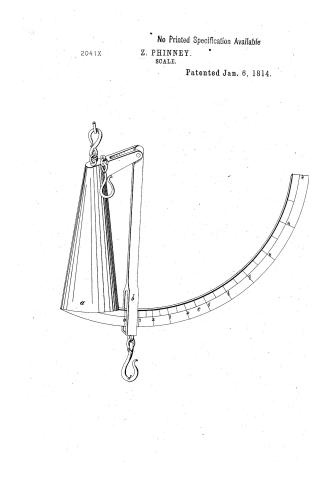 Page 1
-
 Page 2


U.S. Patent and Trademark Office · Google Patents
Show the transcription Hide (439 words)
Machine transcription (LightOnOCR) of the pages as scanned by the USPTO, most of them the handwritten copies made when the records were restored after the 1836 fire. Not checked; it can misread handwriting, so compare it with the scan.
Page 1.
2041X
No Printed Specification Available
Z. PHINNEY.
SCALE.
Patented Jan. 6, 1814.

Page 2.
Jan 16th 1844
Jena Thimney
Letters Batch A
The Machine referred to in the Letter Patent and making part of the same containing a description in the words of the said Jena Thimney him self of his improved Steel Weights or Scales.
This machine consists of a weight, a beam, or rod arm and one scale, all of which are described as follows. viz: The weight may be made of various forms to answer the same purpose, but I intend to have it of a conical form, or an angular form as far up it as to the fulcrum on which it is hung; and from it I have a kind of an arm extending upwards in an angle of about 30 degrees altitude, this arm may be varied agreeably to the size of the machine, that is to say, it may be longer or shorter agreeably to the length of the weight, and there is a mortise in the upper end of it to receive the upper end of the arm, and there is a pin which goes through the upper arm of the weight and the end of the rod, which supports and fixes them each by side. There may be a second arm to the weight and of a circular form, and attached to it near the bottom end, or it may be attached to the rod and pass through a mortise in the weight, or slip by the side, or under the lower end of the weight, or when attached to the lower end of the weight it may pass by the side of the rod. The circular arm has marks and figures on it, for to show the pounds and ounces. The scale is hung to the lower end of the rod, and whatever is to be weighed being put in it, it tends to pull the rod downwards. It has a tendency to throw the lower end of the weight out of its perpendicular situation, which is the mode of weighing, and by looking at the edge of the weight on the circular arm at the mark or figure on it, you tell the weight of the article in the scale. There can also be two hooks, one for the little side.
Witnesses
William Thornton
Geo Lyon
Jena Thimney
(378 words)
Patented January 16, 1844
About this record
- Patentee
- DATAMP
- Date
- the Name and Date index of patents, DATAMP, USPTO records
- Invention
- DATAMP
- Listed in
- the Name and Date index of patents, DATAMP, USPTO records, Jim Shaw's X-patent list, S. A. Elliot's printed list of patents, Burke's List of Patents (1847)
- S. A. Elliot's printed list of patents gives the same name and date.
- Burke's 1847 Patent Office list gives the same patent.