

Drawings and documents
National Archives restored drawings: drawing
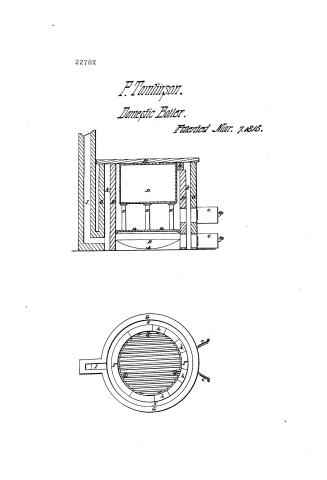
P. Tomlinson's Patent Drawing for Improvements in the Construction of Furnaces and Fireplaces

National Archives, Restored Patent Drawings (Record Group 241) · Full-size scan at the National Archives · Catalog record
Show the text on the drawing Hide (122 words)
Words on the drawing as machine-read by the National Archives; not checked. Useful mainly for searching.
190 / Vol.3.p.401 Vol.3 401 / 150 / P. O TOMLINSON / Biler / CLASSIFICATION / Constructing Furnaces & Fire Places / 2278.x / DIVISION. / Patented 11/ "March 1815 / Section / a., Grate / _A, Bottom of Furnace / B. Ash nit / C. Doors / D.B oiler / it / E' / II. Supporting Pillars / F Tnner Wall / G. Outer Wall / H. Top stone Supported bypiers h / I Chimney / K. Papag for Flame & Smoke / useful in Stills steams engines, Cubrises +Coppers, and overs. / This / It Pl Z an / JC / To / FL / Pl / 17 / BI / 7C / Strickland Del / Patent office Mar 2 21840 / Made under the direction of the communisms of hotent / in conformety with act of 3 March 1837 / M L Superth / Commissioner of patents / bru.G,
USPTO scan
The patent as scanned by the USPTO
-
 Page 1
-
 Page 2
-
 Page 3


U.S. Patent and Trademark Office · Google Patents
Show the transcription Hide (718 words)
Machine transcription (LightOnOCR) of the pages as scanned by the USPTO, most of them the handwritten copies made when the records were restored after the 1836 fire. Not checked; it can misread handwriting, so compare it with the scan.
Page 1.
2278X
F. Tomlinson.
Domestic Boiler.
Patented Mar. 7, 1815.


Page 2.
March 7, 1815
2278X
The schedule refers to in these Letters Patent and making part of, the same containing a description in the words of the said Peter Tomlinson himself of his mode of constructing Furnaces & Fire places.
The bottom of the improved furnace is in the form of a shallow bowl without iron grating in the centre over an ash pit, with suitable doors above & below the grating, the boiler is suspended on three or more pillars of cast iron bricks or suitable stone leaving a hollow space around the pillars between the bottom of the furnace & the boiler, extending under the whole bottom of the boiler. The inner wall of the furnace is then raised with brick or suitable stone up the sides of the boiler concentrically therewith & surrounding at the distance of about one inch leaving a space all around the boiler of one inch for the passage of the heat & flame in its ascent & is not to come in contact with the boiler. The sides thus surrounding the boiler are raised nearly to the top about four inches thick, thus forming an inner or partition wall. Another wall of brick is then raised so as to surround the first at the distance of about three inches in all parts leaving a space of about 3 inches between the first described partition wall & the outer wall of the furnace. Over the whole is a top of thin stone or cast iron, fitting plain & tight to the boiler & the outward wall & resting on piers on the inner wall so as to have communication for the passage of the flame & smoke between the inner & outer vacant space except about one third round the boiler near the funnel or chimney where the communication is cut off by carrying the inner partition up to the cover. The cover can at any time be removed so as to sweep or cleanse the passages when soiled. A chimney or funnel is to be erected on one side so as to communicate with the bottom of the exterior vacant space to carry off the smoke. The effect of this furnace is that when the fire is placed on the grate the flame and heat ascend without obstructing upon the bottom & up the sides.
Page 3.
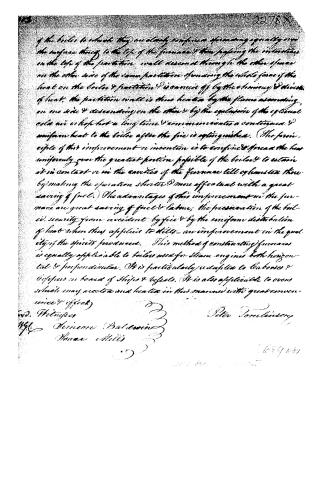
of the boiler to which they are closely confined, spreading equally over the surface thereof to the top of the furnace, & then passing the incandescent in the top of the partition wall downward through the other space on the other side of the same partition, spreading the whole force of the heat on the boiler & partition & is carried off by the chimney & dissipated of heat, the partition wall is thus heated by the flame ascending on one side & descending on the other & by the expansion of the external cold air is kept hot a long time & communicates a continuous & uniform heat to the boiler after the fire is extinguished. (The principle of this improvement or invention is to confine & spread the heat uniformly over the greatest portion possible of the boiler & to retain it in contact or in the cavities of the furnace till extinguished thereby making the operation shorter & more effectual with a great saving of fuel.) The advantages of this improvement in the furnace are great saving of fuel & labour, the preservation of the boiler, security from accident by fire & by the uniform distribution of heat when thus applied to stills—an improvement in the quality of the spirits produced. This method of constructing furnaces is equally applicable to boilers used for steam engines both horizontal & perpendicular. It is particularly adapted to Cabins & Offices on board of Ships & Vessels. It is also applicable to ovens which may be erected and heated in this manner with great convenience & effect.)
Peter Tomkins
Witnesse
Wm. Vereen Baldwin
Thomas Mills
63900
About this record
- Patentee
- Jim Shaw's X-patent list
- Date
- the Name and Date index of patents, USPTO records, Jim Shaw's X-patent list
- Invention
- the Name and Date index of patents
- Listed in
- the Name and Date index of patents, USPTO records, Jim Shaw's X-patent list, S. A. Elliot's printed list of patents, Burke's List of Patents (1847)
- S. A. Elliot's printed list of patents gives the same name and date.
- Burke's 1847 Patent Office list gives the same patent.
- Residence from Burke's 1847 Patent Office list; the standard lists give none.