

Drawings and documents
National Archives restored drawings: drawing
Charles Postley's Patent Drawing for Improvements to Stoves

National Archives, Restored Patent Drawings (Record Group 241) · Full-size scan at the National Archives · Catalog record
Show the text on the drawing Hide (178 words)
Words on the drawing as machine-read by the National Archives; not checked. Useful mainly for searching.
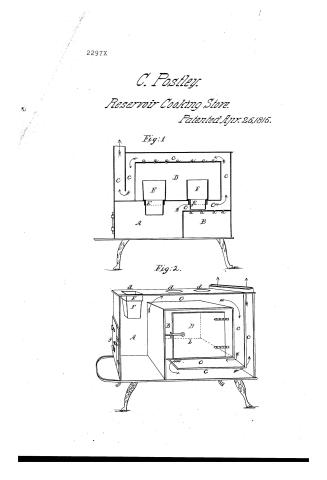
126 STOVES &FURNA CTS is / X Reservoir Cooking Stoves / $150 / CLASS TICATION / Calonfic book stone / 2297-x / CHARLES POSTLEY. / DIVISION. / Imp in Moves. / Beference. / Patented April 26th 1815. / Vol: 3. page 426- / Fig:1. represents the Stove with 13 plates- / Fig:2 represents Stove with 12 plates / A, (Figs 192) the furnace- / B, ( Figs 102) oven / c, / Figh) flue / D, (Fig:1. , second oven / E E', (Fig142) openings for recuring / Fig.1. / Fig, 2. / projecting tubes from boilers F.F. / a,a,a,oc (Figl , small opening for / >>>> / Fy / carrying off the steam which may / Perspective view. / arrise from cooking &c... / & showing the interior / c, (Fig2) flue / IB / b, (Fig:2) door fixed on hinges, / d,d,d, (Fig:2) appertures in topptate / f, (Fig:2) folding doors - for the / purpose of showing the fire / the same as a Franklin Stove. / Section / August A. Von Johmidt Detra / Patent Office / May 8th 1846. / made under the direction of the Commifsioner / of Patents in conformity with the act of / 3: March 1857. / Allmu Durke / Commissionerg Patents
USPTO scan
The patent as scanned by the USPTO
-
 Page 1
-
 Page 2
-
 Page 3
-
 Page 4


U.S. Patent and Trademark Office · Google Patents
Show the transcription Hide (930 words)
Machine transcription (LightOnOCR) of the pages as scanned by the USPTO, most of them the handwritten copies made when the records were restored after the 1836 fire. Not checked; it can misread handwriting, so compare it with the scan.
Page 1.
2297X
C. Postley.
Reservoir Cooking Stove.
Patented Apr. 26, 1815.
Fig. 1
Fig. 2.
Page 2.
Charles Fostley —
Letters Patent dated April 26th 1845 and Recorded anew May, 26th, 1845.
The Schedule referred to in these Letters Patent and making part of the same containing a description in the words of the said Charles Fostley himself of his improvement in Stoves.
This Stove may be made either of sheet or cast iron or any other suitable materials, it consists of thirteen plates, at one end of the stove is a furnace of the width of the stove, the depth and height according to the size of the stove, say from 9 to 12 inches depth, height 4½ inches and in length the width of the stove.
The fire is made on the bottom of the plate of the stove and the remainder of the stove consists of an oven of the height of from 6 to 9 inches, above the oven is a flue leading from the furnace of 2½ inches in height, and the width of the stove, this leads to the end of the stove farthest from the furnace and then being contracted to 2 inches ascends to the top and is carried under the top plate to within 4½ inches of the other end, then descends to the plate over the furnace, and again ascends to the opening which carries off the smoke, the centre of the stove forms a second oven which will be from 18 to 24 inches in length according to the size. By this construction the fire being made at one end and adjoining the plate of the bottom oven, is carried over the same and also all around the upper oven giving a more uniform heat than other stoves. (Burns in the furnace) and also in the flue leading directly from it are openings of 8¼ inches in length and 1¼ inch in depth for receiving projecting tubes from
Page 3.
boilers which are shown in said openings and remain at pleasure, these tubes are from 9 to 12 inches long according to the size of the boilers, and in width and thickness to fill the openings that are in the stove. In the top plates of the ovens are small openings for escaping of the steam which may arise from cooking etc. The boilers may be made of copper tin sheet or cast iron, or any other suitable materials and of any size required; the boilers for boiling clothes may be made of wood with copper tubes, or other suitable materials.
The stove may also be constructed thus, with 12 plates, the furnace at one end of the stove, from 9 to 12 inches in width and in length the width and the height of the stove, the fire ascends to the top of the stove, and there is carried off in a flue of 3 inches in depth and the width of the stove, to within 2 1/2 inches of the other end of the stove, then the flue is contracted to 2 inches and descends to within 4 1/2 inches of the bottom and then takes a direction along the bottom of the oven until it arrives at the back plate of the furnace and then returns to the farther end in a flue of 2 inches and then ascends to the opening which carries off the smoke in a flue of 2 inches also, all the flues are of the whole width of the stove, thus leaves the middle of the stove open and is converted into an oven by means of a door fast on hinges and will be of any size according to the size of the stove, say in general from 15 to 24 inches in length & from 8 to 12 inches in depth and is surrounded with heat.
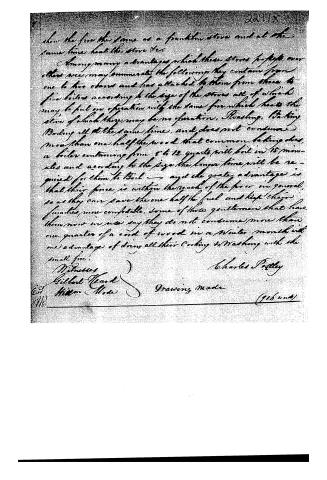
The top plate of the stove has from 2 to 3 apertures immediately over the fire, the others between that and the further end of the stove, in they may be placed tubes of any size the stove will admit of; there are also openings in the furnace for receiving projecting tubes of boilers, the fire being at one end of the stove the furnace may have sliding doors and being left open
Page 4.
show the fire the same as a Franklin stove and at the same time heat the stove too.
Among many advantages which these stoves possess over others we may enumerate the following: they contain from one to two chairs and has attached to them from three to five boilers according to the size of the stoves all of which may be put in operation with the same fire which heats the stove of which there may be no operation. Stewing, Baking, Boiling all at the same time, and does not consume more than one half the wood that common baking does, a boiler containing from 8 to 12 quarts will boil in 15 minutes and according to the size the longer time will be required for them to boil — and the great advantage is that their price is within the reach of the poor in general, so as they can save the one half the fuel and keep their families more comfortable. Some of these gentlemen that have them now in use say they do not consume more than one quarter of a cord of wood in a winter month with one advantage of doing all their Cooking & Washing with the small fire.
Witnesses
Gilbert Heard
William Mode
Charles Pottley
Drawing made
(216 and)
62
1716
About this record
- Patentee
- Jim Shaw's X-patent list
- Date
- the Name and Date index of patents, USPTO records, Jim Shaw's X-patent list
- Invention
- the Name and Date index of patents
- Listed in
- the Name and Date index of patents, USPTO records, Jim Shaw's X-patent list, S. A. Elliot's printed list of patents, Burke's List of Patents (1847)
- S. A. Elliot's printed list of patents gives the same name and date.
- Burke's 1847 Patent Office list gives the same patent.
- Residence from Burke's 1847 Patent Office list; the standard lists give none.