

Drawings and documents
National Archives restored drawings: drawing
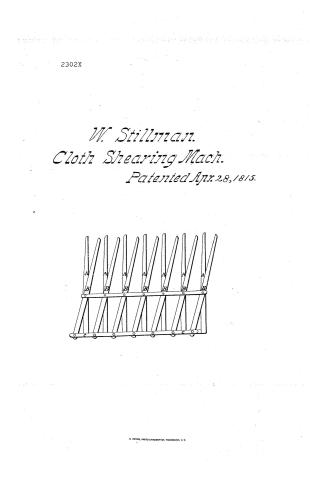
William Stillman's Patent Drawing for a Machine for Shearing Cloth

National Archives, Restored Patent Drawings (Record Group 241) · Full-size scan at the National Archives · Catalog record
Show the text on the drawing Hide (71 words)
Words on the drawing as machine-read by the National Archives; not checked. Useful mainly for searching.
M. / CLOTH. Dhus butt / Vol.3. 11.417 / [37] Shearing. / $1- / CLASSIFICATION / 2302-X / DIVISIÓN. / W () S STILLMAN / Shearing Cloth / Patented 25ᵗʰ 11' 1515 / A I edget blades / B. Runners or Flying Wades / C. Counting Rod / Strickland Del / Patent office Mar 2 1840 / Made under the direction of the commyssoner of pated / in conformity with act of 3 March 1337- / Commisuour of Patents / brd.G.
USPTO scan
The patent as scanned by the USPTO
-
 Page 1
-
 Page 2
-
 Page 3


U.S. Patent and Trademark Office · Google Patents
Show the transcription Hide (474 words)
Machine transcription (LightOnOCR) of the pages as scanned by the USPTO, most of them the handwritten copies made when the records were restored after the 1836 fire. Not checked; it can misread handwriting, so compare it with the scan.
Page 1.
2302X
W. Stillman.
Cloth Shearing Mach.
Patented Apr. 28, 1815.

H. PETERS, PHOTO-LITHOGRAPHER, WASHINGTON, D. C.
Page 2.
April 28, 1815
William Pittman
Letters Patent
2302X
April 28, 1815
The Schedule referred to in these Letters Patent and making part of the same containing a description in the words of the said William Pittman himself of his improvement in Shears for Shearing Cloth.
The distinguishing principle of this improvement consists in having a number of pairs of small shears abreast, and may be termed a gang of shears for shearing cloth. The larger blade of each pair is placed lengthwise of the piece of cloth to be sheared, and are about six inches long, though they may be longer or shorter, and are about four inches apart, though their distance apart may be more or less. There must be a sufficient number of them to extend from one edge of the cloth to the other.
The manner of flying blades more backward, and forward similar to hand shears, they may couple together with a rod and move all at once, or be moved separately as is found best. While the shears are in operation the whole gang is gradually moved until the first pair shear to the place where the next pair began, and that pair to where the next pair began, and so on through the gang, thus a strip as wide as the cut of the shears is long, is sheared quite across the piece of cloth, while the shears move but a very small distance. This being done the whole gang is thrown back to the place where they first began, and begin anew. This operation is continually repeated while the cloth is gradually moving forward across the cushion against which the shears operate, or the cloth may be moved forward by sudden thrusts, as often as the gang of shears are thrown back. These shears may be applied horizontally or perpendicularly over or under the cloth. Again I discover that the side motion may be given either to the cloth or shears, and have the same effect, as to the frame of the machine, and apparatus necessary.
Page 3.
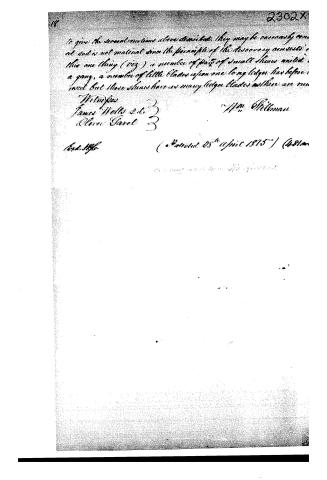
to give the several motions above described, they may be correctly arranged and is not material since the principle of the discovery consists in this one thing (viz.) a number of pairs of small shears united in a gang, a number of little blades upon one long ledger has before existed but these shears have as many ledger blades as there are rows.
Windsor
James Wells & Co.
Oliver Tavel
Wm. Stillman
( Patented 25th April 1875 ) (481m
Exd. 1876.
About this record
- Patentee
- Jim Shaw's X-patent list
- Date
- the Name and Date index of patents, USPTO records, Jim Shaw's X-patent list
- Invention
- the Name and Date index of patents
- Listed in
- the Name and Date index of patents, USPTO records, Jim Shaw's X-patent list, Burke's List of Patents (1847)
- Burke's 1847 Patent Office list gives the same patent.