

Drawings and documents
National Archives restored drawings: drawing
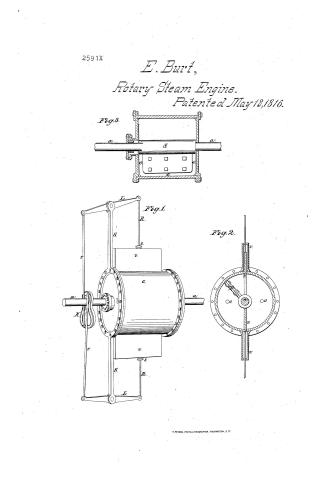
Enoch Burt's Patent Drawing for a Steam Engine

National Archives, Restored Patent Drawings (Record Group 241) · Full-size scan at the National Archives · Catalog record
Show the text on the drawing Hide (165 words)
Words on the drawing as machine-read by the National Archives; not checked. Useful mainly for searching.
W Burt / motary. / ENOCH BI / Piston / PL / Steam Engine / Sh A / CLASSIFICATION / 2591-4 / Patented May. 12th 18, / DIVISION. / FIG 3 / V.3. h.477 / Gylender.Head / Fig.1. C The cylinder / V.r. The valve-cases / Piston / R.R. Rods attachedlo the Valves / L. Lever Beams connecte 11 with the Rods / S. Standards supporting them. which are modejast 1/10 Head / The Cylacter by Botts. 7c. Cam. a.The axis. / L. / 7:7: Rods by which me I ever Beams are movell haveng all their / opposite ends recision rollers which are embraced / hy the two projecting 721118 office exacutrio Camk / S.S. slassing Boxes around the / D.O. Passagesjanthe steam to enter Hie Colinder / Fig 2. Section nj colunder showing the perston / FIG. 1. / aller axes, /e Piston, U.Y. unlves, 0.0. Steam/sajjages / S. Shaft / e.c.e.e. Edging forlayingen parking / FIG / OX / 7c / Patent 1838 / Made under the direction of the Commysioner / of Patents in conformity with acts March 1837. / Commifroner of Patents
USPTO scan
The patent as scanned by the USPTO
-
 Page 1
-
 Page 2
-
 Page 3


U.S. Patent and Trademark Office · Google Patents
Show the transcription Hide (633 words)
Machine transcription (LightOnOCR) of the pages as scanned by the USPTO, most of them the handwritten copies made when the records were restored after the 1836 fire. Not checked; it can misread handwriting, so compare it with the scan.
Page 1.
2591X
E. Burt,
Rotary Steam Engine.
Patented May 12, 1816.
Fig. 3.
Fig. 1.
Fig. 2.
Page 2.
Pat. May 12, 1816
Enoch Burt
Letters Patent.
The Inventor referred to in these Letters Patent and making part of the same containing a description in the words of the said Enoch Burt himself of his improvement in the Steam Engine.
First: in a piston revolving in a circular cylinder or steam vessel, instead of reciprocating in a rectilinear one by which means the power is applied immediately to the main axis. Second: the power acts constantly at right angles, which cannot be the case in the common engine. Third: the steam acts without intermission on the piston constantly propelling it forward, whereas in the common engine the piston is brought to rest twice in every revolution of the main axis.
Every engine is constructed after the following manner: The cylinder or steam vessel may externally resemble a sphere, or the common cylinder lying horizontally — the axis passing through its center; the piston is attached to the axis. As the axis revolves the piston describes a circle corresponding to the internal cavity of cylinder. To prevent the steam from passing by the piston it is packed after the common manner. At opposite sides of the cylinder are two sliding valves for the steam alternately to react upon — If one of these valves be shut, and the piston standing in front of it the steam to admit between them it will of necessity act on the piston, and propel it forward; the opposite valve being open the piston will pass its place in the cylinder without obstruction, but immediately on the piston passing that point the valve begins to close and will be completely shut when the piston has come to opposite
Page 3.
from a right angle with it, at this instant the steam shifts into the other part of the cylinder between the piston and the valve that has just closed, while the steam behind this valve is condensed, and the other sliding valve is opened so that the piston now passes by its place in the cylinder as it has that of the other when this valve also closes the steam is shifted as before between the valve and piston and the opposite side at the same time is condensed.
Since then the sliding valve in the cylinder which opens at the approach of the piston and closes after it shuts down in the middle of the steam it is evident that at the moment the steam shifts it is in the act of shifting that section of the cylinder which lies between the valve last shut and the piston is fully charged with steam into which the steam is again admitted as it shifts which is an operation almost instantaneous hence the piston must have the full and constant action of the steam upon it with a constant vacuum before it. If the steam be shifted by the hand of the engineer so as to act on the opposite side of the piston, the motion is instantly reversed, which will continue until by a similar operation the first motion be again restored. It may be proper here to state that I make use of the common condensing apparatus, only adapting it to my engine, and also that I convey the steam into the cylinder through the common steam chest, & shift it by the sliding valve therein.
With these exceptions, the above described engine I claim as an invention and improvement of my own.
Witnesses
Sarah B. Coden
David Meeker
( Patented May 12, 1816 )
About this record
- Patentee
- Jim Shaw's X-patent list
- Date
- the Name and Date index of patents, USPTO records, Jim Shaw's X-patent list
- Invention
- the Name and Date index of patents
- Listed in
- the Name and Date index of patents, USPTO records, Jim Shaw's X-patent list, S. A. Elliot's printed list of patents, Burke's List of Patents (1847)
- S. A. Elliot's printed list of patents gives the same name and date.
- Burke's 1847 Patent Office list gives the same patent.