

Drawings and documents
USPTO scan
The patent as scanned by the USPTO
-
 Page 1
-
 Page 2
-
 Page 3
-
 Page 4


U.S. Patent and Trademark Office · Google Patents
Show the transcription Hide (1,034 words)
Machine transcription (LightOnOCR) of the pages as scanned by the USPTO, most of them the handwritten copies made when the records were restored after the 1836 fire. Not checked; it can misread handwriting, so compare it with the scan.
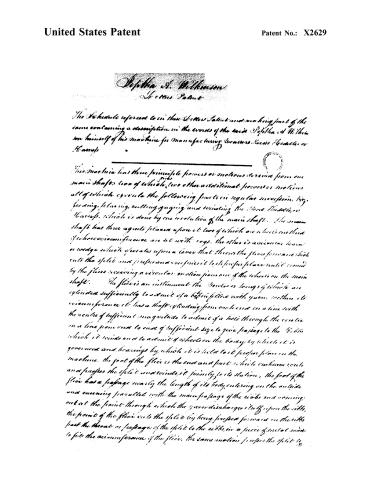
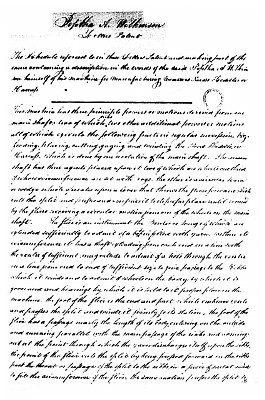
Page 2.
United States Patent
Patent No.: X2629
Stephanie A. Wilkinson
Letters Patent
The Schedule referred to in this Letters Patent and making part of the same containing a description in the words of the said Stephanie A. Wilkinson herself of his machine for manufacturing tobacco, cigars, cigarettes or Hamap.
This machine has three principle powers or motions derived from one main shaft, two of which, two other additional powers or motions all of which operate the following parts in regular succession, viz., feeding, slicing, cutting, guaging and winding the same. The main shaft has three agents placed upon it, two of which are wheels one third of whose circumference are set with cogs, the other is a conical beam or wedge which operates upon a lever that throws the flens forward which cuts the slice and presses and confines it to its proper place until wound by the flens receiving a circular motion from one of the wheels on the main shaft. The flens is an instrument the bowls or loings of which are extended sufficiently to admit of a being filled with yarn, within its circumference it has a shaft extending from each end on a line with the centre of sufficient magnitude to admit of a hole through the centre on a line from one to end of sufficient size to give passage to the bits which it winds and to admit of wheels on the body by which it is governed and bearings by which it is held to its proper place in the machine. The foot of the flens is the end and part which continues to cut and passes the slice and winds it firmly to its station, the foot of the flens has a passage nearly the length of its body, entering on the outside and running parallel with the main passage of the coils and coming out at the point through which the yarn discharges itself upon the coils, the point of the flens cuts the slice by being pressed forward on the coils past the throat or passage of the slice to the coils in a piece of metal made to fit the circumference of the flens. The same motion passes the slice to
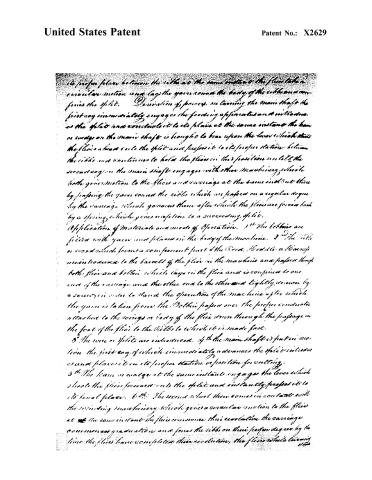
Page 3.
United States Patent
Patent No.: X2629
its proper place between the ribs at the same instant the flint takes a circular motion and lays the yarn round the body of the rib and confines the split. Deviation of process, on turning the main shaft the first way immediately engages the feeding apparatus and introduces the split and conducts it to its place at the same instant the beam or swage on the main shaft is brought to bear upon the lever which thrusts the flint ahead onto the split and forces it to its proper station between the ribs and continues to hold the flint in this position until the second way on the main shaft engages with other machinery which both gives motion to the flint and overage at the same instant then by passing the yarn round the ribs which are spaced on a regular degree by the overage which governs them after which the flint are forced back by a spring which gives motion to a succeeding split.
Application of Materials and mode of Operation. 1st The bobbins are filled with yarn and placed in the body of the machine. 2nd The ribs or wood which forms a component part of the Rod, Head etc. a Screw is introduced to the barrel of the flint in the machine and passes through both flint and bobbin which lays in the flint and is confined to one end of the carriage and the other end to the other and tightly secured by a screw in order to stand the operation of the machine after which the yarn is taken from the Bobbin passed over the proper conductor attached to the wings or body of the flint down through the passage in the foot of the flint to the ribs to which it is made fast.
3rd The wire or split are introduced. 4th the main shaft is put in motion the first way of which immediately advances the split introduced and places it in its proper station or position for cutting. 5th The beam or swage at the same instant engages the lever which shoots the flint forward onto the split and instantly forces it to its final place. 6th: The second wheel then comes in contact with the winding machinery which gives a circular motion to the flint at the same instant the flint commences this revolution the carriage commences graduation and forces the ribs on their proper degree by the time the flint have completed their revolution, the flint while turning
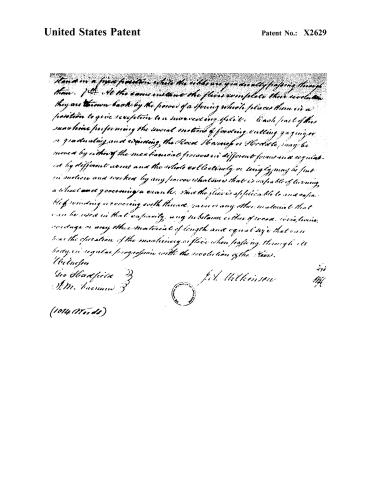
Page 4.
United States Patent
Patent No.: X2629
stands in a fixed position while the corks are gradually passing through them. At the same instant the flairs complete their revolution they are thrown back by the power of a spring which places them in a position to give reception to a succeeding flair. Each part of this machine performing the several motions of forcing, cutting, or grating or gradually and winding the thread through or through the may be moved by either of the mechanical powers in different forms and regulated by different means and the whole collectively or singly may be put in motion and worked by any power whatsoever that is capable of turning a wheel and governing a crank. That the flairs is applicable to and capable of winding or covering with thread, yarn or any other material that can be used in that capacity, any substance either of wood, wire, twine, cordage or any other material of length and equal size that can be at the discretion of the machinery or flairs when passing through its body in regular progression with the revolution of the thread.
Witnesses
Geo. Shadefield
J.M. Loomis
J.H. Wilkinson
(1014 Words)
DATAMP: illustration
Illustrations from DATAMP
DATAMP (Directory of American Tool and Machinery Patents), via the Internet Archive · Archived DATAMP page
About this record
- Patentee
- DATAMP
- Date
- the Name and Date index of patents, DATAMP, USPTO records
- Invention
- DATAMP
- Listed in
- the Name and Date index of patents, DATAMP, USPTO records, Jim Shaw's X-patent list, S. A. Elliot's printed list of patents, Burke's List of Patents (1847)
- S. A. Elliot's printed list of patents gives the same name and date.
- Burke's 1847 Patent Office list gives the same patent.