

Drawings and documents
USPTO scan
The patent as scanned by the USPTO
-
 Page 1
-
 Page 2
-
 Page 3
-
 Page 4


U.S. Patent and Trademark Office · Google Patents
Show the transcription Hide (1,049 words)
Machine transcription (LightOnOCR) of the pages as scanned by the USPTO, most of them the handwritten copies made when the records were restored after the 1836 fire. Not checked; it can misread handwriting, so compare it with the scan.
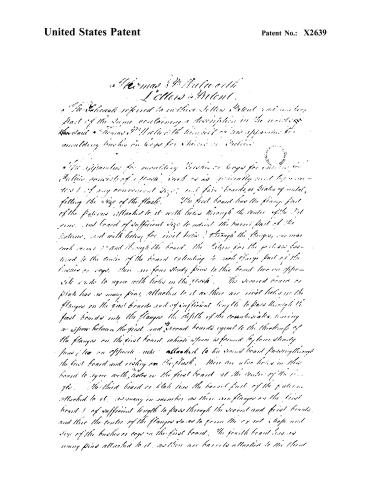
Page 2.
United States Patent
Patent No.: X2639
Thomas & W. H. H. H.
Letters & Patent.
The Patent referred to in these Letters Patent and one copy part of the same containing a description in the words of the said Thomas & W. H. H. H. himself or his apparatus for moulding bushes or cups for shoes or boots.
The apparatus for moulding bushes or cups for shoes or boots consists of a flask, such as is generally used by manufacturers of any convenient size, and four boards or plates of metal, filling the size of the flask. The first board has the flange part of the patterns attached to it with holes through the centre of the flask, and board of sufficient size to admit the barrel part of the patterns, and with holes for said holes through the flanges on each corner and through the board. The holes for the patterns fastened to the centre of the board extending to each flange part of the bushes or cups. There are four sturdy pins to this board two on opposite sides under to agree with holes on the flask. The second board or plate has as many pins attached to it as there are said holes in the flanges on the first boards and of sufficient length to pass through the first boards into the flanges the depth of the counter-sink, leaving as space between the first and second boards equal to the thickness of the flanges on the first board, which space is formed by four sturdy pins (two on opposite sides) attached to the second board passing through the first board and resting on the flask. There are also holes in this board to agree with holes in the first board at the centre of the flange. The third board or plate has the barrel part of the patterns attached to it, as many in number as there are flanges on the first board, of sufficient length to pass through the second and first boards, and thus the centre of the flanges so as to form the exact shape and size of the bushes or cups on the first board. The fourth board has as many pins attached to it as there are barrels attached to the third
Page 3.
United States Patent
Patent No.: X2639
board of a size to agree with the inside of the barrels and of sufficient length to extend into the barrels passing through the third and second and first boards, leaving a space between the fourth and third boards equal to the length of the barrels below the flanges on the first board, which space is formed by two pins, two in opposite ends, attached to the second board passing through the third and second boards and resting on the first board. The fifth board places in it to form the counter-sink to the rivet holes in the flanges. The process for moulding the cast or cups is by placing that part of the flange commonly called the neck in a convenient place for moulding with the holes for the steady pins affixed, then the first board to which is attached the flange part of the pattern is placed on the flask the steady pins in the board filling the holes in the flask to keep it from varying; then the second board is placed on the first board, the third on the second, and the fourth on the third, two narrow strips of wood are put between the fourth and third boards (of sufficient thickness to fill the space) to prevent any variation by the pressure of the sand while moulding; then by laying the boards and flasks over the exact shape and size of the castings or cups are to be run on the first board, the sand is then thrown freely into the flasks (on the patterns) until the flasks are full, a board is then placed on the flasks and the whole is turned bottom up, the two strips of wood between the fourth and third boards are taken out, and the fourth or top board (to which is attached the pins that extend into the barrel part of the patterns) is kept firmly to its place to prevent the sand moulded in the barrels from rising while the third board, to which is attached the barrel part of patterns, is drawn up to the fourth or top board, then the two boards, fourth and third, are taken off; then the second board (to which is attached the pins that fit the rivet holes in the flanges) is kept firmly to its place to prevent the sand that form the rivet holes in the flanges from rising while the first board (to which is attached the flange part of the patterns) is drawn up to it, the second and first boards are then taken off.
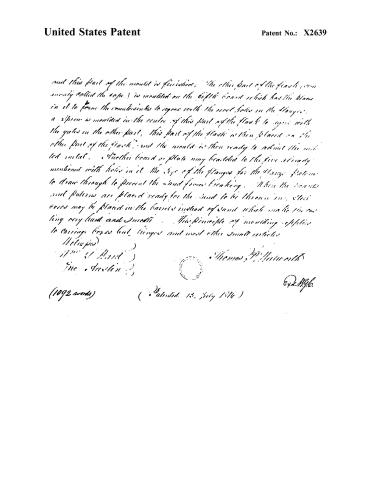
Page 4.
United States Patent
Patent No.: X2639
and this part of the mould is finished; the other part of the flask (commonly called the cope) is moulded on the fifth board which has the places in it to form the counter-sinks to agree with the cast holes in the flanges. A spout is moulded in the centre of this part of the flask to agree with the gates in the other part. This part of the flask is then placed on the other part of the flask, and the mould is then ready to admit the melted metal. Another board or plate may be added to the five already mentioned with holes in it the size of the flanges for the flange plates to draw through to prevent the sand from breaking. When the boards and plates are placed ready for the sand to be thrown in, steel cores may be placed in the cavities instead of sand which make the casting very hard and smooth. This principle of moulding applies to carriage boxes (and hinges and most other small articles.
Melicpao
11th of March
The A. Austin
Thomas P. Hittworth
(1092 words)
(Patented 13, July 1876)
About this record
- Patentee
- Jim Shaw's X-patent list
- Date
- the Name and Date index of patents, USPTO records, Jim Shaw's X-patent list
- Invention
- the Name and Date index of patents
- Listed in
- the Name and Date index of patents, USPTO records, Jim Shaw's X-patent list, S. A. Elliot's printed list of patents, Burke's List of Patents (1847)
- S. A. Elliot's printed list of patents gives the same name and date.
- Burke's 1847 Patent Office list gives the same patent.