

Drawings and documents
USPTO scan
The patent as scanned by the USPTO
-
 Page 1
-
 Page 2
-
 Page 3


U.S. Patent and Trademark Office · Google Patents
Show the transcription Hide (1,028 words)
Machine transcription (LightOnOCR) of the pages as scanned by the USPTO, most of them the handwritten copies made when the records were restored after the 1836 fire. Not checked; it can misread handwriting, so compare it with the scan.
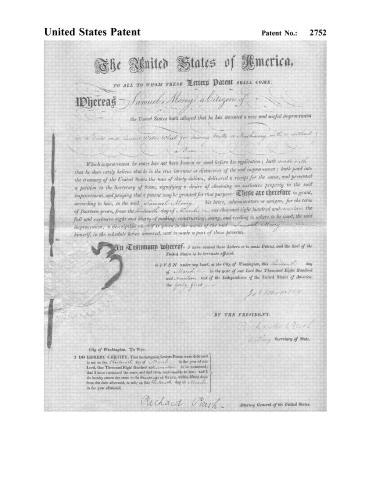
Page 1.
United States Patent
Patent No.: 2752
The United States of America,
TO ALL TO WHOM THESE Letters Patent shall come:
Whereas Samuel Henry, a citizen of the United States, hath alleged that he has invented a new and useful improvement in a Water and Current Water Wheel for driving Mills or Machinery with or without a Dam.
Which improvement he states has not been known or used before his application; hath made oath that he does truly believe that he is the true inventor or discoverer of the said improvement; hath paid into the treasury of the United States the sum of thirty dollars, delivered a receipt for the same, and presented a petition to the Secretary of State, signifying a desire of obtaining an exclusive property in the said improvement, and praying that a patent may be granted for that purpose: These are therefore to grant, according to law, to the said Samuel Henry, his heirs, administrators or assigns, for the term of fourteen years, from the twentieth day of March, one thousand eight hundred and one, the full and exclusive right and liberty of making, constructing, using, and vending to others to be used, the said improvement; a description whereof is given in the words of the said Samuel Henry, himself, in the schedule hereto annexed, and is made a part of these presents.
In Testimony whereof, I have caused these Letters to be made Patent, and the Seal of the United States to be hereunto affixed.
In J. V. P. M. under my hand, at the City of Washington, this twentieth day of March, in the year of our Lord One Thousand Eight Hundred and one, and of the Independence of the United States of America, the forty-first.
BY THE PRESIDENT.
Richard Rush
Secretary of State.
City of Washington, To Wit:
I DO HEREBY CERTIFY, That the foregoing Letters Patent were delivered to me on the twentieth day of March, in the year of our Lord, One Thousand Eight Hundred and one, to be examined; that I have examined the same, and find them conformable to law; and I do hereby return the same to the Secretary of State, within fifteen days from the date above, in wit; on this twentieth day of March, in the year above.
Richard Rush
Attorney General of the United States.
Page 2.
United States Patent
Patent No.: 2752
The wheel is supported on three iron bars, and moving part of the frame containing a mechanism on the wheel of the first element, every member of the mechanism is a bar with a round head, ready for driving a belt or chainway, with or without a chain.
The couple of a further wheel of an eight eight flange, placed in such a manner that the wheel may enter the wheel on one side on a common, equal in width to help to drive, with a width of that of the length of the flange, helping out in every direction except where we enter, acting constantly on each, every flange of the wheel to drive it round. The wheel may be constructed looking with reference to the following manner: a flange and polygonal wheel for a bar wheel, the inner part of which is a circular platform is fixed, round of boards or plank, of the diameter of the outer bar wheel, say 12 feet diameter. A circle within flange of a above four feet diameter, is two thirds of that of the wheel, which is divided into eight equal parts, one part of the circumference is then fixed to the first flange, and the other seven parts join to the flange, of the wheel, a bar then drawn from one part to the other, across the flange and face of the board, and of the board, and the top and bottom of the frame, across the other ends are supported at top by a bar rising to form a round arch, about nine or ten inches wide. A frame is formed to cover the remaining face of the wheel, at an angle of about 45 degrees to form that part, and divide the top, into the other face, when the flange round it is nearly parallel lines, but an inclination to help out, it cuts the flange at nearly a right angle, a part helping out by each flange, and the side helping round on the wheel to the frame, or where a first element, constantly helping the wheel round by its gravity, as well as by its action on helping in but not against the flange. A wheel of that top with flange for feet long, with flange in a round of about four inches high, a frame sufficient to turn a quarter circle, four feet diameter, for purposes, or well be the work of from one to two men while at work. The top not only be made of boards, the flange on the back for flange be covered by a clear edge, then the, one, two, and help through the wheel, the more round. This is a double flange, be placed by the side of the wheel to keep the more from helping by it when thrown, that way by the frame. The frame sides may be reduced, in laying out a wheel of any size, from one of three feet diameter, to those of sixteen or twenty. Wheels 24 feet diameter may have 12, and those of 32 feet in are set out by the same rule, that is, let the width of the flange be the same as the distance from each other on the circle, two thirds the diameter of the wheel. If the wheel is designed to be run by the
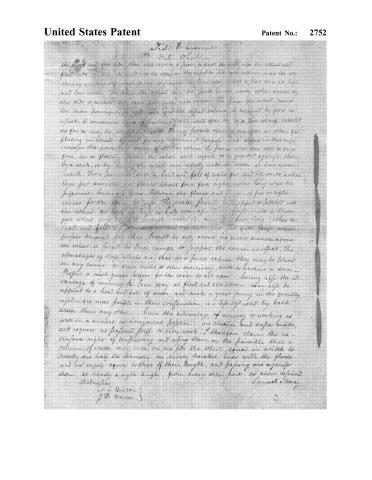
Page 3.
United States Patent
Patent No.: 2752
Title: Wheel
The R and the S are then connected by a p and the w is put into the w at the f and l are then put into the w at the r …
About this record
- Patentee
- DATAMP
- Date
- the Name and Date index of patents, DATAMP, USPTO records
- Invention
- DATAMP
- Listed in
- the Name and Date index of patents, DATAMP, USPTO records, Jim Shaw's X-patent list, S. A. Elliot's printed list of patents, Burke's List of Patents (1847)
- S. A. Elliot's printed list of patents gives the same name and date.
- Burke's 1847 Patent Office list gives the same patent.