

Drawings and documents
USPTO scan
The patent as scanned by the USPTO
-
 Page 1
-
 Page 2
-
 Page 3
-
 Page 4
-
 Page 5
-
 Page 6
-
 Page 7


U.S. Patent and Trademark Office · Google Patents
Show the transcription Hide (2,201 words)
Machine transcription (LightOnOCR) of the pages as scanned by the USPTO, most of them the handwritten copies made when the records were restored after the 1836 fire. Not checked; it can misread handwriting, so compare it with the scan.
Page 2.
United States Patent
Patent No.: X2845
Alexander Blacke
Sellers Patent
This schedule referred to in the said Patent and making part of the same containing a description on the works of the said Alex Blacke of his improvement in Lamps.
The Lamp is a common Argand Lamp for light heated and the work is raised by a view the same method of heating to be applied to any other kind of Lamps. For heating the oil a pipe, syphon, tube, hood inverted, funnel or cap of copper or other metal, square, round, or any other figure that the heated air may be driven into around once or under the oil. One part of the hood or other consequence is attached to the case of the reservoir with a hole for the smoke and heat to rise. And the lamp is so connected to the fountain clearly so that communication is kept in between the two edges of the case and fountain fit closely. Keep two small holes near the union with the fountain for discharging the smoke which collects between them. When large reflectors are used a hole is cut through the reflector for placing the glass upon the lamp. Finally over this hole inside of the reflector a self if necessary is applied to convey the smoke through behind the reflector which operates on the pipe syphon tube hood inverted funnel or cap in the same manner as with small reflectors. Also a solid rod or bar of metal with fire, has a semicircular effect for the same purpose by inserting a metal rod through the fountain base of the lamp with its top part bent over the blaze of the lamp and made hollow like the hood or cap before mentioned, so that the blaze may operate on the inside of the cavity and heat the metal. At the bottom of the rod a hole extends through the fountain a large metal bottom may be soldered to retain the heat between the case and fountain. The hood or cap part of the rod may be one half of an inch more or less in the thickness, and the rod may be one inch thick or more or less.
Page 3.
United States Patent
Patent No.: X2845
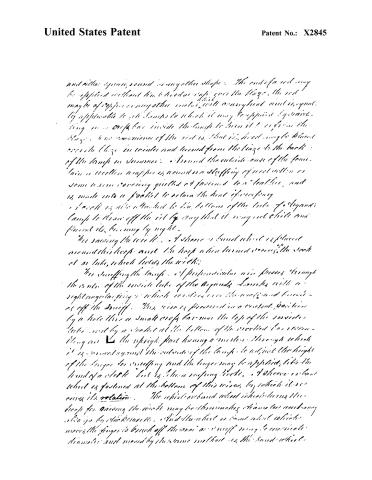
and either square, round or any other shape. The ends of a rod may be applied without the holder or cap over the blaze, the rod may be of copper or any other metal with a conical head and is equally applicable to all lamps to which it may be applied by inserting it in a socket inside the lamp to turn it to expose the blaze. One convenience of the rod is that it, itself, may be turned over the blaze in winter and turned from the blaze to the back of the lamp in summer. Around the outside case of the fountain a woolen wrapper is wound or a stuffing of wool cotton or some warm covering quilted or fashioned to a leather, and is made into a pocket to retain the heat if necessary. A socket is also attached to the bottom of the tube of Argand lamp to draw off the oil by way that it may not chill and freeze it, burning by night.
In saving the wick, a stone or band wheel is placed around the hoop and the hoop when turned carries the wick or tube, which holds the wick.
In snuffing the lamp, a perpendicular wire passes through the center of the inside tube of the Argand Lamps with a right angled finger which rotates on the wire and breaks off the snuff. This wire is preserved in a central position by a hole thru a small crock bar near the top of the inside tube and by a socket at the bottom of the crock bar resembling an L the upright part having a motion through which it is moved against the outside of the lamp to adjust the height of the finger for snuffing and the finger may be applied, like the hand of a clock but is then a snuffing hook. A stone or band wheel is fastened at the bottom of this wire, by which it receives its rotation. The whistler band wheel which turns the hoop for raising the wick may be the same as steam to work any also go by clockwork. And the wheel or band wheel which moves the finger to break off the snuff or snuff may be circular diameter and moved by the same method as the band wheel.
Page 4.
United States Patent
Patent No.: X2845
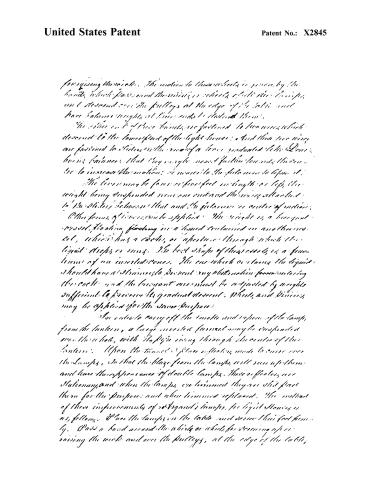
furnishing the wheels. The motion to these wheels is given by the hands, which pass round the wheels or wheels, which the lamps and descend over the pulleys at the edge of the table and have balance weights at their ends to retard them.
The other end of these hands are fastened to two wires which descend to the lower part of the light house: and these two wires are fastened to sliders on the arm of a lever graduated like a D and being balanced that they may be moved further towards the center to increase the motion: or moved to the fulcrum to oppose it.
The lever may be four or five feet in length, or less, the weight being suspended near one end and the wires attached to the sliders between that and the fulcrum or centre of motion.
Other forms of improvements applied: The weight is a buoyant vessel, floating floating in a liquid contained in another vessel, which has a cock, or aperture through which the liquid drops or runs. The best shape of these vessels is a frustum of an inverted cone. The one which contains the liquid should have a strainer to prevent any obstruction from entering the cock and the buoyant one must be adjusted by weights sufficient to preserve its gradual descent. Wheels and linings may be applied for the same purpose.
In order to carry off the smoke and vapors of the lamps from the lantern, a large inverted funnel may be suspended over the hole, with its pipe going through the centre of the lantern. Upon the funnel a plane reflection made to cover over the lamps, so that the blaze from the lamps will run up them and have the appearance of double lamps. These reflectors are stationary and when the lamps are trimmed they are slid past them for the purpose and when trimmed replaced. The method of these improvements of Argand’s lamps for light houses is as follows: Place the lamps on the table and secure their feet firmly. Pass a band around the wheels or wheels for receiving up or raising the work and over the pulleys, at the edge of the table,
Page 5.
United States Patent
Patent No.: X2845
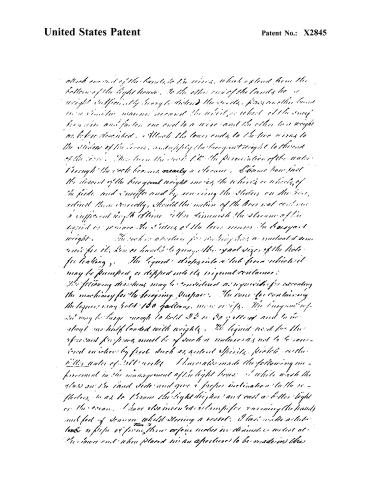
attach one end of the bands to the wires, which extend from the bottom of the light house. To the other end of the bands be a weight sufficiently heavy to descend the wires. Pass another band in a similar manner around the wheel, so that of the same length and fasten one end to a wire and the other to a weight as before described. Attach the lower ends to the two wires to the sides of the wires, and apply the buoyant weight to the end of the wires. Then turn the rock like the operation of the water through the rock becomes nearly a stream. Observe how fast the descent of the buoyant weights moves the wheels or wheels of the pike and rudder and by moving the sliders on the line, adjust them evenly, should the motion of the line not continue a sufficient length of time to the diminish the stream of the liquid or remove the sides of the line near the buoyant weights. The rock is suitable for making has a mounted some weight for its lower handle to grasp the exact size of the hole for loading. The liquid drips into a tub from which it may be pumped or dipped into its original container.
The following directions may be considered as requisite for executing the machinery for the foregoing purpose. The room for containing the liquor may hold 150 gallons, more or less. The buoyant weight may be large enough to hold 25 or 30 gallons and to be about one half loaded with weights. The liquid used for the aforesaid purposes must be of such a nature as not to be converted into ice by frost such as salted spirits, pickles, or the like water of salt water. I have also made the following improvement in the management of the light house. I while wash the glass on the land side and give a proper inclination to the reflectors, so as to throw the light higher and cast a better light on the ocean. I have also invented a lamp for warming the hands and feet of seamen whilst steering a vessel. I have made a tube like a pipe of from three or four inches in diameter, with at the lower end when placed in an aperture to be made in the
Page 6.
United States Patent
Patent No.: X2845
deck of a vessel for warming it. I then make another tube or pipe of copper, or any other metal, that will retain and conduct heat, 10 from 10 to 15 feet in length, and of about 3 inches in diameter; this tube or pipe is flattened so as to have an aperture from one eighth to one fourth of an inch and is made fast to the deck of a vessel the center immediately over and in an aperture made in the deck. The small or narrowest end of the first mentioned tube or pipe is then inserted in this aperture and fastened or connected to the bottom or lower side of the flattened tube or pipe fastened on the deck. The lamp is suspended on the railing, immediately and directly under the first mentioned tube or pipe and made fast by wires attached to the lamp, near the base and to the deck; and kept in that position, so that the flame or blaze of the lamp will strike directly to the center of the mouth or open ends of this tube or pipe, so that the heat may be conducted to the flattened tube or pipe fastened on the deck of the vessel, and also to a metal plate or button, and a rod which are to be attached to the upper side of the flattened tube or pipe on the deck. To the upper side of the flattened tube or pipe is attached a metal plate or button, about one or two inches thick and three or four inches diameter. To this plate or button is affixed or secured in a rod which will prevent the heat from the lower tube or pipe, to which the man at the helm or apply his hands when cold. His feet also may be warmed by stepping on or applying them to the flattened tube or pipe fastened to the deck. The ends of this tube are left open for discharging the smoke. A stay placed between the deck and flattened tube or pipe will prevent it from burning the deck. The same principle can be applied to any house or Dwelling and carriages of any kind. I also make a lamp for warming the feet and giving light to a person travelling on horse back or in a carriage in cold, stark weather. To do this I make a case or slipper of copper sufficiently large to contain the feet.
Page 7.
United States Patent
Patent No.: X2845
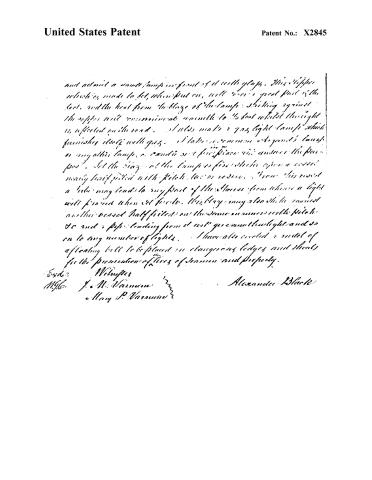
and admit a small lamp in front of it with glass. This reflector, which is made to fit, when put on, will cover a great part of the face, and the heat from the blaze of the lamp striking against the reflector will communicate warmth to the foot whilst the light is reflected on the road. I also make a gas light lamp which furnishes itself with gas. I take a common 8-gallon lamp or any other lamp, or candle so it fits place in answer the purpose. Let the blaze of the lamp or fire which opens a view many half filled with pitch tar or resin. Then this vessel a tube may lead to any part of the house from where a light will proceed when it fires. This blaze may also strike against another vessel half filled in the same manner with pitch etc and a pipe leading from it will give another light and so on to any number of lights. I have also invented a model of a floating bell to be placed on dangerous ledges and sheets for the preservation of lives of seamen and property.
Ends: Witness
Myle J. M. Varnum
Mary P. Varnum
Alexander Black
About this record
- Patentee
- DATAMP
- Date
- the Name and Date index of patents, DATAMP, USPTO records
- Invention
- DATAMP
- Listed in
- the Name and Date index of patents, DATAMP, USPTO records, Jim Shaw's X-patent list, Burke's List of Patents (1847)
- Burke's 1847 Patent Office list gives the same patent.