

Drawings and documents
USPTO scan
The patent as scanned by the USPTO
-
 Page 1
-
 Page 2
-
 Page 3


U.S. Patent and Trademark Office · Google Patents
Show the transcription Hide (967 words)
Machine transcription (LightOnOCR) of the pages as scanned by the USPTO, most of them the handwritten copies made when the records were restored after the 1836 fire. Not checked; it can misread handwriting, so compare it with the scan.
Page 1.
G. D. AVERY.
Plow.
Patented Dec. 28, 1818.
3051X

Page 2.
3051X
UNITED STATES PATENT OFFICE.
GEORGE D. AVERY.
IMPROVEMENT IN PLOWS.
Specification forming part of Letters Patent dated December 28, 1818.
To all whom it may concern:
Be it known that I, GEORGE D. AVERY, have invented an Improvement in Plows, of which the following is a specification.
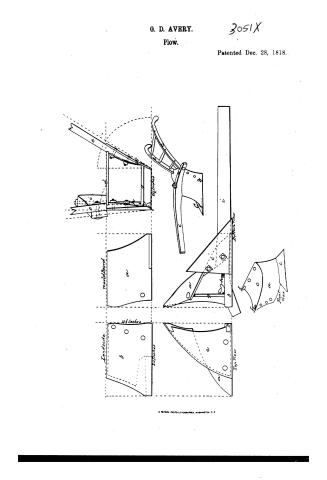
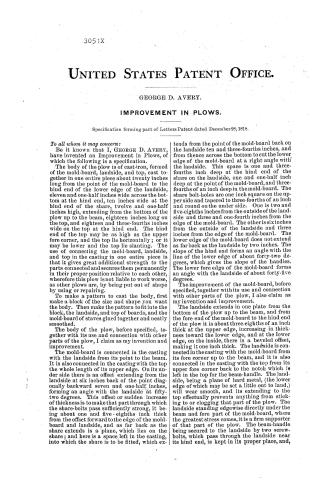
The body of the plow is of cast-iron, formed of the mold-board, landside, and top, cast together in one entire piece about twenty inches long from the point of the mold-board to the hind end of the lower edge of the landside, eleven and one-half inches wide across the bottom at the hind end, ten inches wide at the hind end of the share, twelve and one-half inches high, extending from the bottom of the plow up to the beam, eighteen inches long on the top, and eighteen and three-fourths inches wide on the top at the hind end. The hind end of the top may be as high as the upper fore corner, and the top lie horizontally; or it may be lower and the top lie slanting. The use of connecting the mold-board, landside, and top in the casting in one entire piece is that it gives great additional strength to the parts connected and secures them permanently in their proper position relative to each other, wherefore this plow is not liable to work worse, as other plows are, by being put out of shape by using or repairing.
To make a pattern to cast the body, first make a block of the size and shape you want the body. Then make the pattern to fit into the block, the landside, and top of boards, and the mold-board of staves glued together and neatly smoothed.
The body of the plow, before specified, together with its use and connection with other parts of the plow, I claim as my invention and improvement.
The mold-board is connected in the casting with the landside from its point to the beam. It is also connected in the casting with the top the whole length of its upper edge. On its under side there is an offset extending from the landside at six inches back of the point diagonally backward seven and one-half inches, forming an angle with the landside at fifty-two degrees. This offset or sudden increase of thickness is to make that part through which the share-bolts pass sufficiently strong, it being about one and five-eighths inch thick from the offset forward to the edge of the mold-board and landside, and as far back as the share extends is a plane, which lies on the share; and here is a space left in the casting, into which the share is to be fitted, which extends from the point of the mold-board back on the landside ten and three-fourths inches, and from thence across the bottom to cut the lower edge of the mold-board at a right angle with the landside. This space is one and three-fourths inch deep at the hind end of the share on the landside, one and one-half inch deep at the point of the mold-board, and three-fourths of an inch deep in the mold-board. The share bolt-holes are one inch square on the upper side and tapered to three-fourths of an inch and round on the under side. One is two and five-eighths inches from the outside of the landside and three and one-fourth inches from the edge of the mold-board. The other is six inches from the outside of the landside and three inches from the edge of the mold-board. The lower edge of the mold-board does not extend as far back as the landside by two inches. The slope of the hind end forms an angle with the line of the lower edge of about forty-two degrees, which gives the slope of the handles. The lower fore edge of the mold-board forms an angle with the landside of about forty-five degrees.
The improvement of the mold-board, before specified, together with its use and connection with other parts of the plow, I also claim as my invention and improvement.
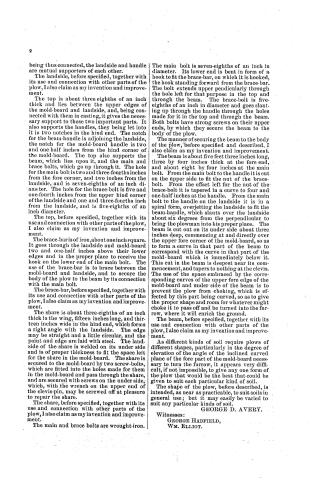
The landside extends in one plate from the bottom of the plow up to the beam, and from the fore end of the mold-board to the hind end of the plow it is about three-eighths of an inch thick at the upper edge, increasing in thickness toward the lower edge, and at the lower edge, on the inside, there is a beveled offset, making it one inch thick. The landside is connected in the casting with the mold-board from its fore corner up to the beam, and it is also connected in the casting with the top from its upper fore corner back to the notch which is left in the top for the beam-handle. The landside, being a plane of hard metal, (the lower edge of which may be set a little out to land,) will wear smooth, and its extending to the top effectually prevents anything from sticking to or clogging that part of the plow. The landside standing edgewise directly under the beam and fore part of the mold-board, where the greatest stress comes, it is a firm supporter of that part of the plow. The beam-handle being secured to the landside by two screw-bolts, which pass through the landside near its hind end, is kept in its proper place, and,
Page 3.
being thus connected, the landside and handle are mutual supporters of each other.
The landside, before specified, together with its use and connection …
About this record
- Patentee
- DATAMP
- Date
- the Name and Date index of patents, DATAMP, USPTO records
- Invention
- DATAMP
- Listed in
- the Name and Date index of patents, DATAMP, USPTO records, Jim Shaw's X-patent list, S. A. Elliot's printed list of patents, Burke's List of Patents (1847)
- S. A. Elliot's printed list of patents gives the same name and date.
- Burke's 1847 Patent Office list gives the same patent.