

Drawings and documents
USPTO scan
The patent as scanned by the USPTO
-
 Page 1
-
 Page 2
-
 Page 3
-
 Page 4
-
 Page 5
-
 Page 6


U.S. Patent and Trademark Office · Google Patents
Show the transcription Hide (1,634 words)
Machine transcription (LightOnOCR) of the pages as scanned by the USPTO, most of them the handwritten copies made when the records were restored after the 1836 fire. Not checked; it can misread handwriting, so compare it with the scan.
Page 2.
United States Patent
Patent No.: X3342
Allen Hand
Letters Patent
The Schedule referred to in these Letters Patent and making part of the same containing a description in the words of the said Allen H. and himself of his improvement in the mode of marking out cloth for cutting into clothing by means of Slates & Protractor & Scale.
To cut out a coat by my system, I first make a protractor about 16 inches diameter, and divide the semicircle of the Protractor into fifty equal parts, with the arc of the protractor placed from me. I begin on the left and number the degrees, with the number one on the first degree, 2 on the second, 3 on the third, and so increase the numbers agreeably to the lines, which lines must be previously run from the middle of the straight edge of the protractor. 90 degrees will form a right angle with the straight edge of the protractor. I next proceed to make a scale the semi-circumference of my protractor, only taken close under his arms divided into 32 equal parts, and these parts numbered beginning at the left hand end of the scale with No. 1 on the first line, No. 2 on the second, and so continue the figures upon the parts, until all the parts are numbered, which constitutes a scale suitable for the thickness round the breast, and make one scale at so for the waist in like manner having taken the length of the coat. I spread my cloth the nap running to my left, I apply the protractor and square my cloth by an angle of 90 degrees beginning at the right hand ends of my cloth, which is generally termed the top of the cloth. From the rear center of which I run an angle of 2 degrees, which represents the back seam of the coat, from the opposite arm seam to the said seam, or angle one and a half of the scale and make a mark on said angle at back seam, from said mark I run down six and a half and make a mark, from which I run across at right angles with the back seam, eleven of the scale, this will give the top.
Page 3.
United States Patent
Patent No.: X3342
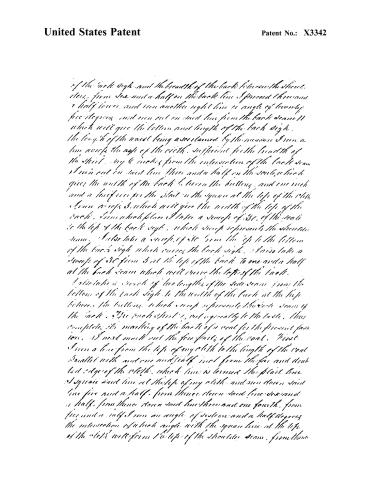
of the back edge and the breadth of the back between the shoulder, from six and a half on the back line I proceed three and a half inches and run another right line at an angle of twenty-five degrees and run out on said line from the back seam 11 which will give the bottom and length of the back edge. The length of the waist being ascertained by the measure I run a line across the top of the cloth, sufficient for the breadth of the skirt, say 6 inches from the intersection of the back seam I run out on said line three and a half on the scale which gives the width of the back between the buttons and one inch and a half over for the skirt in the square at the top of the cloth from across 3, which will give the width of the top of the back. From which place I take a sweep of 30 of the scale to the top of the back edge, which sweep represents the shoulder seam. I also take a sweep of 30 from the top to the bottom of the back edge which covers the back edge. I also take a sweep of 30 from 3 at the top of the back to one and a half at the back seam which will cover the top of the back.
I also take a sweep of two lengths of the side seam from the bottom of the back edge to the width of the back at the hip between the buttons, which sweep represents the side seam of the back. The back skirt is cut generally to the taste, thus complete the marking of the back of a coat for the present fashion. I next mark out the free parts of the coat. First I run a line from the top of my cloth to the length of the coat parallel with and one and a half inch from the free and doubled edge of the cloth, which line is termed the plait line. I square said line at the top of my cloth and run down said line five and a half, from there down said line six and a half, from there down said line three and one fourth, from five and a half I run an angle of seventy and a half degrees the intersection of which angle with the square line at the top of the cloth will form the top of the shoulder seam, from there
Page 4.
United States Patent
Patent No.: X3342
I run down said seam line which will give the front of the shoulder seam. I next run an angle from six and a half on the plait line of 20 degrees, I come out on said nine and three fourths to find the front of the right, from thence I continue along said angle fourteen to find the top of the breast. Then run another angle from three and a fourth on the plait line by 25 of the protractor which is a right angle with my scale. I commence at the plait line and mark one on the far side of said line from which I take a sweep of six to the six and a half on the plait line, which sweep will locate the top of the side seam. From said three and a fourth on the plait line I run six in on the angle of 25 degrees which does will give the bottom of the right. From thence I continue 21 on said angle to find the front of the breast, from which point I take a sweep of 15 to the top of the breast, from thence I take a sweep of fifteen to the top of the shoulder seam which forms the yoke, from the front of the shoulder seam to the front of the right. I take a sweep of twelve to form the upper part of the right, from said nine and three fourths on front of the right to the bottom of the right. I take a sweep of four and one fourth which forms the under part of the right, from the said bottom of right to six and a half on the plait line. I take a sweep of six which forms the hind part of the right and the top of the side seam, from which top I run down the plait line the length of the back side seam to find the hip, and from thence to the bottom of the seat, from the hip I run an angle of twenty one and a half degrees which forms the flap line. I run along said line 20 numbers of a scale corresponding with the waist measure and from said twenty, 8, proceed nine inches to the front of the waist from which I take a sweep thirty two to curve the front of the breast below, from twenty one said flap line I run an angle of 32, by which I cut the skirt, an angle of 14 is to be run from the length of the breast, on the skirt line which will form the bottom of the
Page 5.
United States Patent
Patent No.: X3342
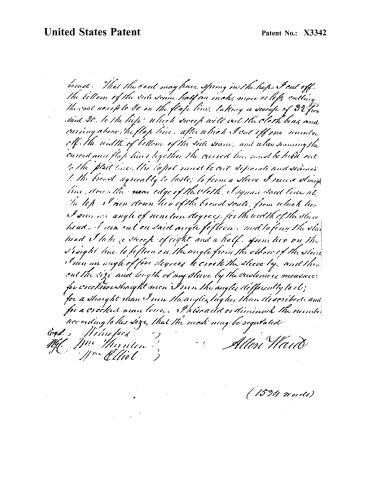
breast. That the coat may have spring in the hips, I cut off the bottom of the side seam half an inch, more or less, cutting the coat across to do on the flap line, taking a sweep of 32 from said 20, to the hips: which sweep will cut the cloth bias and running above the flap line, after which I cut off one number off the width of bottom of the side seam, and when joining the curved and flap lines together the curved line must be held out to the plait line, the lapel must be cut separate and retained to the breast agreeably to taste; to form a sleeve I run a straight line down the near edge of the cloth, I square said line at the top, I run down two of the breast scale, from which two I run an angle of nineteen degrees, for the width of the sleeve head. I run out on said angle fifteen, and to form the sleeve head I take a sweep of eight and a half, from two on the straight line to fifteen on the angle from the elbow of the sleeve I run an angle of five degrees to crook the sleeve by, and then out the size and length of my sleeve by the customer's measure: for crooked straight men I run the angles differently to it; for a straight man I run the angles higher than described and for a crooked man lower. I also add or diminish the number according to his size, that the work may be regulated.
End, Witness
Mr. Wm. Thornton
Mr. Elliot
Allen Ward
(1594 words)
Page 6.
United States Patent
Patent No.: X3342
DRAFTSMAN'S DIVISION.
All communications should be addressed to
"The Commissioner of Patents,"
Washington, D. C.
DEPARTMENT OF THE INTERIOR,
United States Patent Office,
Washington, D. C.
SIR:
The printed Carpets
etc. exhausted.
As soon as reprinted a copy will be mailed you to complete your order.
By direction of the Commissioner:
Very respectfully,
Chief Clerk.
2-328 a.
189
of Patent No. C. Waid
June 16, 1892!
314306-57-5m
About this record
- Patentee
- Jim Shaw's X-patent list
- Date
- the Name and Date index of patents, USPTO records, Jim Shaw's X-patent list
- Invention
- the Name and Date index of patents
- Listed in
- the Name and Date index of patents, USPTO records, Jim Shaw's X-patent list, S. A. Elliot's printed list of patents, Burke's List of Patents (1847)
- S. A. Elliot's printed list of patents gives the same name and date.
- Burke's 1847 Patent Office list gives the same patent.