

Drawings and documents
USPTO scan
The patent as scanned by the USPTO
-
 Page 1
-
 Page 2
-
 Page 3
-
 Page 4
-
 Page 5
-
 Page 6
-
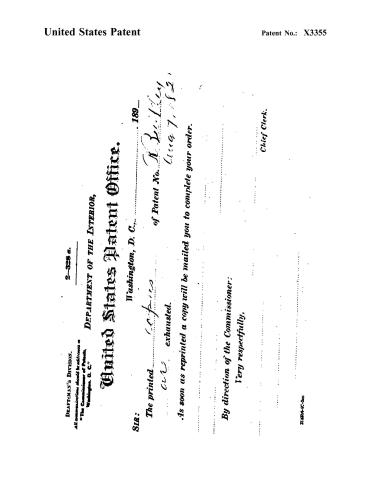 Page 7


U.S. Patent and Trademark Office · Google Patents
Show the transcription Hide (1,481 words)
Machine transcription (LightOnOCR) of the pages as scanned by the USPTO, most of them the handwritten copies made when the records were restored after the 1836 fire. Not checked; it can misread handwriting, so compare it with the scan.
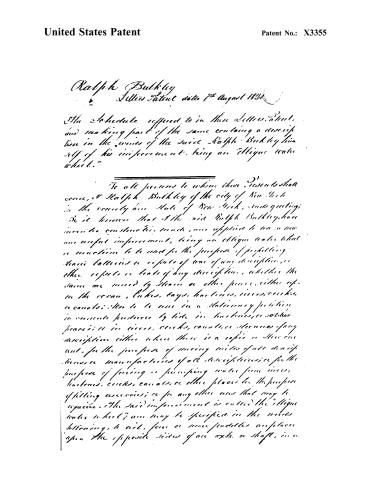
Page 2.
United States Patent
Patent No.: X3355
Ralph Bulkeley
Letters Patent dated 7th August 1824
The Schedule referred to in these Letters Patent, and making part of the same, containing a description in the words of the said Ralph Bulkeley himself of his improvement, being an "Oblique water wheel."
To all persons to whom these Presents shall come, I Ralph Bulkeley of the city of New York in the county and State of New York, do hereby declare that I the said Ralph Bulkeley have invented and constitute, made, and applied to use a new and useful improvement, being an oblique water wheel or machine to be used for the purpose of propelling steam boilers or vessels of any description, or other vessels or boats of any description, whether the same are moved by steam or other power, either upon the ocean, lakes, bays, harbors, rivers, canals, or canals; also to be used in a stationary position in mills, factories, or other places in cities, towns, canals, or steamers of any description, either where there is a rapid or slow current, for the purpose of moving mills of all descriptions or manufacturers of all descriptions for the purpose of forcing or pumping water from rivers, harbors, cisterns, canals, or other places for the purpose of filling reservoirs; or for any other use that may be required. The said improvement is called the "Oblique water wheel"; and may be specified in the words following, to wit, four or more paddles are placed upon the opposite sides of an axle or shaft, in a
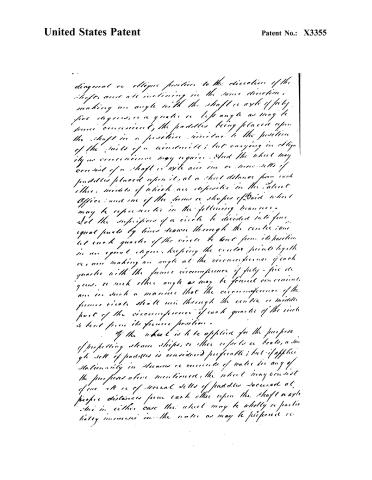
Page 3.
United States Patent
Patent No.: X3355
diagonal or oblique position to the direction of the shaft, and all inclining in the same direction, making an angle with the shaft or axle of fifty-five degrees, or a greater or less angle as may be found convenient, the paddles being placed upon the shaft in a position similar to the position of the sails of a windmill; but varying in obliquity as convenience may require. And the wheel may consist of a shaft or axle and one or more sets of paddles placed upon it, at a short distance from each other, most of which are deposited in the Patent Office; and one of the forms or shapes of said wheel may be represented in the following manner.
Let the superficies of a circle be divided into four equal parts by lines drawn through the center and let each quarter of the circle be bent from its position in an equal degree, keeping the center points together, and making an angle at the circumference of each quarter with the former circumference of fifty-five degrees, or such other angle as may be found convenient, and in such a manner that the circumference of the former circle shall run through the center or middle part of the circumference of each quarter of the circle to bend from its former position.
If the wheel is to be applied for the purpose of propelling steam ships, or other vessels or boats, a single set of paddles is considered preferable; but if applied stationarily in steam or currents of water for any of the purposes above mentioned, the wheel may consist of one set or of several sets of paddles secured at proper distances from each other upon the shaft or axle. And in either case the wheel may be wholly or partially immersed in the water as may be preferred or
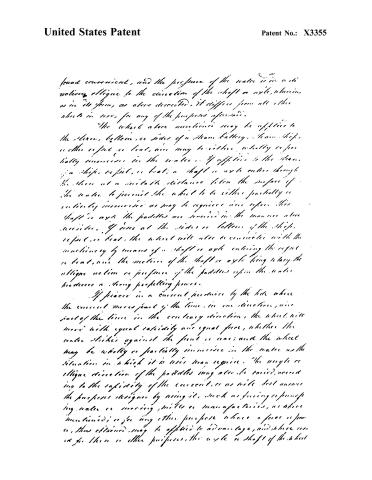
Page 4.
United States Patent
Patent No.: X3355
found convenient, and the presence of the water is in a direction oblique to the direction of the shaft or axle, which, as in its form, as above described, it differs from all other wheels in use, for any of the purposes aforesaid.
The wheel above mentioned may be applied to the stern, bottom, or sides of a steam battery, steam ship, or other vessel or boat, and may be either wholly or partially immersed in the water. If applied to the stern of a ship, vessel, or boat, a shaft or axle enters through the stern at a suitable distance below the surface of the water to prevent the wheel to be either partially or entirely immersed as may be required and upon this shaft or axle the paddles are secured in the manner above described. If fixed at the sides or bottom of the ship, vessel, or boat, the wheel will also be connected with the machinery by means of a shaft or axle entering the vessel or boat, and the motion of the shaft or axle being to lay the oblique action or pressure of the paddles upon the water produces a strong propelling power.
If placed in a current produced by the tide where the current moves part of the time, in one direction, and part of the time in the contrary direction, the wheel will move with equal rapidity and equal force, whether the water strikes against the front or rear; and the wheel may be wholly or partially immersed in the water as the situation in which it is used may require. The angle or oblique direction of the paddles may also be varied, according to the rapidity of the current, or as with best answer the purposes designed by using it, such as forcing or propelling water or moving mills or manufactories, as above mentioned; or for any other purpose where a force or power, thus obtained, may be applied to advantage, and where used for them or other purposes, the axle or shaft of the wheel
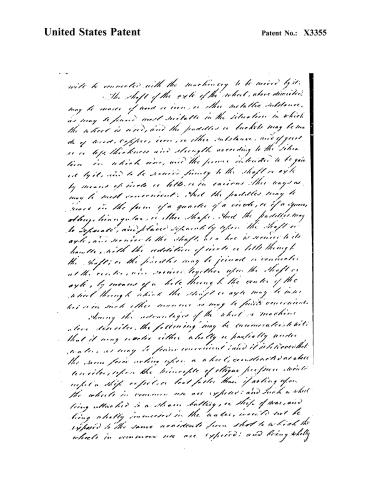
Page 5.
United States Patent
Patent No.: X3355
will be connected with the machinery to be moved by it.
The shaft of the axle of the wheel, above described, may be made of wood or iron, or other metallic substance, as may be found most suitable in the situation in which the wheel is used, and the paddles or buckets may be made of wood, copper, iron, or other substance, and of great or less thickness and strength according to the situation in which they are, and the power intended to be given by it, and to be applied firmly to the shaft or axle by means of irons or bolts, or in various other ways as may be most convenient. And the paddles may be made in the form of a quarter of a circle, or of a square, oblong, triangular, or other shape. And the paddles may be separate, and placed separately upon the shaft or axle, and secured to the shaft, as a box is secured to its handle, with the addition of irons or bolts through the shaft; or the paddles may be joined or connected at the center, and secured together upon the shaft or axle, by means of a hole through the center of the wheel through which the shaft or axle may be inserted, or in such other manner as may be found convenient.
Among the advantages of the wheel or machine above described, the following may be enumerated: It will that it may operate either wholly or partially under water, as may be found convenient; and it is believed that the same force acting upon a wheel, constructed as above described, upon the principle of oblique pressure, would upon a ship or vessel, or boat faster than if acting upon the wheels in common use are exposed; and such a wheel being attached to a steam battery, or ship of war, and being wholly immersed in the water, would not be exposed to the same accidents from shot to which the wheels in common use are exposed; and being wholly
Page 6.
United States Patent
Patent No.: X3355
increased its motion would not be materially impeded by emergence a dashing sea; and when used stationarily in harbours, rivers, creeks, canals, or other streams, or not quite free, may be obtained by means of the oblique surface of the steam, upon the wheel; and may be applied to the purposes above mentioned, or to other purposes when a force or power thus obtained may be found convenient or useful.
Witnesses
Ralph Bilkley
J. Bilkley
Daniel A. A.
This invention recorded 20 January 1844
not thought necessary to make a drawing of
Page 7.
United States Patent
Patent No.: X3355
DRAFTSMAN'S DIVISION.
All communications should be addressed to
"The Commissioner of Patents,"
Washington, D. C.
DEPARTMENT OF THE INTERIOR,
United States Patent Office,
Washington, D. C.
SIR:
The printed copies of Patent No. 189 exhausted.
As soon as reprinted a copy will be mailed you to complete your order.
By direction of the Commissioner:
Very respectfully,
Chief Clerk.
About this record
- Patentee
- Jim Shaw's X-patent list
- Date
- the Name and Date index of patents, USPTO records, Jim Shaw's X-patent list
- Invention
- the Name and Date index of patents
- Listed in
- the Name and Date index of patents, USPTO records, Jim Shaw's X-patent list, S. A. Elliot's printed list of patents, Burke's List of Patents (1847)
- S. A. Elliot's printed list of patents gives the same name and date.
- Burke's 1847 Patent Office list gives the same patent.
- Residence from Burke's 1847 Patent Office list; the standard lists give none.