

Drawings and documents
USPTO scan
The patent as scanned by the USPTO
-
 Page 1
-
 Page 2
-
 Page 3
-
 Page 4


U.S. Patent and Trademark Office · Google Patents
Show the transcription Hide (634 words)
Machine transcription (LightOnOCR) of the pages as scanned by the USPTO, most of them the handwritten copies made when the records were restored after the 1836 fire. Not checked; it can misread handwriting, so compare it with the scan.
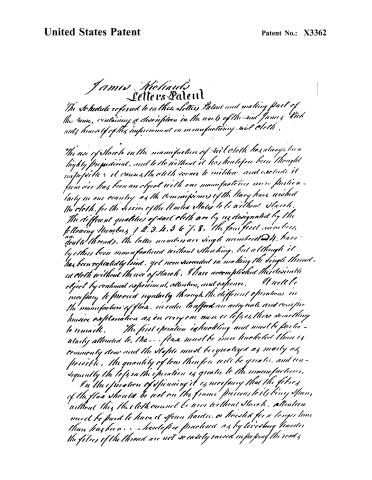
Page 2.
United States Patent
Patent No.: X3362
James Richards
Letters Patent
The Schedule referred to in these Letters Patent and making part of the same, containing a description in the words of the said James Richards himself of his improvement in manufacturing said cloth.
The use of Starch in the manufacture of said cloth has always been highly prejudicial, and to do without it has heretofore been thought impossible. It causes the cloth sooner to mildew, and exclude it from air has been an object with our manufacturers more particularly in our country as the commissioners of the Navy have wished the cloth for the service of the United States to be without Starch.
The different qualities of said cloth are by us designated by the following Numbers, 1 2. 3. 4. 5 & 7. 8. The four first numbers are double threads, the latter numbers are single numbers. 2 & 4 have by others been manufactured without Starching, but although it has been repeatedly tried, yet none succeeded in making the single thread cloth without the use of Starch. I have accomplished this desirable object by continual experiment, attention, and expense. It will be necessary to proceed regularly through the different operations in the manufacture of flax, in order to afford an accurate and concise concise explanation as, in every one more or less, there something to remark. The first operation is hackling and must be particularly attended to, the... flax must be more hackled than is commonly done and the staple must be equalized as nearly as possible. The quantity of tow therefore will be greater, and consequently the loss in the operation is greater to the manufacturer.
In the operation of spinning it is necessary that the fibres of the flax should be well on the frame previous to its being spun, without this the cloth cannot be used without Starch. Attention must be paid to have it spun harder, or twisted for a longer time than has been... heretofore practiced as by twisting harder the fibres of the thread are not so readily raised in passing the reeds,
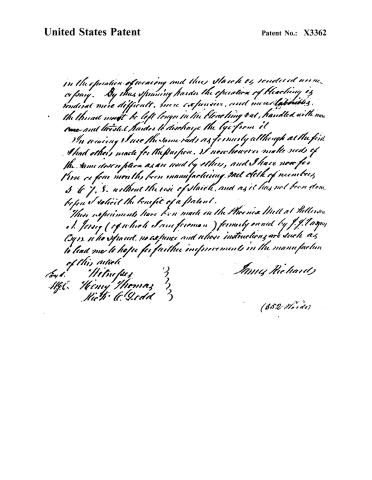
Page 3.
United States Patent
Patent No.: X3362
in the operation of weaving and thus slack is rendered unnecessary. By thus spinning harder the operation of bleaching is rendered more difficult, more expensive, and more laborious. The thread must be left longer in the bleaching vat, handled with more care and twisted harder to discharge the dye from it.
In weaving I use the same rods as formerly although at the first I had others made for the purpose. I now however make rods of the same description as are used by others, and I have now for three or four months been manufacturing and cloth of numbers 5 to 7. S. without the use of slack, and as it has not been done before I solicit the benefit of a patent.
These experiments have been made in the Phoenix Mill at Patterson, N.J. (of which I am foreman) formerly owned by J.J. Targy Esqrs. who spared no expense and whose instructions are such as to lead me to hope for further improvement in the manufacture of this article.
James Richards
(552 Words)
Page 4.
United States Patent
Patent No.: X3362
DRAFTSMAN'S DIVISION.
All communications should be addressed to
"The Commissioner of Patents,"
Washington, D. C.
DEPARTMENT OF THE INTERIOR,
United States Patent Office.
Washington, D. C.
SIR:
The printed copies of Patent No. 189-
are exhausted.
As soon as reprinted, a copy will be mailed you to complete your order.
By direction of the Commissioner:
Very respectfully,
Chief Clerk.
31436-67-5u.
About this record
- Patentee
- Jim Shaw's X-patent list
- Date
- the Name and Date index of patents, USPTO records, Jim Shaw's X-patent list
- Invention
- the Name and Date index of patents
- Listed in
- the Name and Date index of patents, USPTO records, Jim Shaw's X-patent list, S. A. Elliot's printed list of patents, Burke's List of Patents (1847)
- S. A. Elliot's printed list of patents gives the same name and date.
- Burke's 1847 Patent Office list gives the same patent.
- Residence from Burke's 1847 Patent Office list; the standard lists give none.