

Drawings and documents
USPTO scan
The patent as scanned by the USPTO
-
 Page 1
-
 Page 2
-
 Page 3
-
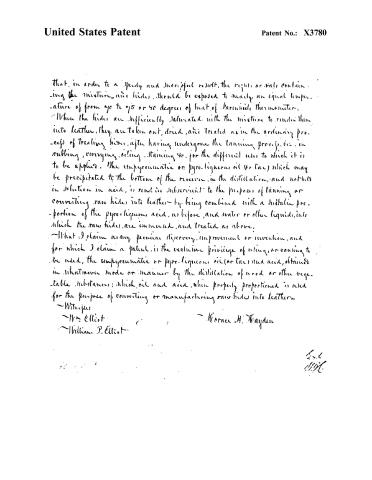 Page 4


U.S. Patent and Trademark Office · Google Patents
Show the transcription Hide (1,122 words)
Machine transcription (LightOnOCR) of the pages as scanned by the USPTO, most of them the handwritten copies made when the records were restored after the 1836 fire. Not checked; it can misread handwriting, so compare it with the scan.
Page 2.
United States Patent
Patent No.: X3780
Horace H. Mayden
Letters Patent
The schedule referred to in these Letters Patent, and making part of the same, containing a description in the words of the said Horace H. Mayden himself of his improvement or discovery in the converting, manufacturing or tanning of raw hides of all kinds into leather, by means of impyromatic or pyroligneous oil and acid, produced by the distillation of wood and all other vegetable substances.
The empyreumatic or pyroligneous oil (or tar) and pyroligneous acid, are obtainable only by the distillation of any or all kinds of wood and other vegetable substances, and in the following or a similar manner viz: The wood or other vegetable substance is put into a vessel or receptacle of proper or suitable dimensions, made of iron, copper or other metal of a cylindrical or other form, having one or two openings as convenience may require viz: If required to distill the empyreumatic or pyroligneous oil (or tar) and acid in the small way, one opening in the vessel intended for the reception of the wood or other vegetable substance, may serve for the purpose of introducing the wood or other vegetable substance, and at the same time, for the reception of a tubular pipe or still horn, which receives and conveys off, the empyreumatic or pyroligneous oil (or tar) and acid, into a common receiver. If required to distill the above mentioned articles in the large way, the vessel into which the wood or other vegetable substance is received, should have an opening in the upper or superior surface, with a door or lid so adapted as when the wood is introduced to admit of being closed up and luted.
When the cylinder or other formed vessel is filled or otherwise charged with wood or other vegetable substance, it is placed in a furnace constructed of brick or stone, having two or three openings as occasion or convenience may require, for example—One opening for introducing the wood, in order to make a fire for carrying on the distillation—another or a second, for the purpose of conveying away the smoke, and a third on the top of the furnace, corresponding to the opening or door in the metallic cylinder (containing the wood for distillation) for the purpose of introducing the successive supplies of wood
Page 3.
United States Patent
Patent No.: X3780
or other vegetable substances for distillation. The furnace being thus, or in a similar manner prepared, a tubular pipe, or still horn, is adapted to the opening in the end of the metallic cylinder and fitted. As soon as the wood in the furnace is ignited and the distillation commences, the empyreumatic or pyroligneous oil (or tar) and acid pass over in a gaseous form through the tubular pipe, or still horn (which is immersed in cold water) into a receiver where it is condensed into the form of the empyreumatic or pyroligneous oil (or tar) and acid. From thence it is taken and used for the purposes of manufacturing raw hides into leather, in the following manner.
Mode of using the pyroligneous oil and acid in tanning. In the distillation of wood or other suitable substances for the purpose of obtaining the empyreumatic or pyroligneous oil and acid, the two ingredients pass over into the receiver nearly together and more or less in combination; hence the pyroligneous acid holds a part of the pyroligneous oil (or tar) in solution. When the acid becomes saturated, the superabundant oil is precipitated to the bottom, in either of which states they are made subservient to the purposes of manufacturing of raw hides into good and firm leather, and in the following manner, viz: The pyroligneous acid containing the pyroligneous oil (or tar) in solution is decanted or poured off into another vessel, when it is diluted with water or other proper diluent, in a suitable proportion; say equal parts of water, and the acid and oil in solution; or if the acid is strong it may require three parts of water to one of the acid and oil in combination: at any rate the quantity of water or other diluent should be in quantity sufficient to prevent the acid from injuring the animal fibre of the hides, which it sometimes will do, if too strong. In this mixture the hides, after being deprived of the hair in the usual manner, by liming, are to be immersed and there retained twenty or thirty-six hours, or until the principal part of the oil contained in the mixture appears to be taken up by the hides, which may be known, in part, by the liquor becoming less turbid or almost clear. If the hides are not sufficiently charged with the empyreumatic or pyroligneous oil, which constitutes the essential principle in converting raw hides into leather, they must be subjected to a second mixture of the same kind and for the same time, or longer if necessary, observing however
Page 4.
United States Patent
Patent No.: X3780
That, in order to a speedy and successful result, the raw or raw containing the mixture, and hides, should be exposed to nearly an equal temperature of from 90 to 95 or 50 degrees of heat of Fahrenheit thermometer. When the hides are sufficiently saturated with the mixture to render them into leather, they are taken out, dried, and treated as in the ordinary process of treating hides, after having undergone the tanning process, i.e., in rubbing, carrying, salting, staining, etc., for the different uses to which it is to be applied. The empyreumatic or pyro-liquorous oil (or tar) which may be precipitated to the bottom of the receiver, in the distillation, and not held in solution in acid, is useful as subservient to the purposes of tanning or converting raw hides into leather—by being combined with a suitable proportion of the pyro-liquorous acid, as before, and water or other liquids, into which the raw hides are immersed, and treated as above.
What I claim as my peculiar discovery, improvement or invention, and for which I claim a patent, is the exclusive privilege of using, or causing to be used, the empyreumatic or pyro-liquorous oil (or tar) and acid, obtained in whatsoever mode or manner by the distillation of wood or other vegetable substances; which oil and acid, when properly proportioned is used for the purpose of converting or manufacturing raw hides into leather.
Witnesses
Wm. Elliot
William P. Elliot
Horace M. Hayden
[Signature]
About this record
- Patentee
- DATAMP
- Date
- the Name and Date index of patents, DATAMP, USPTO records
- Invention
- DATAMP
- Listed in
- the Name and Date index of patents, DATAMP, USPTO records, Jim Shaw's X-patent list, Burke's List of Patents (1847)
- Burke's 1847 Patent Office list gives the same patent.