

Drawings and documents
USPTO scan
The patent as scanned by the USPTO
-
 Page 1
-
 Page 2
-
 Page 3
-
 Page 4
-
 Page 5
-
 Page 6


U.S. Patent and Trademark Office · Google Patents
Show the transcription Hide (1,138 words)
Machine transcription (LightOnOCR) of the pages as scanned by the USPTO, most of them the handwritten copies made when the records were restored after the 1836 fire. Not checked; it can misread handwriting, so compare it with the scan.
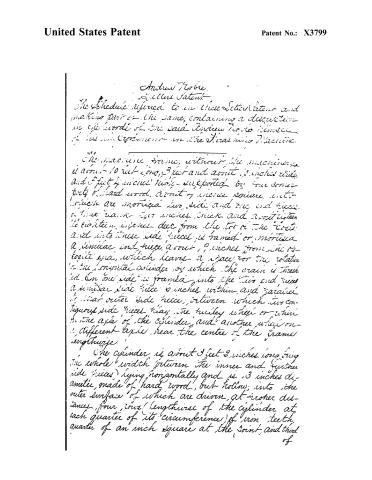
Page 2.
United States Patent
Patent No.: X3799
Andrew Noble
Letter Patent
The schedule referred to in these Letters Patent and making part of the same, containing a description in the words of the said Andrew Noble himself of his invention in the Virginia Machine.
The machine frame, without the machinery, is about 10 feet long, 3 feet and about 3 inches wide, and 3 feet 4 inches high—supported by two corner posts of hard wood, about 7 inches square, into which are morticed two side and one end pieces of pine, each 5 inches thick and about fifteen to eighteen inches deep from the top of the posts, and into these side pieces is framed or morticed a similar end piece, about 9 inches from the opposite side, which leaves a space for the rotation of the horizontal cylinder, by which the grain is threshed. On one side is framed, into the two end pieces, a similar side piece 6 inches within and parallel to that outer side piece, between which two contiguous side pieces may the burley wheel or wheel at the axle of the cylinder, and another wheel on a different axle near the centre of the frame lengthwise.
The cylinder is about 3 feet 2 inches long (being the whole width between the inner and further side pieces) lying horizontally and is 3 inches diameter, made of hard wood, but hollow; into the outer surface of which are driven, at proper distances, four rows (lengthwise of the cylinder at each quarter of its circumference) of iron teeth, quarter of an inch square at the joint, and third of
Page 3.
United States Patent
Patent No.: X3799
of an inch at the surface of the cylinder, projecting two inches outwards. Under the cylinder one third part of its circumference is a concave fall, made of hard wood commencing about two inches below the axis of the cylinder into which concave fall commencing to the circle of the cylinder are driven at proper distances four rows of similar iron teeth, the first two to be lengthwise of the fall, and to project upwards two inches. These iron teeth in the cylinder, while in rotation, are between the four rows of stationary teeth in the concave fall, leaving the space about three sixteenths of an inch on either side thereof.
The tray containing the grain is placed on an inclined plane and is driven by hand. The distance is about one inch and an half from the side of the cylinder, and is raised by hand under the cylinder. When in rotation and pressed into the concave fall or with teeth the grain is separated and clearly separated from the stalks, the dust and in turn by the cylinder and fall of grain the grain is separated from the straw, and at the farther end of the axle of the cylinder is fixed the machinery which performs motion, the idler and turn the pan and that winnows the grain. The winnowing apparatus is attached to a frame attached from the threshing machine at the rear. On the upper half of the cylinder is a screen having of cards to collect the leaf in and prevent the straw from passing over the cylinder when in rotation.
The cylinder has a wood shaft, into each end of which is driven an iron axle, which extends through the three side pieces of the frame and
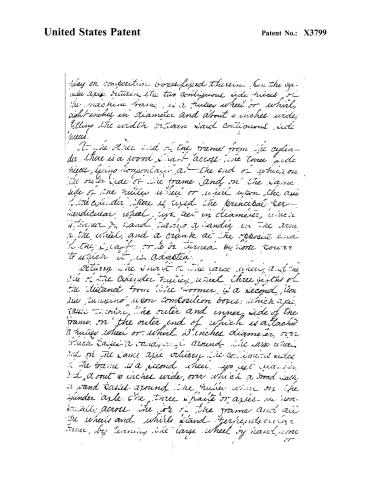
Page 4.
United States Patent
Patent No.: X3799
play on composition boxes fixed therein. On the cylinder axle, between the two contiguous side pieces of the machine frame, is a pulley wheel or whir, eight inches in diameter and about 6 inches wide, filling the width between said contiguous side pieces.
At the other end of the frame from the cylinder, there is a wood shaft across the three side pieces, lying horizontally at the end of which on the outer side of the frame (and on the same side of the pulley wheel or whir upon the one of the cylinder) there is fixed the principal perpendicular wheel, six feet in diameter, which is turned by hand having a handle on the arm of the wheel, and a crank at the opposite end of the shaft, or to be turned by horse power to which it is adapted.
Between the shaft at the rear and at the side of the cylinder pulley wheel three feet of the distance from the corner is a second iron bar running upon composition boxes, which are fastened between the outer and inner side of the frame, on the outer end of which is attached a pulley wheel or whir 13 inches diameter, over which a band runs around the same wire, and on the same axle between the contiguous sides of the frame is a second wheel, two feet diameter, and, about 6 inches wide, over which a band runs and band runs around the pulley wheel on the cylinder axle. One three shafts or axles run horizontally across the top of the frame and all the wheels and whirs stand perpendicular to each other, by turning the large wheel by hand, horse or
Page 5.
United States Patent
Patent No.: X3799
or water power, the whole machinery is put in operation and the cylinder by which the grain is threshed, performs nine revolutions to one of the great wheel. The cylinder revolutions can be multiplied in a greater ratio, if required.
The threshing machine, to be turned by hand including the winnowing apparatus, can be furnished to purchasers from 50 to 100 dollars and to be put in operation in one hour, and at 10 dollars additional price. One person can turn it by hand to thresh and winnow thirty bushels of grain in a day, and two hands to turn, and two to attend it can thresh and winnow sixty bushels in a day. The machinery, consisting of a single horse tower, consist of a right shaft with a horizontal wheel on the end connected with the large perpendicular wheel of the machine by bands and pulleys or by other means and fission.
Done at Alfred in the county of York, and State of Maine, this 9th day of December 1823.
Andrew Toole.
Witnesses:
Goyd Cookin
R. A. Littlefield
Filed
Dec. 31
1823.
Page 6.
United States Patent
Patent No.: X3799
DRAFTSMAN'S DIVISION.
All communications should be addressed to
"The Commissioner of Patents."
Washington, D. C.
2-328 a.
DEPARTMENT OF THE INTERIOR,
United States Patent Office,
Washington, D. C., 189
SIR:
The printed copy exhausted.
As soon as printed a copy will be mailed you to complete your order.
By direction of the Commissioner:
Very respectfully,
Chief Clerk.
81616-97-5m
About this record
- Patentee
- Jim Shaw's X-patent list
- Date
- the Name and Date index of patents, USPTO records, Jim Shaw's X-patent list
- Invention
- the Name and Date index of patents
- Listed in
- the Name and Date index of patents, USPTO records, Jim Shaw's X-patent list, S. A. Elliot's printed list of patents, Burke's List of Patents (1847)
- S. A. Elliot's printed list of patents gives the same name and date.
- Burke's 1847 Patent Office list gives the same patent.