

Drawings and documents
USPTO scan
The patent as scanned by the USPTO
-
 Page 1
-
 Page 2
-
 Page 3
-
 Page 4
-
 Page 5


U.S. Patent and Trademark Office · Google Patents
Show the transcription Hide (1,136 words)
Machine transcription (LightOnOCR) of the pages as scanned by the USPTO, most of them the handwritten copies made when the records were restored after the 1836 fire. Not checked; it can misread handwriting, so compare it with the scan.
Page 2.
United States Patent
Patent No.: X3829
Elisha Congdon
Letters Patent.
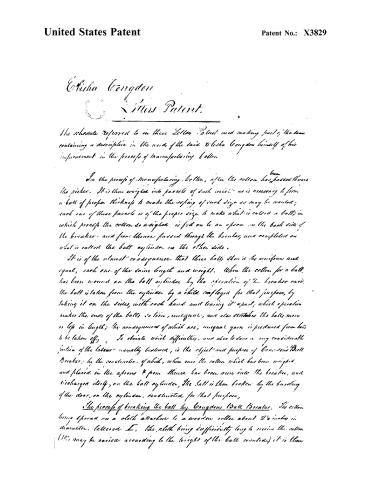
The schedule referred to in these Letters Patent and making part of the same containing a description in the words of the said Elisha Congdon himself of his improvement in the process of manufacturing cotton.
In the process of manufacturing cotton, after the cotton has passed through the picker, it is then weighed into parcels of such weight as is necessary to form a ball of proper thickness to make the refining of such size as may be wanted; each one of these parcels is of the proper size to make what is called a ball; in which process the cotton so weighed is fed on to an apron on the back side of the breaker, and from thence passed through the breaker, and completed on what is called the ball cylinder on the other side.
It is of the utmost consequence that these balls should be uniform and equal, each one of the same length and weight. When the cotton for a ball has been wound on the ball cylinder by the operation of the breaker card, the ball is taken from the cylinder by a child employed for that purpose, by taking it on the sides, with each hand and tearing it apart; which operation makes the ends of the balls so torn, unequal, and also stretches the balls more or less in length; the consequences of which are, unequal yarn is produced from balls to be taken off. To obviate which difficulties, and also to save a very considerable portion of the labour usually bestowed, is the object and purpose of Congdon’s Ball Breaker; by the construction of which, whenever the cotton which has been weighed and placed in the aprons & from thence has been run into the breaker, and discharged itself, on the ball cylinder, the ball is then broken by the bursting of the door, on the cylinder, constructed for that purpose.
The process of breaking the ball by Congdon’s Ball Breaker. The cotton being spread on a cloth attached to a wooden roller about 2½ inches in diameter, lettered I, the cloth being sufficiently long to receive the roller (this may be varied according to the weight of the ball wanted) it is then
Page 3.
United States Patent
Patent No.: X3829
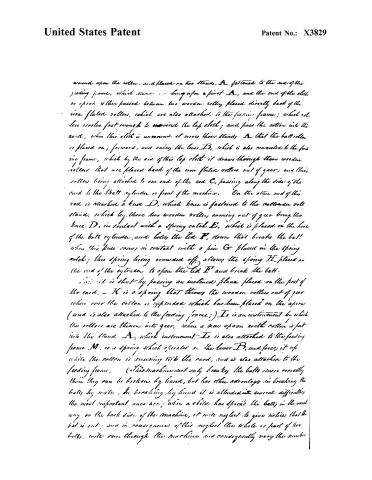
wound upon the roller, and placed on two stands, A, fastened to the end of the feeding frame, which stands ... hung upon a pivot A, and the end of the cloth or apron is then passed between two wooden rollers placed directly back of the iron fluted rollers, which are also attached to the feeding frame; which rollers revolve fast enough to unwind the lap cloth, and pass the cotton into the card, when this cloth is unwound it moves those stands A that the batt roller is placed on, forward, and raises the lever B, which is also connected to the feeding frame, which by the aid of this lap cloth it draws through those wooden rollers that are placed back of the iron fluted rollers out of gear; and these rollers being attached to one end of the rod C, passing along the side of the card to the batt cylinder or front of the machine. On the other end of this rod is attached a knee D, which knee is fastened to the callender roll stand, which by those two wooden rollers, coming out of gear brings the knee D, in contact with a spring catch E, which is placed on the hub of the batt cylinder, and holds the lid F, down that breaks the batt when this knee comes in contact with a pin G placed in the spring catch; this spring being crowded off, allows the spring H, placed on the end of the cylinder to open the lid F and break the batt.
This is that by passing an inclined plane placed on the front of the card, — K is a spring that throws the wooden rollers out of gear when ever the cotton is expanded which has been placed on the apron (and is also attached to the feeding frame;) L is an instrument by which the rollers are thrown into gear, when a new apron with cotton is put into the stand A, which instrument L is also attached to the feeding frame M. is a spring which operates on the lever B, and forces it up while the cotton is running into the card, and is also attached to the feeding frame. (This machine not only breaks the batts more correctly than they can be broken by hand, but has other advantages in breaking the batts by water, in breaking by hand it is attended with several difficulties the most important ones are; when a child has spread the batts in the usual way on the back side of the machine, it will neglect to give notice that the bat is out; and in consequence of this neglect the whole or part of two batts, will run through the machine and consequently vary the number
Page 4.
United States Patent
Patent No.: X3829
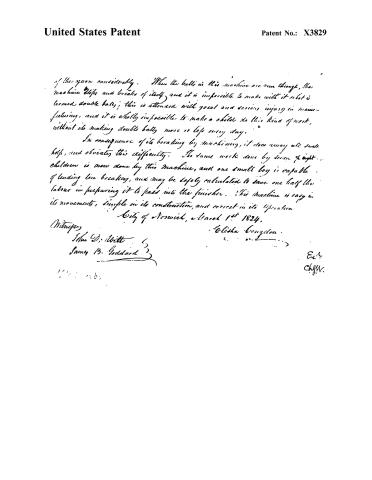
of the yarn considerably. When the balls in this machine are run through, the machine stops and breaks of itself, and it is impossible to make with it what is termed double bales; this is attended with great and serious injury in manufacturing, and it is wholly impossible to make a child do this kind of work, without its making double bales, more or less every day.
In consequence of its breaking by machinery, it does away all small help, and obviates this difficulty. The same work done by seven or eight children is now done by this machine, and one small boy is capable of tending the breaker, and may be safely calculated to save one half the labour in preparing it to pass into the finisher. This machine is easy in its movements, simple in its construction, and correct in its operation.
City of Norwich, March 1st 1824.
Witnesses
John D. Nott
Samuel B. Goddard
Elisha Congdon
Exr.
Chf. W.
Page 5.
United States Patent
Patent No.: X3829
DRAFTSMAN'S DIVISION.
All communications should be addressed to
"The Commissioner of Patents,"
Washington, D. C.
2-328 a.
DEPARTMENT OF THE INTERIOR,
United States Patent Office,
Washington, D. C., 189
SIR:
The printed copies of Patent No. 60019, dated March 12, 1892, are exhausted.
As soon as printed a copy will be mailed you to complete your order.
By direction of the Commissioner:
Very respectfully,
Chief Clerk.
314316-87-5m
About this record
- Patentee
- Jim Shaw's X-patent list
- Date
- the Name and Date index of patents, USPTO records, Jim Shaw's X-patent list
- Invention
- the Name and Date index of patents
- Listed in
- the Name and Date index of patents, USPTO records, Jim Shaw's X-patent list, S. A. Elliot's printed list of patents, Burke's List of Patents (1847)
- S. A. Elliot's printed list of patents gives the same name and date.
- Burke's 1847 Patent Office list gives the same patent.
- Residence from Burke's 1847 Patent Office list; the standard lists give none.