

Drawings and documents
USPTO scan
The patent as scanned by the USPTO
-
 Page 1
-
 Page 2
-
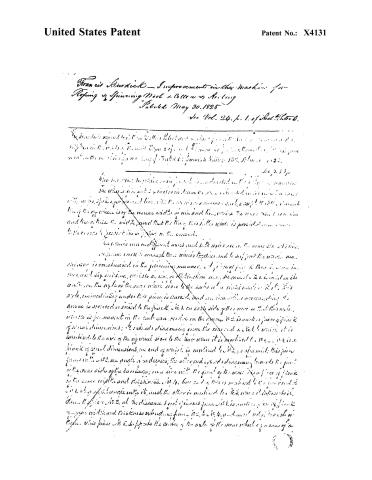 Page 3


U.S. Patent and Trademark Office · Google Patents
Show the transcription Hide (768 words)
Machine transcription (LightOnOCR) of the pages as scanned by the USPTO, most of them the handwritten copies made when the records were restored after the 1836 fire. Not checked; it can misread handwriting, so compare it with the scan.
Page 2.
United States Patent
Patent No.: X4131
Francis Bardick of Dorchester, New York
Letters Patent
The Schedule referred to in their Letters Patent and making part of the same containing a description in the words of the said Francis Bardick himself of his improvement in a machine for spinning and spinning wool & cotton &c.
This machine consists of a box or chest, on the top edge of the box or chest there may be a gutter or a trough for a carriage or guide to run on; on the top of the box near the end is placed in a horizontal position, Spindles, and on the point of the Spindles is placed a burr. These burrs may be made of metal, wood, or leather. The burrs being fastened on the ends of the Spindles will cause the yarn to keep in its proper place while spinning; or the points of the Spindles may be turned one side, or there may be Spools in place of Spindles with a burr or wires, put in the end of them, to keep the yarn to its place. The threads may be drawn in a right line with the Spindles or Spools. Near the butt end of the Spindles or Spools are placed wheels, and in a right line with the wheels, across the Spindles or Spools on the side of the box or chest are placed perpendicular arms, rising above the edge of the box or chest, and near the top of these arms runs a Spindle, and on this Spindle wheels are placed with bands passing from them to the wheels on the Spools or Spindles. On the end of this Spindle outside of the arms, a wheel is placed with a band passing from it to the rim hung on the same side of the machine; or this Spindle may be placed under the Spools or Spindles and pass through the sides of the box or chest, or on the end of the Spindle a cog wheel may be placed for a strap running to the rim on the same side of the machine. This rim is placed on the axle passing through near the centre of the machine, and on the other end of the axle a crank is placed to put the machine in motion. In the box or chest on the axle, two hubs or rollers are placed, one of these hubs or rollers is stationary, in the end of this hub are holes to receive a pin or point which is fastened into the box hub and in
Page 3.
United States Patent
Patent No.: X4131
Francis Burdick — Improvement in the Machine for Roping & Spinning Wool & Cotton or Acetate
Patented May 30, 1825
See Vol. 24, p. 1 of Act. 1825.
The invention relates to a machine for roping and spinning wool or cotton or acetate. The machine is constructed with a frame and a series of rollers arranged in a specific manner to perform the roping and spinning process. The rollers are mounted on a shaft and are driven by a motor or a manual crank. The material to be processed is fed into the machine and passes through the rollers, which compress and twist the fibers to form a rope or spun yarn.
The machine includes a tensioner to maintain consistent pressure on the material as it passes through the rollers. The tensioner is adjustable to accommodate different types of materials and desired output densities. The machine also features a guide system to ensure the material remains aligned and does not become misaligned or tangled during processing.
The rollers are made of a durable material such as steel or hardened metal to withstand the friction and wear associated with the roping and spinning process. The rollers are also coated with a lubricant to reduce friction and prevent damage to the material being processed.
The machine is designed for use in both industrial and home settings. It can be powered by electricity, steam, or manual labor, making it versatile for various applications. The machine is relatively simple to operate and maintain, requiring minimal training for users.
In addition to its primary function, the machine can be modified to perform additional tasks such as cutting, measuring, or marking the processed material. This versatility makes it a valuable tool for a wide range of industries, including textiles, manufacturing, and construction.
About this record
- Patentee
- Jim Shaw's X-patent list
- Date
- the Name and Date index of patents, USPTO records, Jim Shaw's X-patent list
- Invention
- the Name and Date index of patents
- Listed in
- the Name and Date index of patents, USPTO records, Jim Shaw's X-patent list, S. A. Elliot's printed list of patents, Burke's List of Patents (1847)
- S. A. Elliot's printed list of patents gives the same name and date.
- Burke's 1847 Patent Office list gives the same patent.
- Residence from Burke's 1847 Patent Office list; the standard lists give none.