

Drawings and documents
USPTO scan
The patent as scanned by the USPTO
-
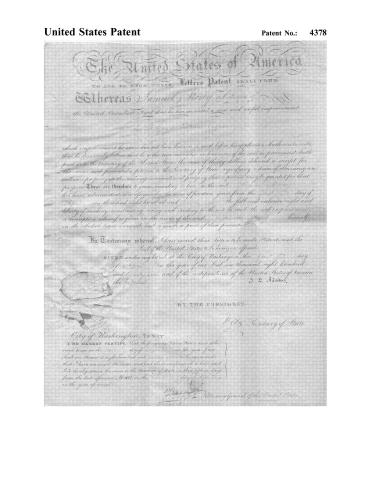 Page 1
-
 Page 2
-
 Page 3
-
 Page 4
-
 Page 5
-
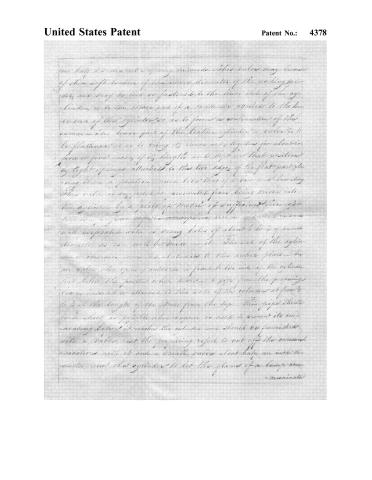 Page 6
-
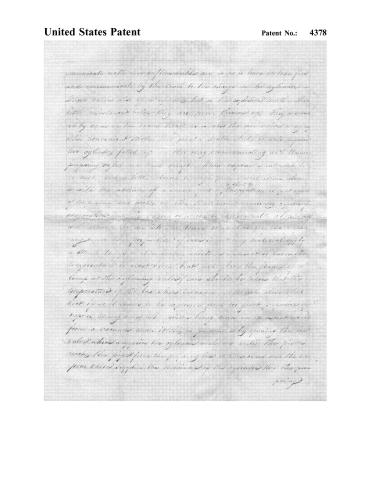 Page 7
-
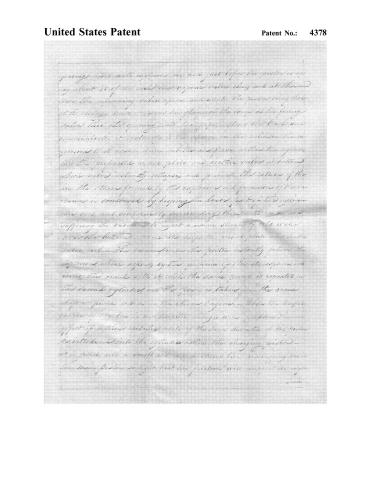 Page 8
-
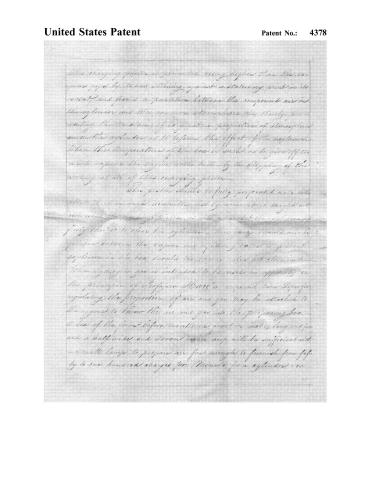 Page 9
-
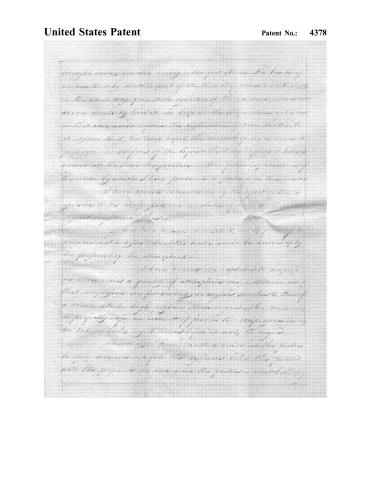 Page 10
-
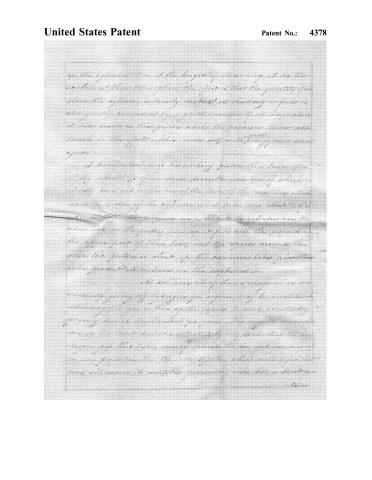 Page 11


U.S. Patent and Trademark Office · Google Patents
Show the transcription Hide (1,043 words)
Machine transcription (LightOnOCR) of the pages as scanned by the USPTO, most of them the handwritten copies made when the records were restored after the 1836 fire. Not checked; it can misread handwriting, so compare it with the scan.
Page 1.
United States Patent
Patent No.: 4378
The United States of America
By the President of the United States
To the Public
Whereas I, J. A. Smith, of New York, New York, being duly sworn, do depose and say:
That on or about the 15th day of March, 1923, I was granted a patent for an invention entitled “A Novel Method for the Efficient Extraction of Rare Earth Elements from Ores” by the United States Patent and Trademark Office.
That said patent was issued under the authority of the United States Government and is hereby acknowledged as a public record.
That the patent is now in the public domain and may be freely used, reproduced, or disseminated without further permission or compensation.
That no claim is made to any exclusive rights or privileges beyond the scope of the original patent grant.
That this statement is made for the purpose of ensuring transparency and public access to the information contained herein.
In Testimony Whereof, I have hereunto set my hand and seal the 15th day of March, 1923, at the City of Washington, D.C.
J. A. Smith
BY THE PRESIDENT
Henry Morgenthau, Jr.
Secretary of the Treasury
City of Washington, D.C.
I, the undersigned, do hereby certify that the foregoing statement was made by J. A. Smith on or about the 15th day of March, 1923, and that the same is true to the best of my knowledge and belief.
Henry Morgenthau, Jr.
Secretary of the Treasury
End of Document
Page 2.
United States Patent
Patent No.: 4378
Page 3.
United States Patent
Patent No.: 4378
Page 4.
United States Patent
Patent No.: 4378
The Schottky effect is in this Patent, as a making part of the same, containing a description in the words of the kind of material a theory of the same, and the like, as in the original.
*In the present case, the same principle which has been that of Schottky's theory of the effect of the field of a metal on the surface of a metal, and the like, has been applied to a metal in a vacuum, and the effect of the field of a metal on the surface of a metal in a vacuum has been shown to be the same as the effect of the field of a metal on the surface of a metal in a vacuum, and the like, and the like, and the …
Page 5.
United States Patent
Patent No.: 4378
Page 6.
United States Patent
Patent No.: 4378
*One half the diameter of the inner diameter of the working pipe, and may be held or fastened to the lower end of the cylinder, so as to be turned out of a manner attached to the lower end of the cylinder, so as to form an outlet outlet of the same. The lower part of the hollow cylinder is attached to the flange, so as to bring its inner end together for about the same part of its length as the right end that is closed by tight-fitting attached to the two ends of the flat part, placing them in a position more like that of a cone and having their ends being pulled or pressed from being driven into the cylinder by a plate of metal of sufficient thickness to prevent any pressure from being applied to the inner end of the cylinder, so as to prevent any damage to the inner end of the cylinder. The end of the cylinder is connected to the other plate, so as to allow the opening of the cylinder to be at the side of the cylinder, …
Page 7.
United States Patent
Patent No.: 4378
*Communicate with the inflammables are so as to have the fuel and combustible by the wind to the blaze on the cylinder. I have taken the great opportunity but as the cylinder with a little moisture before they are used. I have used a very small quantity of the same as to allow the air to be drawn into the cylinder filled up. This may be communicating with steam preparing my fuel and such as to have exposed to the wind, and a little steam, enough to prevent the air from entering with the addition of a small part of the quantity of gas of the same and water to allow the same to be used as a fuel for the purpose …
Page 8.
United States Patent
Patent No.: 4378
Page 9.
United States Patent
Patent No.: 4378
Page 10.
United States Patent
Patent No.: 4378
Page 11.
United States Patent
Patent No.: 4378
up the cylinder, it is at the height of its working at the time
continues. Then, when the first is that the quantity of air
above the cylinder is nearly doubled, the quantity of force is
also greatly increased by a great increase of air temperature.
It now seems to the public while the machine driver adds
pressure to the piston. This mode acts in the first place, more
rapidly.
I have attached to the working piston this tube, open
at the bottom, about 1/2 of an inch diameter, one end of which is
directly over and above one of the holes of the pump, and attached
to the bottom of the cylinder, which tube is about 1/2 inch
wide. The air prepared air is let into the cylinder, near the
bottom, and the piston rises up, at the same time prepared air
the upper part of these tubes, and the space around them
when the piston is above the maximum, takes place the
tubes prevent the violence in the expansion.
We are aware of the various tubes are
generally placed off by a given air engine, may be substituted
utilizing the air in lieu of the request to work constantly
for every stroke, which is not possible. The engine is complete
and we have made its description by only conducting the type
of engine, and this tube, may be connected to the air pipe, and may be
in the proportion like the other type, which will be provided
with an air valve, which will be provided with a short air
tube.
Published accounts: journal notice
Notice in the monthly list of patents
Franklin Journal and American Mechanics' Magazine, vol. 1 (1826), p. 368 · View the page
In the gas or vapour engine, April 1, Samuel Morey, Oxford, New Hampshire.
Originals held in libraries and archives: letters patent
Letters patent for a gas or vapour engine, signed by President John Quincy Adams, 1826
Held by Rauner Special Collections Library, Dartmouth College, Samuel Morey papers (MS-150). Not reproduced here. · Catalog record
DATAMP: illustration
Illustrations from DATAMP
DATAMP (Directory of American Tool and Machinery Patents), via the Internet Archive · Archived DATAMP page
About this record
- Patentee
- DATAMP
- Date
- the Name and Date index of patents, DATAMP, USPTO records
- Invention
- DATAMP
- Listed in
- the Name and Date index of patents, DATAMP, USPTO records, Jim Shaw's X-patent list, the Journal of the Franklin Institute, S. A. Elliot's printed list of patents, Burke's List of Patents (1847)
- S. A. Elliot's printed list of patents gives the same name and date.
- The original letters patent is held by the Rauner Special Collections Library, Dartmouth College.
- Burke's 1847 Patent Office list gives the same patent.