

Drawings and documents
USPTO scan
The patent as scanned by the USPTO
-
 Page 1
-
 Page 2
-
 Page 3
-
 Page 4


U.S. Patent and Trademark Office · Google Patents
Show the transcription Hide (894 words)
Machine transcription (LightOnOCR) of the pages as scanned by the USPTO, most of them the handwritten copies made when the records were restored after the 1836 fire. Not checked; it can misread handwriting, so compare it with the scan.
Page 2.
United States Patent
Patent No.: X4610
John C. Rives
Letters Patent
The Schedule referred to in these Letters Patent, and making part of the same, containing a description in the words of the said John C. Rives himself of his improvement in the mode of chaining Tickets.
In this system of chaining Tickets the tickets are made or numbered by changing as often as it can be done, the numbers, figures, letters, marks, or characters, and on a certain number of decimal points. If numbers are used, compounded of two figures, then each number must be separated by a dot or mark; but if single simple figures, letters, marks, or characters are used, then there is no necessity for such operation. Each and every ticket in a scheme must have on it the same number of numbers, figures, letters, marks, or characters. The number of numbers, figures, letters, marks, or characters, used in making or numbering the tickets multiplied into itself as often as there are decimal points on a ticket, or in other words as often as there are numbers, figures, letters, or marks, or characters, on a ticket will give the number of tickets that can be made with those numbers, figures, letters, marks, or characters. For example, if twenty five numbers, figures, letters, marks, or characters, are changed on three decimal points, or in other words, if three of the twenty five numbers, figures, letters, . . . . . or characters are put on a ticket, the third power of twenty five (15625) is the number of tickets that can be …
Page 3.
United States Patent
Patent No.: X4610
contain an equal number of each of the numbers, figures, letters, marks, or characters used. They will be equally distributed on all the decimal points. The same numbers, figures, letters, marks, or characters that are found in reading or enumerating from left to right, will also be found in reading or enumerating from right to left. The position or relation that any number, figure, letter, mark, or character bears to another will be found to be maintained or reciprocated — by each of the others. To draw a lottery when the tickets are made or numbered as above described, there must be put into the wheel, such an one as is usually made use of, in drawing lotteries, as many of each of the numbers, figures, letters, marks, or characters used in making the tickets as there are decimal points, or numbers, figures, letters, or characters on a ticket. If ten figures, numbers, letters, marks, or characters are used in making or numbering the tickets, and four of them are put on each ticket, then four of each must be put into the wheel which together will make forty. For example, suppose the ten figures in arithmetic were used, and four put on each ticket, then there would be put into the wheel, four 0’s, four 1’s, four 2’s, four 3’s, four 4’s, four 5’s, four 6’s, four 7’s, four 8’s, four 9’s. This one example is thought a sufficient explanation as regards putting the numbers, figures, letters, marks, or characters into the wheel. There must be drawn from the wheel as many numbers, figures, letters, marks, or characters, as there are numbers, figures, letters, marks, or characters on a ticket, which will decide which of the tickets are blanks, and which are prizes, and also what prize or prizes each ticket is entitled to, or if it should be thought best the capital prize might be decided by drawing from the wheel as many numbers, figures, letters, marks, or characters, as there are on a ticket for each of them. The secondary prizes by drawing from the wheel
Page 4.
United States Patent
Patent No.: X4610
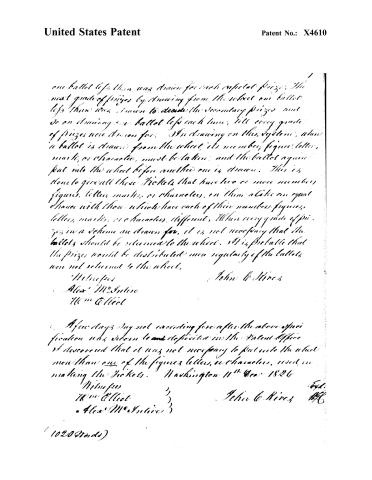
one ballot left then was drawn for each separate prize. The next grade of prizes by drawing from the wheel one ballot left then was drawn to decide the secondary prizes, and so on drawing one ballot left each time, till every grade of prizes were drawn for. In drawing on this system, when a ballot is drawn from the wheel, its number, figure, letter, mark, or character, must be taken, and the ballot again put into the wheel before another one is drawn. This is done to give all those tickets that have two or more numbers, figures, letters, marks, or characters, on them a like or equal chance with those which have each of their numbers, figures, letters, marks, or characters, different. When every grade of prizes in a scheme are drawn for, it is not necessary that the ballots should be returned to the wheel. It is probable that the prizes would be distributed more regularly if the ballots were not returned to the wheel.
Witnesses
Alex. McInire
Wm Elliot
John C. Hires
A few days day not exceeding five after the above specification was drawn to and deposited in the Patent Office I discovered that it was not necessary to put into the wheel more than one of the figures, letters, or characters, used in making the tickets. Washington 11th Decr 1826
Witnesses
Wm Elliot
Alex. McInire
John C. Hires
(1020 Words)
Published accounts: journal notice
Notice in the monthly list of patents
Franklin Journal and American Mechanics' Magazine, vol. 4 (1827), p. 71 · View the page
In the mode of drawing lotteries; John C. Rives, Washington, D. C., Dec. 22.
About this record
- Patentee
- DATAMP
- Date
- the Name and Date index of patents, DATAMP, USPTO records
- Invention
- DATAMP
- Listed in
- the Name and Date index of patents, DATAMP, USPTO records, Jim Shaw's X-patent list, the Journal of the Franklin Institute, Burke's List of Patents (1847)
- Burke's 1847 Patent Office list gives the same patent.