

Drawings and documents
USPTO scan
The patent as scanned by the USPTO
-
 Page 1
-
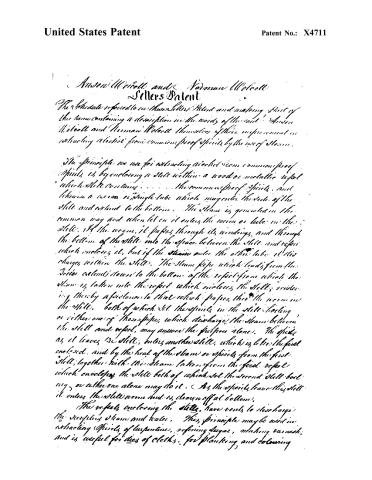 Page 2
-
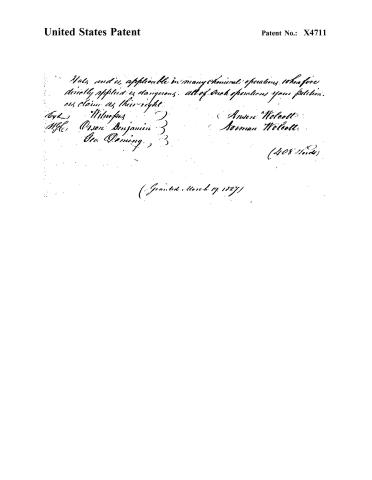 Page 3


U.S. Patent and Trademark Office · Google Patents
Show the transcription Hide (530 words)
Machine transcription (LightOnOCR) of the pages as scanned by the USPTO, most of them the handwritten copies made when the records were restored after the 1836 fire. Not checked; it can misread handwriting, so compare it with the scan.
Page 2.
United States Patent
Patent No.: X4711
Anson McClell and Norman McClell
Sellers Patent
The Schedule referred to in these Letters Patent and making part of the same containing a description in the words of the said Anson McClell and Norman McClell themselves of their improvement in extracting alcohol from common proof spirits by the use of Steam.
The principle we use for extracting alcohol from common proof spirits is by enclosing a still within a wood or metallic vessel which still contains . . . . . the common proof spirits, and likewise a worm or single tube which may enter the side of the still and extend to the bottom. The steam is generated in the common way and when let on it enters the worm or tube in the still. At the worm, it passes through its windings, and through the bottom of the still into the space between the still and vessel which encloses it, but if the steam enters the other tube it dies charges within the still. The steam pipe which leads from the boiler extends down to the bottom of the vessel from which the steam is taken into the vessel which encloses the still, rendering thereby a pressure to that which passes thru the worm in the still, both of which set the spirits in the still boiling, or either one of those pipes which discharge the steam between the still and vessel, may answer the purpose alone. The spirits as it leaves the still, enters another still, which is let in the first enclosed, and by the heat of the steam or spirits from the first still, together with the steam taken from the first vessel which envelopes the still both of which set the second still boiling, or either one alone may do it. As the spirits leave the still it enters the still worm and is drawn off at bottom.
The vessels enclosing the stills have vents to discharge the superfluous steam and water. This principle may be used in extracting spirits of turpentine, refining sugar, making varnish, and is useful for dyes of cloths, for planking and coloring.
Page 3.
United States Patent
Patent No.: X4711
Vals, and is applicable in many chemical operations, when force directly applied is dangerous, all of such operations your petition. as claim as their right.
<table>
<thead>
<tr>
<th>First</th>
<th>Wilberforce</th>
<th>Anderson Wilcott</th>
</tr>
</thead>
<tbody>
<tr>
<td>Second</td>
<td>Orson Benjamin</td>
<td>Norman Wilcott</td>
</tr>
<tr>
<td>Third</td>
<td>Geo. Fleming</td>
<td></td>
</tr>
</tbody>
</table>
(408 Words)
(Granted March 19, 1827)
Published accounts: specification
Specification printed in the Mirror of the Patent Office (1828)
American Journal of Improvements in the Useful Arts, and Mirror of the Patent Office, vol. 1 (1828), printed p. 74 · View the page
Text of the specification as printed in the Mirror of the Patent Office, machine-transcribed from the page scans (GLM-OCR); not proofread. Check the scan for figures and reference letters.
Specification—Of Anson Wolcott and Norman Wolcott, of Bloomfield, Ontario County, New-York, for an improvement in extracting Alcohol by Steam.
The principle we use for extracting alcohol from common spirits, is by enclosing a still within a wooden or metallic vessel, which still contains the common proof spirits, and likewise a worm or a single tube, which may enter the side of the still, and extend to the bottom. The steam is generated in the common way, and when let on, it enters the worm or tube in the still. If the worm, it passes through the windings and through the bottom of the still into the space between the still and vessel which encloses it; but if the steam enter the other tube, it discharges within the still. The steam pipe which leads from the boiler, extends down to the bottom of the vessel from which the steam is taken, into the vessel which encloses the still; rendering thereby assistance to that which passes through the worm in the still; both of which set the spirits in the still, boiling; or either one of those pipes, which discharge the steam between the still and vessel, may answer the purpose, alone. The spirit, as it leaves the still, enters another still, which is like the first, enclosed, and by the heat of the steam or spirits from the first still, together with the steam taken from the first vessel which envelopes the still, both of which set the second still boiling, or either one alone may do it. As the spirit leaves this still, it enters the still worm, and is drawn off at the bottom. The vessels enclosing the stills have vents to discharge the surplus steam, and water. This principle may be used in extracting spirits of turpentine, refining sugar, making varnish; and is useful for dyers of cloth, for planking and coloring hats, and is applicable in many chemical operations, where fire, directly applied, is dangerous. All of such operations, your petitioners claim, as their rights.
ANSON WOLCOTT,
NORMAN WOLCOTT.
Anson Benjamin, George Deming.
Witnesses.
Patented March the 19th, 1827.
Published accounts: journal notice
Notice in the monthly list of patents
Franklin Journal and American Mechanics' Magazine, vol. 4 (1827), p. 143 · View the page
In extracting alcohol from common proof spirits, by the use of steam; A. Wolcott, and N. Wolcott, Bloomfield, Ontario county, N. York, March 19.
Published accounts: journal notice
Notice in the monthly list of patents
Journal of the Franklin Institute, vol. 5 (1828), p. 64 · View the page
In the mode of distilling Alcohol by steam; Anson & Norman Wolcott, Bloomfield, N. Y. March 19. • In a spring temple for weavers; A. Jenks, and J. Clewell, Holmesburg, near Philadelphia, March 19.
About this record
- Patentee
- the Journal of the Franklin Institute, Journal
- Date
- the Name and Date index of patents, USPTO records, Jim Shaw's X-patent list
- Invention
- the Name and Date index of patents
- Listed in
- the Name and Date index of patents, USPTO records, Jim Shaw's X-patent list, the Journal of the Franklin Institute, the Mirror of the Patent Office (1828), S. A. Elliot's printed list of patents, Burke's List of Patents (1847)
- The patentee's full name comes from the Franklin Institute's journal.
- The specification was printed in the Mirror of the Patent Office (1828).
- S. A. Elliot's printed list of patents gives the same name and date.
- Burke's 1847 Patent Office list gives the same patent.