

Drawings and documents
Published accounts: specification
Specification printed in the Mirror of the Patent Office (1828) with its plate
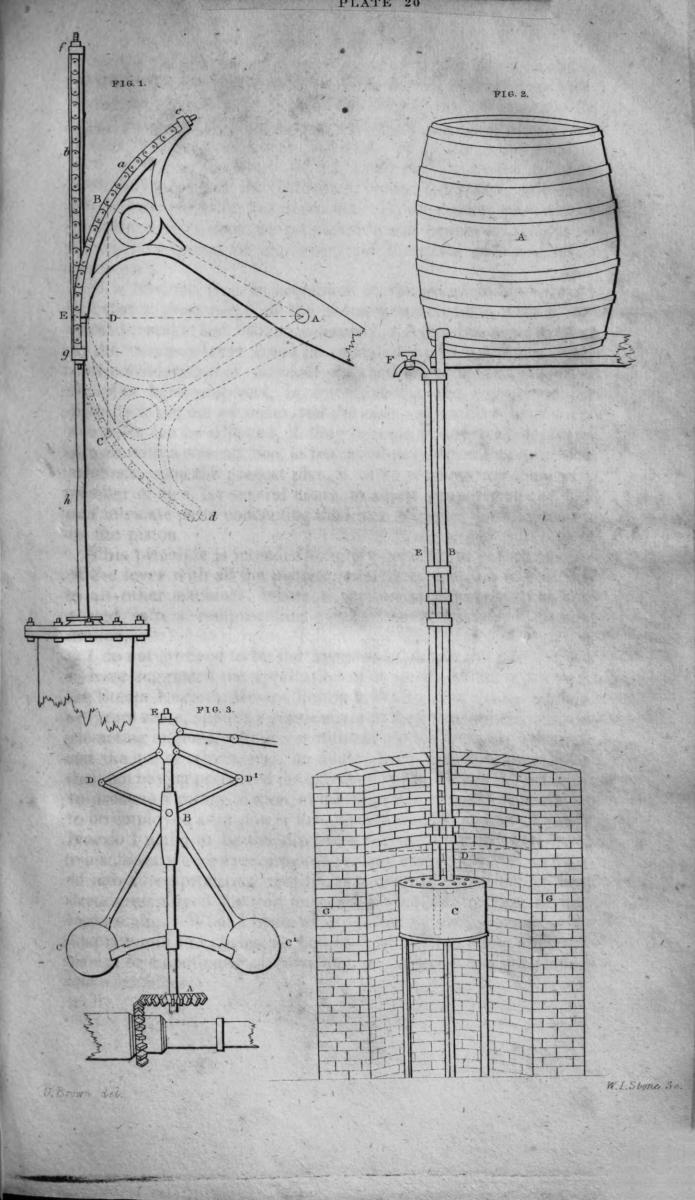
American Journal of Improvements in the Useful Arts, and Mirror of the Patent Office, vol. 1 (1828), printed p. 188 · View the page
Show the transcription Hide (533 words)
Text of the specification as printed in the Mirror of the Patent Office, machine-transcribed from the page scans (GLM-OCR); not proofread. Check the scan for figures and reference letters.
PROCESS OF COOLING WATER AND OTHER FLUIDS.
By Dr. Wm. Thornton, of Washington, District of Columbia.
See plate XX, fig. 2.
Specification.—The principle is to convey the fluid to be cooled into the earth, or wherever the requisite degree of cold exists, and when cool to return it by means of the pressure of an entering stream or superincumbent fluid, or otherwise, to a level with the supplying fountain, or to the place whence it is to be drawn out for use, or discharged.
This may be effected by making a well or hole in the earth, by boring, or otherwise, into which a tube or aqueduct is to be extended to the depth required, and then continued upwards to its ulterior termination. This aqueduct is to be connected with the cistern, fountain, or stream, from which the fluid is to be supplied, so as to admit its entrance into it. The aqueduct may be a continuation of one and the same tube, of such form and dimensions, and disposed in such directions, in whole or in part, spirally, or otherwise, as the depth and limits provided for it; and other considerations may suggest as most expedient; or it may be composed of different tubes and varying in dimensions, as a larger for the descending, and a smaller for the ascending fluid, or otherwise.
Or, a reservoir may be placed in the well or cavity, to which both tubes should be connected. In such case, the descending tube should be made to discharge itself into the reservoir, at or near the top; and the entrance from it into the ascending tube should be at or near the bottom, in order that none but the coolest of the fluid should pass into it. Or still more to facilitate the cooling process, tubes, one or more, may be made to pass through this reservoir, corresponding holes in the top and bottom or opposite sides of the reservoir having been provided for that purpose, into which the ends of such tubes are to be soldered, or otherwise fastened, in such manner as to permit the cool water of the well to pass through and without mixing with the fluid in the reservoir.
When water in shallow wells is conveyed deeper into the earth upon the principles of these improvements, and in all cases herein contemplated, when the fountain is not sufficiently elevated to press the fluid in its ascent to the height required, pumps, or other means may be applied for raising it.
Wells, caverns, or other cool recesses, may be used for the purposes of these improvements.
The tubes, aqueducts, and reservoirs, to be used in the foregoing improvements, may be of cast iron or other materials; and the fastenings of every description, as well as all appendages for regulating the ingress and egress of the fluid, as well as others, may be by means, and in the manner usual in other cases of like nature.
WILLIAM THORNTON.
A. M'INTIRE,
R. W. FENwick,
Patented July 31, 1827.
Published accounts: journal notice
Notice in the monthly list of patents
Journal of the Franklin Institute, vol. 5 (1828), p. 139 · View the page
In the method of cooling water, or other fluids, William Thornton, of Washington City, D. C., July 31.
About this record
- Patentee
- Jim Shaw's X-patent list
- Date
- the Name and Date index of patents, Jim Shaw's X-patent list
- Invention
- the Name and Date index of patents
- Listed in
- the Name and Date index of patents, Jim Shaw's X-patent list, the Journal of the Franklin Institute, the Mirror of the Patent Office (1828), S. A. Elliot's printed list of patents, Burke's List of Patents (1847)
- A drawing was printed in the Mirror of the Patent Office (1828).
- The specification was printed in the Mirror of the Patent Office (1828).
- The Mirror of the Patent Office's supplementary list gives the same patent.
- S. A. Elliot's printed list of patents gives the same name and date.
- Burke's 1847 Patent Office list gives the same patent.