

Drawings and documents
Published accounts: specification
Specification printed in the Mirror of the Patent Office (1828) with its plate
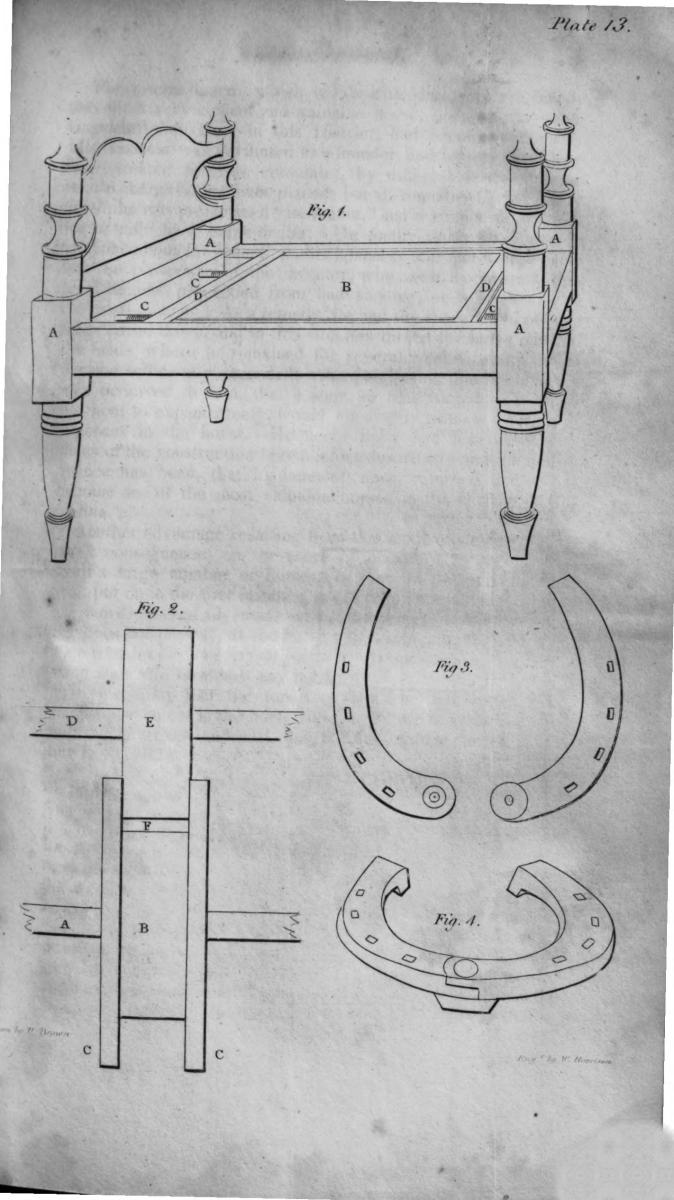
American Journal of Improvements in the Useful Arts, and Mirror of the Patent Office, vol. 1 (1828), printed p. 147 · View the page
Show the transcription Hide (403 words)
Text of the specification as printed in the Mirror of the Patent Office, machine-transcribed from the page scans (GLM-OCR); not proofread. Check the scan for figures and reference letters.
SCOURING AND WASHING CLOTHS.
Improvement by John Goulding, Dedham, Norfolk county, Mass.
See plate XIII. fig. 2.
Specification.—The manner in which this operation is to be performed is as follows, that is to say: Fig. 2, plate XIII letter A, represents the main arbour or shaft. On it is fastened a drum or pulley, B, which has flanches or sides, C C, projecting above the drum or pulley, for the purpose of contracting and maintaining the cloth in a close and compact state. This groove or channel is made broader or narrower according to the cloth that is to be cleansed in it; say for common double width cloth, about four inches broad and six inches deep; the drum being from eighteen to twenty-four inches diameter. In this groove or channel may be placed one or more rollers or pulleys, E, which has a shaft, D; which shaft, pulley androllerorrollerswillhanginagallowsormframe;saidframetobe suspendedattheoppositeendfrom thepulleyorroller. On that end of the frame where the pulley is placed,is to be fixeda weight or spring. Thisweightorpowerbeingsufficientto startorloosenthegreaseorfilth fromthecloththatiscouring.The clothistopassbetweenthetworeollersinthenchannelatF. Theclothwill then passbelow thepulleysintoaboxfor that purpose,whichmayhaveanykindofcleansingliquor in it. Thisboxortroughmaybeheated,ifnecessary,blyanfitand propermode of heatingkettles.Thetwoendsofthel clothmustbesewedorfastenedtogether,sosastopassround and round,untilitisproperly cleansedandrinsed。When the greaseorfilth is properlystartedbythecleansingliquor,lead orguidehot和coldwateronthecloth,tot rinseandclean it thoroughly.Theupperroller,E,mustsohang,astoplay up anddownintherooveorchannelof thedrumorpulley,B. Theserollersarebestmade ofwhite oak,或otherhard wood.Woodispreferable toiron,或anymetals,oncount ofthelatterbeingmoreliabletocutand injurethecloth.TherotarymotionoftheshaftA,isgivenbyagearorbandwith anyfit and properpower.Thesepulleysarebestmade with thewoodendwise,towardstheriphery。Theremaybeone or moreofthosetoppinchingrollers,E。一共是best—to be placeddirectlyovertherollerB.Atthesidewherethe clothenterthegroove,thereshouldbearaholeinaboardorplank,或two pins,toconduct thecloth totherollersorchannel。Asitpassesfromthechannelorgroovetherehadbetterbeareel,or roller, placedatdeliveringsideoftherollerB,whichroller shouldrevolveroundfasterthanthecleansingsrollers,to take the clothaway fromtherollerstanddrop itinto theboxbelow.
What I claim as new, and as my invention and improvement as aforesaid specified, is, the channel or groove, in which the cloth passes, so as to keep it compact and maintain the cloth to receive all the weight or pressure from the top roller or other drums or rollers.
In testimony that the above is a true specification of my said improvement as above described, and for which I herein claim letters patent, I have hereto set my hand and seal, the sixteenth day of August, in the year of our Lord one thousand eight hundred and twenty-seven.
JOHN GOULDING.
In presence of
JAMES RICHARDSON,
WILLIAM ELLIS.
Published accounts: journal notice
Notice in the monthly list of patents
Journal of the Franklin Institute, vol. 5 (1828), p. 210 · View the page
In the mode of throwing the shuttle, or shuttles, in weaving; John Goulding, of Dedham, Massachusetts, August 24.
About this record
- Patentee
- DATAMP
- Date
- the Name and Date index of patents, DATAMP
- Invention
- DATAMP
- Listed in
- the Name and Date index of patents, DATAMP, Jim Shaw's X-patent list, the Journal of the Franklin Institute, the Mirror of the Patent Office (1828), Burke's List of Patents (1847)
- A drawing was printed in the Mirror of the Patent Office (1828).
- The specification was printed in the Mirror of the Patent Office (1828).
- Burke's 1847 Patent Office list gives the same patent.