

Drawings and documents
USPTO scan
The patent as scanned by the USPTO
-
 Page 1
-
 Page 2
-
 Page 3
-
 Page 4
-
 Page 5


U.S. Patent and Trademark Office · Google Patents
Show the transcription Hide (1,336 words)
Machine transcription (LightOnOCR) of the pages as scanned by the USPTO, most of them the handwritten copies made when the records were restored after the 1836 fire. Not checked; it can misread handwriting, so compare it with the scan.
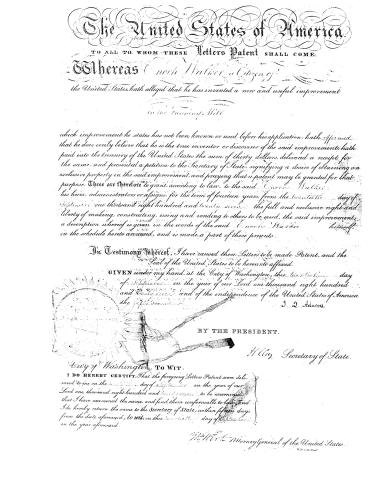
Page 1.
The United States of America.
TO ALL TO WHOM THESE Letters Patent SHALL COME:
Whereas Enoch Walker a Citizen of the United States hath alleged that he has invented a new and useful improvement in the Fanning Mill
which improvement he states has not been known or used before his application, hath affirmed that he does verily believe that he is the true inventor or discoverer of the said improvement, hath paid into the treasury of the United States the sum of thirty dollars, delivered a receipt for the same, and presented a petition to the Secretary of State, signifying a desire of obtaining an exclusive property in the said improvement, and praying that a patent may be granted for that purpose. These are therefore to grant, according to law, to the said Enoch Walker his heirs, administrators or assigns, for the term of fourteen years, from the twentieth day of September one thousand eight hundred and twenty seven, the full and exclusive right and liberty of making, constructing, using and vending to others to be used, the said improvement, a description whereof is given in the words of the said Enoch Walker himself in the schedule hereto annexed, and is made a part of these presents.
In Testimony whereof, I have caused these Letters to be made Patent, and the Seal of the United States to be hereunto affixed.
GIVEN under my hand, at the City of Washington, this twentieth day of September in the year of our Lord one thousand eight hundred and twenty seven and of the independence of the United States of America the fifty second.
J. Q. Adams.
BY THE PRESIDENT.
H. Clay, Secretary of State.
City of Washington, To Wit:
I DO HEREBY CERTIFY, That the foregoing Letters Patent were delivered to me on the day of September in the year of our Lord one thousand eight hundred and twenty seven to be examined; that I have examined the same, and find them conformable to law; and I do hereby return the same to the Secretary of State, within fifteen days from the date aforesaid, to wit, on this twentieth day of September in the year aforesaid.
W. W. L. Attorney General of the United States.
Page 2.
The Schedule referred to in these Letters Patent, making part of the same, containing a description in the words of the said Enoch Walker, himself, of his improvement in the Ginning Mill,—
Each side of the mill is made by nailing or screwing two boards about 24 inches wide cross-ways, the upright one about four feet high, its lower end resting on the floor, and the horizontal one about 4½ feet long, its upper edge about five inches from the top of the upright one — one end extending over the edge of the upright board, about a foot to be rounded or angled for fan cover, to extend round the outside, under & upwards, and drive inner side as low as the cog-shaft, to bring the wind to a focus to act where it should, let the fan turn which way it may; secure those sides of the mill in their places (with the fan shaft about thirty one inches from the floor & the cog-shaft through the body of the mill about 86 inches, also from the floor, & in his mills of common size & form about 16 inches from the fan shaft) by nailing or screwing four boards rabbeted to the edges of the upright board, the two upper ones about five inches wide, and the two lower ones about ten inches wide and each of them about two feet long, according to the width of the mill. In the middle of said shaft passing through the body of the mill there are about four cogs or points to
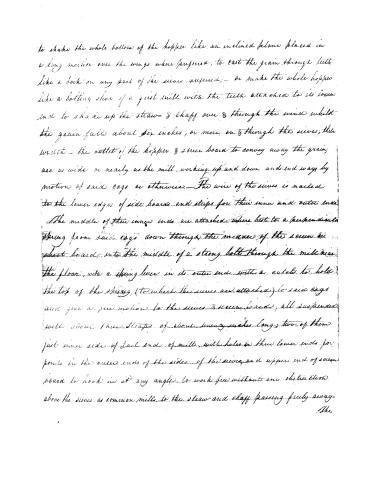
Page 3.
to shake the whole bottom of the hopper like an inclined plane placed in a long moeller over the wings when prepared; to cast the grain through teeth like a fork on any part of the sieves prepared; or make the whole hopper like a bolting shoe of a just mill, with the teeth attached to its lower end to shake up the straw & chaff over & through the wind whilst the grain falls about six inches, or more, on & through the sieves; then with the outlet of the hopper & screen board to convey away the grain, use as wide or nearly as the mill, working up and down and end ways by motion of said cogs or otherwise. The wire of the sieves is nailed to the lower edges of side boards and strips for their inner and outer ends. The middle of their inner ends are attached where best to a perpendicular spring from said cogs down through the measure of the screen or sheet board, into the middle of a strong bolt through the mill near the floor, with a spring lever in its outer end, with a catch to hold the top of the spring (to which the sieves are attached) to said cogs and give a free motion to the sieves & screen board, all suspended with about three straps of about twenty inches long; two of them just inner side of tail end of mill, with holes in their lower ends for points in the outer ends of the sides of the sieves and upper end of screen board to hook in at any angle to work free without any obstruction above the sieves as common mills to the straw and chaff passing freely away.
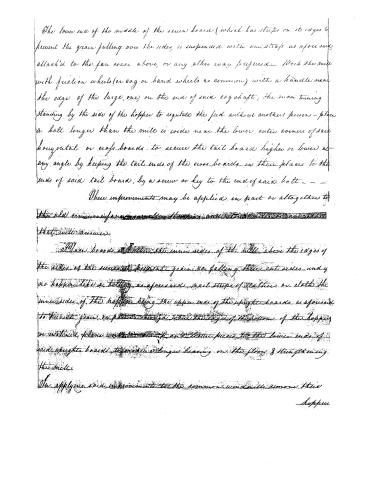
Page 4.
The lower end of the middle of the screw board (which has strips on its edges to prevent the grain falling over the sides) is suspended with a strip as aforesaid attached to the fan cover above, or any other way preferred. Work the mill with friction wheels (or cog or band wheels as common) with a handle near the edge of the large one, on the end of said cog shaft, the man turning standing by the side of the hopper to regulate the feed without another person—place a bolt longer than the mill is wide near the lower outer corners of said horizontal or cross boards to secure the tail boards higher or lower at any angle by keeping the tail ends of the cross boards in their places to the ends of said tail boards, by a screw or key to the end of said bolt.
These improvements may be applied in part or altogether to the old common windmill that will answer.
Place boards on either the inner sides of the mill above the edges of the sides of the screw to prevent grain from falling there out, and if no hopper like is being, as aforesaid, nail strips of leather or cloth the inner sides of the hopper being the upper ends of the upright boards as aforesaid to prevent grain from passing through where the edges of the bottom of the hopper or inclined plane works. Blank and secure pieces to the lower ends of said upright boards to make a longer bearing on the floor & strengthening the mill.
On applying said improvements to the common windmill remove their
Hopkins
Page 5.
hopper elects the within, including the common shoe, and place the eng shaft
to work as aforesaid, as close to the common wings as will answer, & about
seven inches lower than level with the top of the wings over which placed
the bottom of the hopper as aforesaid, with the sieves & screen boards as wide
or nearly as the mill to work as aforesaid or any other way preferred
with the outlet of the hopper as wide or nearly as the mill.
Witnesses
David Past
George Walker
Enoch Walker
Published accounts: journal notice
Notice in the monthly list of patents
Journal of the Franklin Institute, vol. 5 (1828), p. 211 · View the page
In the fanning mill; Enoch Walker, of Springville, Four Corners, Susquehanna County, Pennsylvania, September 20.
About this record
- Patentee
- the Journal of the Franklin Institute, Journal
- Date
- the Name and Date index of patents, USPTO records, Jim Shaw's X-patent list
- Invention
- the Name and Date index of patents
- Listed in
- the Name and Date index of patents, USPTO records, Jim Shaw's X-patent list, the Journal of the Franklin Institute, the Mirror of the Patent Office (1828), S. A. Elliot's printed list of patents, Burke's List of Patents (1847)
- The patentee's full name comes from the Franklin Institute's journal.
- The residence comes from the Franklin Institute's journal.
- The Mirror of the Patent Office's supplementary list gives the same patent.
- S. A. Elliot's printed list of patents gives the same name and date.
- Burke's 1847 Patent Office list gives the same patent.