

Drawings and documents
USPTO scan
The patent as scanned by the USPTO
-
 Page 1
-
 Page 2
-
 Page 3
-
 Page 4
-
 Page 5


U.S. Patent and Trademark Office · Google Patents
Show the transcription Hide (1,240 words)
Machine transcription (LightOnOCR) of the pages as scanned by the USPTO, most of them the handwritten copies made when the records were restored after the 1836 fire. Not checked; it can misread handwriting, so compare it with the scan.
Page 2.
United States Patent
Patent No.: X4898
Samuel Blaisdel (Copy from a Title Sheet)
The schedules referred to in these Letters Patent, and making a part of the same, containing a description in the words of the said Samuel Blaisdel himself, of his improvement on Dearborn’s Patent Ware-house Balance, so called, for weighing all kinds of substances, whether gross and ponderous, or light and delicate, called “Blaisdel’s Improved Avoirdupois Balance.”
To all to whom these presents shall come, Samuel Blaisdel of Lancaster, in the County of Fairfield, in the State of Ohio, White Smith, sends greeting. Be it known, That I, Samuel Blaisdel, have made, constructed, invented and applied to use a new and useful improvement on Dearborn’s Patent Ware-house Balance, so called, for weighing all kinds of substances, whether gross and ponderous, or of a light and delicate weight, called Blaisdel’s improved avoirdupois Balance, for the use of Counters, Warehouses, &c. &c.
The improvement consists in an extension of the left hand, or brachia of the Ware-house Balance, now in use, called “Dearborn’s Balance,” with an additional scale board or dish suspended to a point at a greater distance from the fulcrum. The description is as follows, to wit:
Let there be a Balance constructed on the principle of Dearborn’s Balance.
First—Let the right hand arm or brachia be graduated to the distance of sixteen inches from the fulcrum or axis of motion to the right, commencing with the fulcrum or central axis of motion at the first point, each inch constituting one major subdivision, and each of these again subdivided into eight minor subdivisions, of halves, quarters and eighths.
Second—At the end of this arm or brachia, at a proper distance beyond the last graduated point, let there be constructed a point of suspension for the purpose of receiving a weight designed to neutralize the weight of the scale boards suspended to the other arm.
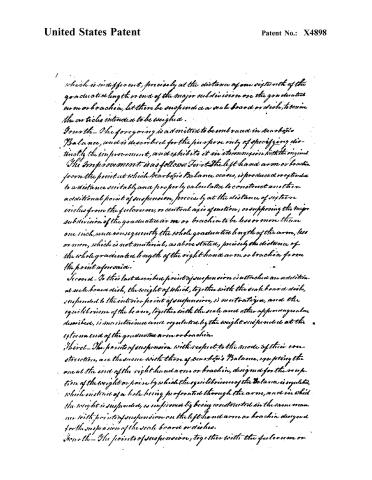
Third—Is a point of suspension on the left hand arm or brachia, precisely at the distance of one inch; or, supposing the major subdivision on the right hand arm or brachia to be less or more than one inch
Page 3.
United States Patent
Patent No.: X4898
which is indifferent, precisely at the distance of one sixteenth of the graduated length or end of the major subdivision on the graduated arm or brachia, let there be suspended a scale board or dish, to receive the articles intended to be weighed.
Fourth—The foregoing is admitted to be embraced in Dearborn’s Balance, and is described for the purpose only of specifying distinctly the improvement, and exhibits it in its connexion with the original. The improvement is as follows: First—The left hand arm or brachia from the point at which Dearborn’s Balance ceases, is produced or extended to a distance suitably and properly calculated to construct another additional point of suspension, precisely at the distance of sixteen inches from the fulcrum, or central axis of motion; or supposing the major subdivision of the graduated arm or brachia to be less or more than one inch, and consequently the whole graduated length of the arm, less or more, which is not material, as above stated, precisely the distance of the whole graduated length of the right hand arm or brachia from the point aforesaid.
Second—To this last described point of suspension is attached an additional scale board dish, the weight of which, together with the scale board dish, suspended to the interior point of suspension, is untruncated, and the equilibrium of the beam, together with the scale and other apparatus above described, is untruncated and regulated by the weight suspended at the extreme end of the graduated arm or brachia.
Third—The points of suspension with respect to the mode of their construction, are the same with those of Dearborn’s Balance, excepting the one at the end of the right hand arm or brachia, designed for the reception of the weight or poise by which the equilibrium of the Balance is regulated, which consists of a hole being perforated through the arm, and in which the weight is suspended, so improved by being constructed in the same manner with points of suspension on the left hand arm or brachia designed for the suspension of the scale board or dishes.
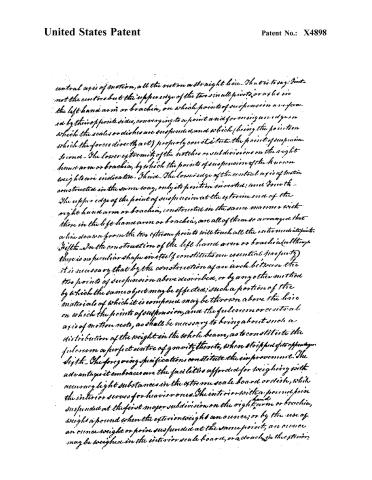
Fourth—The points of suspension, together with the fulcrum or
Page 4.
United States Patent
Patent No.: X4898
central axis of motion, all the motion on a straight line. That is to say: First— not the centers but the upper edge of the two small pivots, or axes in the left hand arm or brachia, on which points of suspension are formed by their opposite sides, converging to a point and forming an edge on which the scales or dishes are suspended, and which (being the point on which the forces directly act) properly constitute the point of suspension. Second—The lower extremity of the notches or subdivisions on the right hand arm or brachia, by which the points of suspension of the known weights are indicated. Third—The lower edge of the central axis of motion constructed in the same way, only its position inverted; and Fourth—The upper edge of the point of suspension at the extreme end of the right hand arm or brachia, constructed in the same manner with those in the left hand arm or brachia, are all of them so arranged that a line drawn from the two extreme points will touch all the intermediate points. Fifth—In the construction of the left hand arm or brachia (although there is no peculiar shape in itself constituting an essential property) it is necessary that by the construction of an arch between the two points of suspension above described, or by any other method by which the same object may be effected; such a portion of the materials of which it is composed may be thrown above the line on which the points of suspension, and the fulcrum or central axis of motion rests, as shall be necessary to bring about such a distribution of the weight in the whole beam, as to constitute the fulcrum a perfect centre of gravity thereto, when stripped of its appendages. Sixth—The foregoing specifications constitute the improvement. The advantage it embraces are the facilities afforded for weighing with accuracy light substances in the extreme scale board or dish, while the interior serves for heavier ones. The interior with a pound poise suspended at the first major subdivision on the right hand arm or brachia, weighs a pound when the exterior weights announce, or by the use of an ounce weight or poise suspended at the same point, an ounce may be weighed in the interior scale board, or a drachm in the exterior.
Page 5.
United States Patent
Patent No.: X4898
Thus in a very material manner running the avoirdupois table.
In testimony that the foregoing is a true specification of my said improvement, as above described, I have hereunto set my hands and seal the Eleventh day of August, A.D. eighteen hundred and twenty-seven.
Witnesses
D. H. Colerick
George Sanderson
Samuel Blaisdell.
(1200 words)
Published accounts: journal notice
Notice in the monthly list of patents
Journal of the Franklin Institute, vol. 5 (1828), p. 211 · View the page
In Dearborn's patent warehouse balance, so called, for weighing all kinds of substances, whether gross and ponderous, or light and delicate, called Blaisdel's improved avoirdupois balance; Samuel Blaisdel, of Lancaster, Fairfield County, Ohio, Oct. 10.
About this record
- Patentee
- the Journal of the Franklin Institute, Journal
- Date
- the Name and Date index of patents, USPTO records, Jim Shaw's X-patent list
- Invention
- the Name and Date index of patents
- Listed in
- the Name and Date index of patents, USPTO records, Jim Shaw's X-patent list, the Journal of the Franklin Institute, the Mirror of the Patent Office (1828), S. A. Elliot's printed list of patents, Burke's List of Patents (1847)
- The patentee's full name comes from the Franklin Institute's journal.
- The Mirror of the Patent Office's supplementary list gives the same patent.
- S. A. Elliot's printed list of patents gives the same name and date.
- Burke's 1847 Patent Office list gives the same patent.