

Drawings and documents
USPTO scan
The patent as scanned by the USPTO
-
 Page 1
-
 Page 2
-
 Page 3
-
 Page 4


U.S. Patent and Trademark Office · Google Patents
Show the transcription Hide (1,060 words)
Machine transcription (LightOnOCR) of the pages as scanned by the USPTO, most of them the handwritten copies made when the records were restored after the 1836 fire. Not checked; it can misread handwriting, so compare it with the scan.
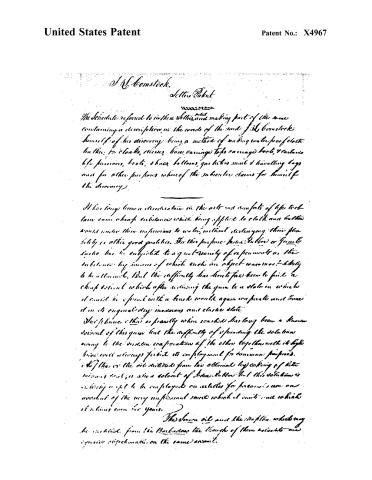
Page 2.
United States Patent
Patent No.: X4967
J. F. Comstock.
Letter Patent
The Schedule referred to in these Letters and making part of the same containing a description in the words of the said J. F. Comstock himself of his discovery being a method of making water proof cloth, leather, for cloaks, sleeves, hose, carriage tops, carriage boots, & various like purposes, boots, shoes, balloons, gas tubes, mail & travelling bags and for other purposes whereof the subscriber claims for himself the discovery.
It has long been a desideratum in the arts and comforts of life to have some cheap substance which being applied to cloth and leather would render them impervious to water, without destroying their flexibility or other good qualities. For this purpose India Rubber or similar substances has been subjected to a great variety of experiments as the substance by means of which such an object was most likely to be attained. But the difficulty has hitherto been to find a cheap solvent which after rendering the gum to a state in which it could be spread with a brush would again evaporate and leave it in its original dry, inodorous and elastic state.
The substance ether is readily when washed has long been a known solvent of this gum but the difficulty of spreading the solution evenly to the surface evaporation of the ether together with its high price will always forbid its employment for common purposes.
The ether or the oil distilled from tar obtained by cooking of bituminous coal, or a solvent of India Rubber but this solution is so very unfit to be employed on articles for purposes are on account of the very unpleasant smell which it emits and which it retains even for years.
The benzene oil and the naphtha which may be distilled from the bituminous tar though of them solvents are equally objectionable on the same account.
Page 3.
United States Patent
Patent No.: X4967
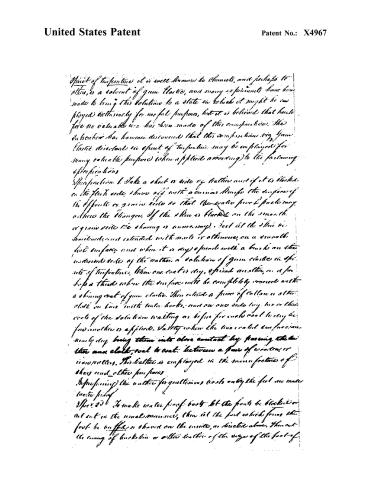
Spirit of turpentine) it is well known to chemists, and perhaps to others, is a solvent of gum elastic, and many experiments have been made to bring this solution to a state in which it might be employed exclusively for useful purposes, but it is believed that heretofore no valuable use has been made of this composition. The subscriber has however discovered that this composition, viz. gum elastic dissolved in spirit of turpentine, may be employed for many valuable purposes when applied according to the following specifications.
Specification 1. Take a sheet or side of leather and if it is blacked on the flesh side, shave off with a razor as many of the surfaces of the flesh side or grain side so that the water proof substance may adhere the thinner. If the skin is blacked on the smooth or grain side the shaving is unnecessary. Next let the skin be moistened and extended with water or otherwise, on a smooth flat surface, and when it is dry spread with a brush on the underside side of the leather a solution of gum elastic in spirit of turpentine. When one coat is dry, spread another, or a few, or a third when the surface will be completely covered with a shining coat of gum elastic. Then extend a piece of cotton or other cloth on both sides with water, and on one side lay two or three coats of the solution waiting as before for each coat to dry before another is applied. Lastly when the two coated surfaces are nearly dry, bring them into close contact by pressing the leather and cloth, coat to coat, between a pair of wooden or iron rollers. This leather is employed in the manufacture of shoes and other purposes.
In specifying the leather for gentlemen’s boots only the feet are made water proof.
Spec. 2. To make water proof boots let the foot be blacked or not cut in the usual manner, then let the part which forms the foot be covered or shrouded on the inside, as directed above. Then cut the lining of buckskin or other leather of the edge of the foot of
Page 4.
United States Patent
Patent No.: X4967
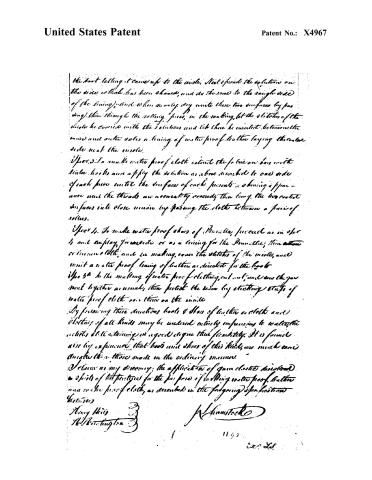
the boot letting it come up to the ankle. Next spread the solution on the side which has been shaved, and do the same to the rough side of the lining; and when nearly dry unite these two surfaces by passing them through the rolling press, in the making, let the stitches of the inside be covered with the solution and let there be inserted between the inner and outer sides a lining of water proof leather laying the outer side next the inside.
Spec. 3. So make water proof cloth, cut the fabric on bars with stiles, hooks and apply the solution as above described to one side of each piece until the surface of each presents a shining appearance until the threads are accurately covered, then bring the two coated surfaces into close union by passing the cloth between a pair of rollers.
Spec. 4. To make water proof shoes of Prussia, proceed as in Spec 4 and employ for outside or as a lining for the Prussia, thin cotton or linen cloth, and in making cover the stitches of the inside, and unit a water proof lining of leather as directed for the boots.
Spec. 5. In the making of water proof clothing, cut out, and sew the garments together as usual; then protect the seams by sticking strips of water proof cloth on them on the inside.
By following these directions boots & shoes of leather or cloth and clothing of all kinds may be rendered entirely impervious to water, the articles being staining in a good degree their flexibility. It is found also by experience that boots and shoes of this kind, are much more durable than those made in the ordinary manner.
I claim as my discovery: the application of gum cloths dissolved in spirits of turpentine for the purpose of making water proof leather and water proof cloth, as described in the foregoing specification.
Witnesses
Henry Mills
H. W. Huntington
J. H. Armstrong
1143
Ex. 25
Published accounts: journal notice
Notice in the monthly list of patents
Journal of the Franklin Institute, vol. 5 (1828), p. 357 · View the page
In making water proof cloth, and water proof leather; J. L. Comstock, of Hartford, Connecticut, January 21.
About this record
- Patentee
- DATAMP
- Date
- the Name and Date index of patents, DATAMP, USPTO records
- Invention
- DATAMP
- Listed in
- the Name and Date index of patents, DATAMP, USPTO records, Jim Shaw's X-patent list, the Journal of the Franklin Institute, the Mirror of the Patent Office (1828), S. A. Elliot's printed list of patents, Burke's List of Patents (1847)
- The Mirror of the Patent Office's supplementary list gives the same patent.
- The Mirror of the Patent Office's supplementary list gives a different date; the date shown follows the standard lists.
- S. A. Elliot's printed list of patents gives the same name and date.
- Burke's 1847 Patent Office list gives the same patent.